Department of Pediatrics, University of Helsinki and Helsinki University Hospital, Helsinki, Finland.
Research Program Unit, Faculty of Medicine, University of Helsinki, Helsinki, Finland.
PLoS One. 2021 Jan 25;16(1):e0245786. doi: 10.1371/journal.pone.0245786. eCollection 2021.
At arrival in new home country, internationally adopted children often have intestinal parasites. International adoptees also exhibit more behavioral problems than their biological peers. We examined whether intestinal parasite infections in international adoptees on arrival in Finland are associated with their later behavioral and emotional problems.
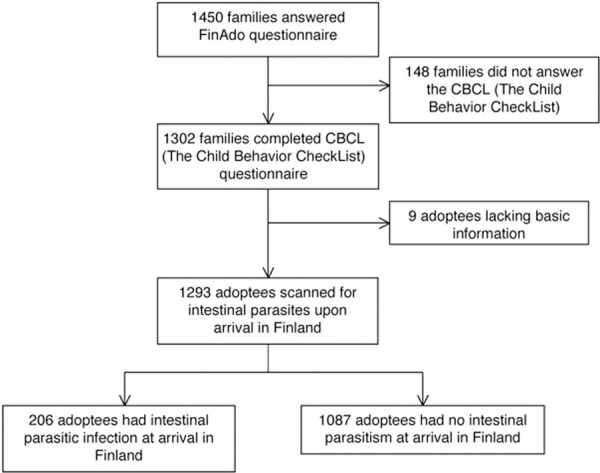
Data for this study were sourced from the Finnish Adoption Study (FinAdo) based on parental questionnaires for all internationally adopted children under 18 years (n = 1450) who arrived in Finland from 1985 to 2007. A total of 1293 families provided sufficient information on the adoptee's background, parasitic status on arrival, and behavioral symptoms at the median time of 5 years after arrival (mean age = 7.8 years). Behavioral and emotional disorders were evaluated with the Child Behavior Checklist (CBCL). Statistical analyses were conducted using linear regression.
Of the 1293 families, parents of 206 adoptive children reported intestinal parasites in their adopted children on arrival. Parasite-infected children had subsequently higher CBCL problem scores than the children without parasites (p < 0.001). The association between intestinal parasites and later behavioral problems was stronger than that between intestinal parasites and any other factors measured in this study, except disability.
The control group was naturally provided by the adopted children without parasite infections, but we could not compare the adopted children to non-adopted children without a defined parasite infection. We were unable to specify the effects associated with a specific parasite type. It was not possible either to include multiple environmental factors that could have been associated with behavioral problems in the models, which indicated only modest explanatory values.
In this study, intestinal parasite infections in early childhood may be associated with children's later psychological wellbeing, even in children who move to a country with a low prevalence of parasites. Our findings may support further developments pertaining to the gut-brain theory.
在抵达新的祖国时,国际收养的儿童通常会感染肠道寄生虫。国际收养儿童也比其亲生同龄人表现出更多的行为问题。我们研究了国际收养儿童抵达芬兰时是否存在肠道寄生虫感染与他们以后的行为和情绪问题是否存在关联。
本研究的数据来自于芬兰收养研究(FinAdo),该研究基于所有 1985 年至 2007 年间从国外抵达芬兰的 18 岁以下国际收养儿童的父母问卷调查(n = 1450)。共有 1293 个家庭提供了有关收养儿童背景、抵达时寄生虫状态和抵达后 5 年中位数时间的行为症状的足够信息(平均年龄= 7.8 岁)。使用儿童行为检查表(CBCL)评估行为和情绪障碍。使用线性回归进行统计分析。
在 1293 个家庭中,206 名收养儿童的父母报告其收养的儿童在抵达时患有肠道寄生虫。感染寄生虫的儿童随后的 CBCL 问题评分高于没有寄生虫的儿童(p <0.001)。肠道寄生虫与以后的行为问题之间的关联强于该研究中测量的任何其他因素(除残疾外)与肠道寄生虫之间的关联。
对照组是由没有寄生虫感染的收养儿童自然提供的,但我们无法将收养儿童与没有明确寄生虫感染的非收养儿童进行比较。我们无法确定与特定寄生虫类型相关的特定作用。也不可能在模型中包含可能与行为问题相关的多个环境因素,这表明模型的解释能力有限。
在这项研究中,幼儿时期的肠道寄生虫感染可能与儿童以后的心理健康有关,即使儿童移居到寄生虫流行率较低的国家也是如此。我们的研究结果可能支持进一步发展与肠道-大脑理论相关的研究。