Chinese Academy of Sciences Key Laboratory of Computational Biology, Chinese Academy of Sciences-Max Planck Society Partner Institute for Computational Biology, Shanghai Institute of Nutrition and Health, Shanghai Institutes for Biological Sciences, University of Chinese Academy of Sciences, Chinese Academy of Sciences, Shanghai 200031, China
Chinese Academy of Sciences Key Laboratory of Computational Biology, Chinese Academy of Sciences-Max Planck Society Partner Institute for Computational Biology, Shanghai Institute of Nutrition and Health, Shanghai Institutes for Biological Sciences, University of Chinese Academy of Sciences, Chinese Academy of Sciences, Shanghai 200031, China.
Biol Open. 2021 Feb 9;10(2):bio056523. doi: 10.1242/bio.056523.
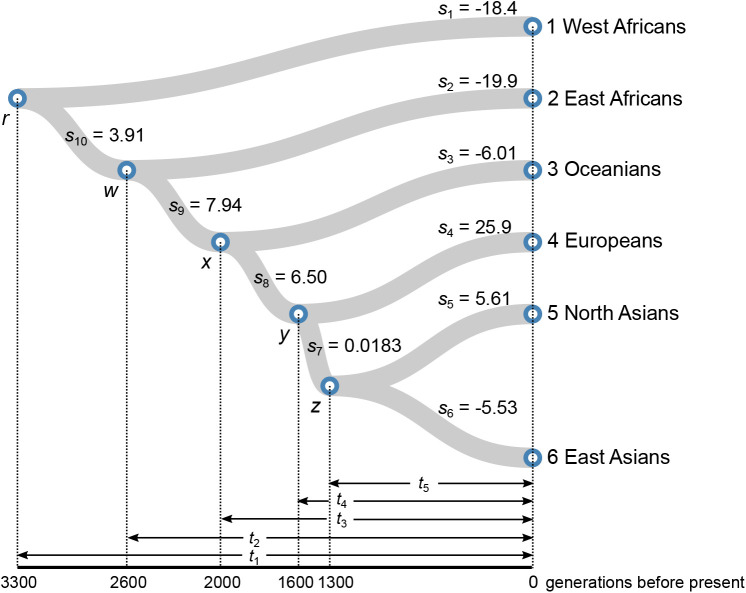
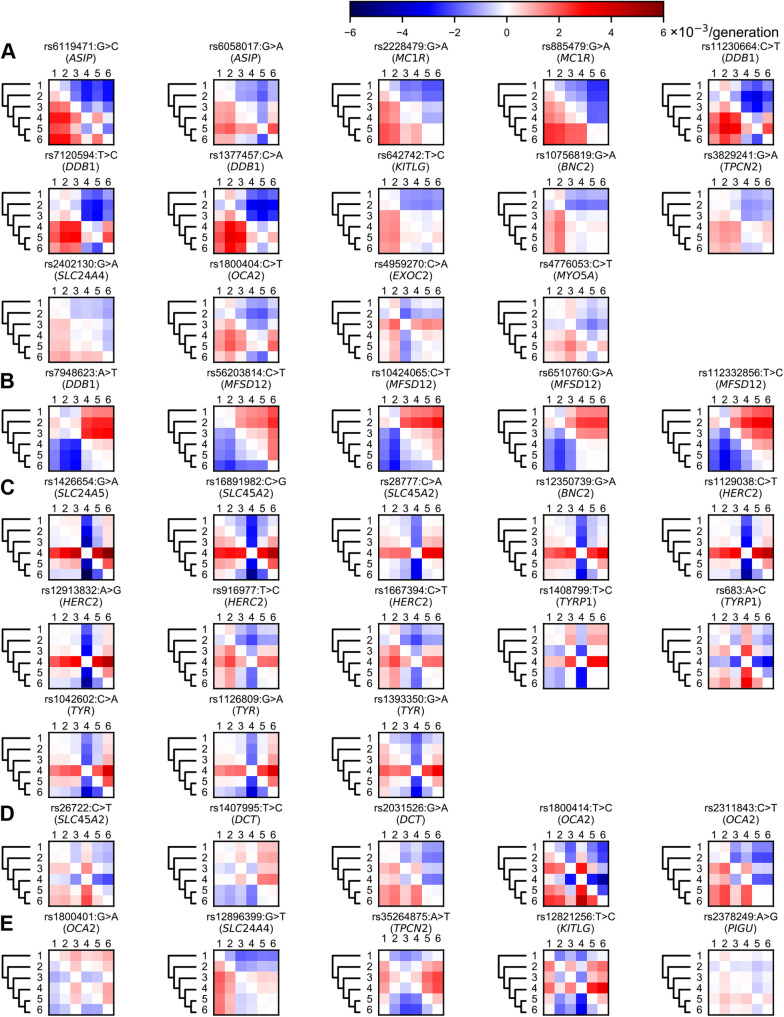
Human pigmentation is a highly diverse and complex trait among populations and has drawn particular attention from both academic and non-academic investigators for thousands of years. Previous studies detected selection signals in several human pigmentation genes, but few studies have integrated contribution from multiple genes to the evolution of human pigmentation. Moreover, none has quantified selective pressures on human pigmentation over epochs and between populations. Here, we dissect dynamics and differences of selective pressures during different periods and between distinct populations with new approaches. We use genotype data of 19 genes associated with human pigmentation from 17 publicly available datasets and obtain data for 2346 individuals of six representative population groups from across the world. Our results quantify the strength of natural selection on light pigmentation not only in modern Europeans (0.0259/generation) but also in proto-Eurasians (0.00650/generation). Our results also suggest that several derived alleles associated with human dark pigmentation may be under positive directional selection in some African populations. Our study provides the first attempt to quantitatively investigate the dynamics of selective pressures during different time periods in the evolution of human pigmentation.This article has an associated First Person interview with the first author of the article.
人类的肤色在不同人群中存在高度的多样性和复杂性,数千年来一直受到学术界和非学术界研究人员的关注。先前的研究在几个人类肤色基因中检测到了选择信号,但很少有研究将多个基因对人类肤色进化的贡献进行整合。此外,也没有研究量化过人类肤色在不同时期和不同人群之间的选择压力。在这里,我们使用来自 17 个公开数据集的 19 个人类肤色相关基因的基因型数据,并获得了来自世界各地六个代表性人群的 2346 个人的数据,采用新方法来剖析不同时期和不同人群中选择压力的动态和差异。我们的研究结果不仅量化了现代欧洲人(0.0259/代),也量化了原始欧亚人(0.00650/代)中浅色肤色的自然选择强度。我们的研究结果还表明,在一些非洲人群中,几个与人类深色肤色相关的衍生等位基因可能受到正向定向选择。本研究首次尝试定量研究人类肤色进化过程中不同时期选择压力的动态。本文附有该文章第一作者的第一人称采访。