Institute for Environmental Engineering, Department of Civil, Environmental and Geomatic Engineering, ETH Zurich, 8093 Zurich, Switzerland.
Institute for Environmental Engineering, Department of Civil, Environmental and Geomatic Engineering, ETH Zurich, 8093 Zurich, Switzerland;
Proc Natl Acad Sci U S A. 2021 Feb 2;118(5). doi: 10.1073/pnas.2005944118.
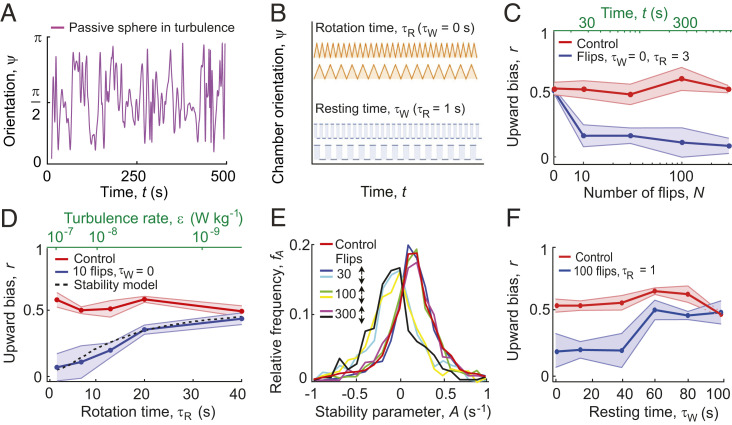
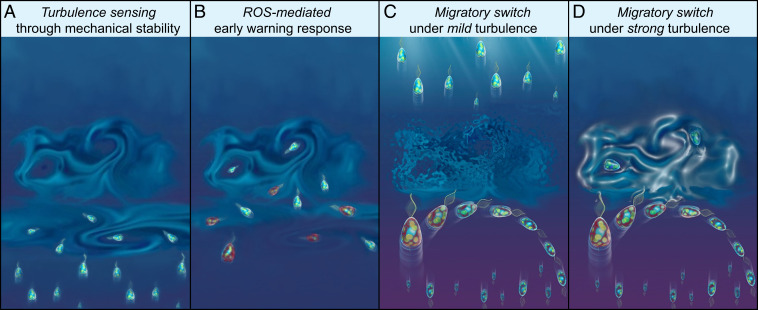
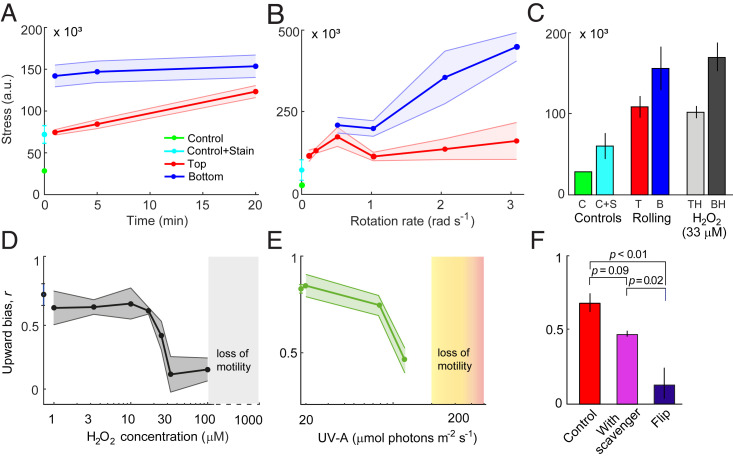
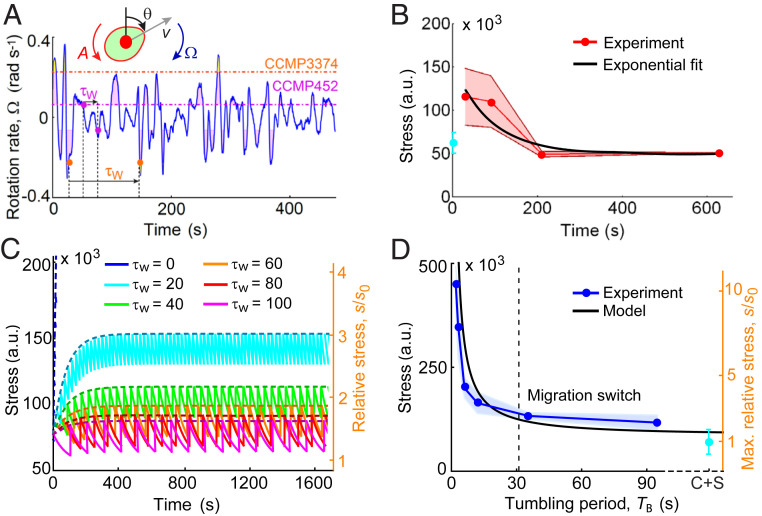
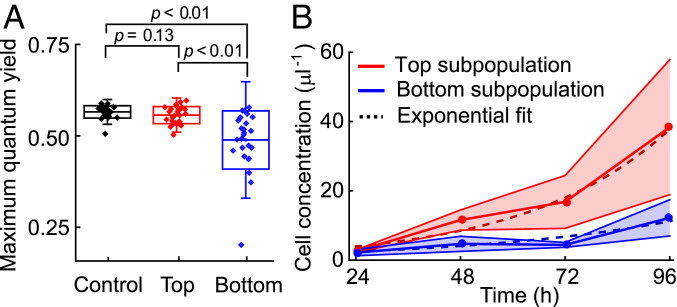
Turbulence is an important determinant of phytoplankton physiology, often leading to cell stress and damage. Turbulence affects phytoplankton migration both by transporting cells and by triggering switches in migratory behavior, whereby vertically migrating cells can actively invert their direction of migration upon exposure to turbulent cues. However, a mechanistic link between single-cell physiology and vertical migration of phytoplankton in turbulence is currently missing. Here, by combining physiological and behavioral experiments with a mathematical model of stress accumulation and dissipation, we show that the mechanism responsible for the switch in the direction of migration in the marine raphidophyte is the integration of reactive oxygen species (ROS) signaling generated by turbulent cues. Within timescales as short as tens of seconds, the emergent downward-migrating subpopulation exhibited a twofold increase in ROS, an indicator of stress, 15% lower photosynthetic efficiency, and 35% lower growth rate over multiple generations compared to the upward-migrating subpopulation. The origin of the behavioral split as a result of a bistable oxidative stress response is corroborated by the observation that exposure of cells to exogenous stressors (HO, UV-A radiation, or high irradiance), in lieu of turbulence, caused comparable ROS accumulation and an equivalent split into the two subpopulations. By providing a mechanistic link between the single-cell mechanics of swimming and physiology on the one side and the emergent population-scale migratory response and impact on fitness on the other, the ROS-mediated early warning response we discovered contributes to our understanding of phytoplankton community composition in future ocean conditions.
湍流是浮游植物生理学的一个重要决定因素,常常导致细胞应激和损伤。湍流通过运输细胞和触发迁移行为的转变来影响浮游植物的迁移,从而使垂直迁移的细胞在暴露于湍流线索时可以主动改变其迁移方向。然而,单细胞生理学和浮游植物在湍流中垂直迁移之间的机械联系目前尚不清楚。在这里,我们通过将生理和行为实验与应激积累和耗散的数学模型相结合,表明导致海洋鞭毛藻迁移方向转变的机制是由湍流线索产生的活性氧(ROS)信号的整合。在短短几十秒的时间内,新兴的向下迁移亚群的 ROS 增加了两倍,这是应激的一个指标,与向上迁移的亚群相比,其光合作用效率降低了 15%,多个世代的生长速度降低了 35%。由于双稳态氧化应激反应而导致的行为分裂的起源得到了证实,即细胞暴露于外源胁迫(HO、UV-A 辐射或高光强)而不是湍流会导致类似的 ROS 积累,并导致两个亚群的分裂。通过提供一个机械联系,一方面是游泳和生理学的单细胞力学,另一方面是新兴的种群尺度的迁移反应和对适应性的影响,我们发现的 ROS 介导的早期预警反应有助于我们理解未来海洋条件下浮游植物群落的组成。