Center for Infectious Disease Control, National Institute for Public Health and the Environment (RIVM), P.O. Box 1, 3720 BA, Bilthoven, The Netherlands.
Department of Interdisciplinary Social Science, Faculty of Social and Behavioural Sciences, Utrecht University, Utrecht, The Netherlands.
Sci Rep. 2021 Jan 25;11(1):2148. doi: 10.1038/s41598-021-81675-w.
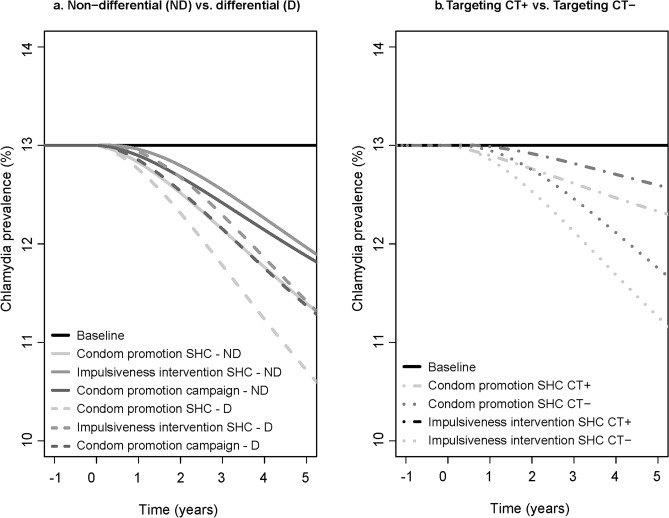
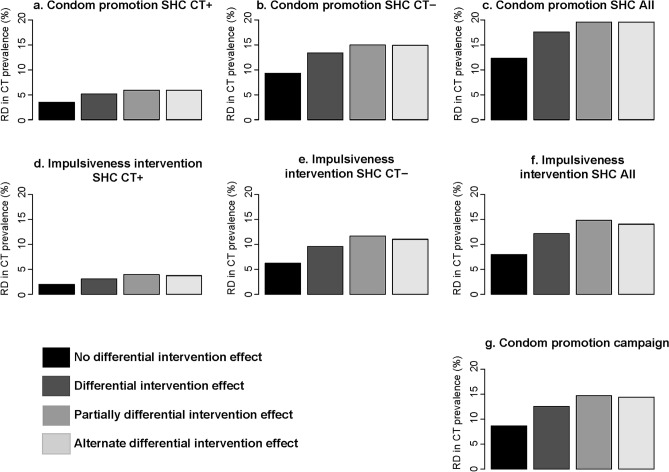
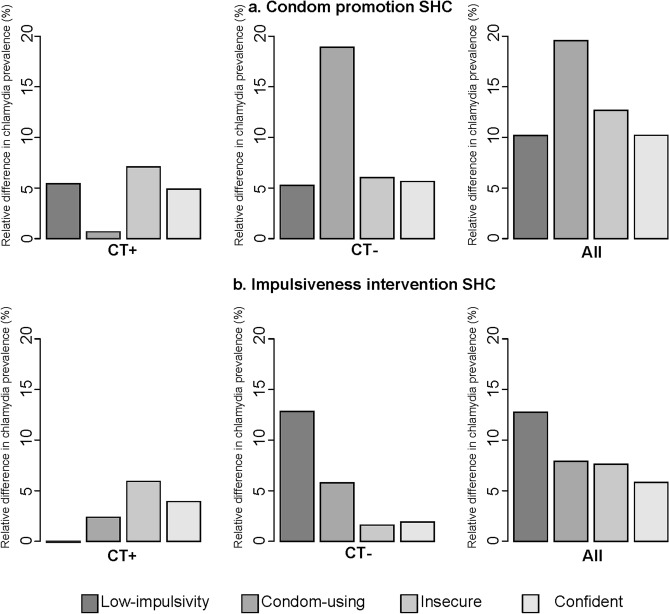
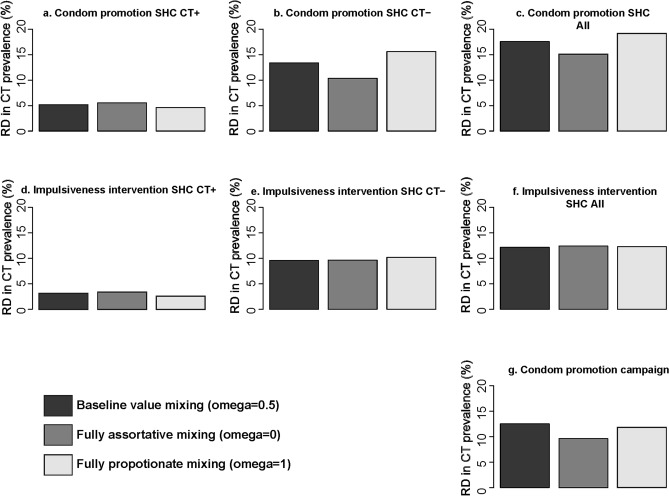
Behavioural interventions tailored to psychological characteristics of an individual can effectively achieve risk-reducing behaviour. The impact of tailored interventions on population-level chlamydia prevalence is unknown. We aimed to assess the impact on overall chlamydia prevalence five years after the introduction of an intervention aimed at increasing self-efficacy, social norms, attitudes and intentions towards condom use (i.e., condom intervention), and an intervention aimed at increasing health goals and decreasing impulsiveness (i.e., impulsiveness intervention). A pair model, informed by longitudinal psychological and behavioural data of young heterosexuals visiting sexual health centers, with susceptible-infected-susceptible structure was developed. The intervention effect was defined as an increased proportion of each subgroup moving to the desired subgroup (i.e., lower risk subgroup). Interventions tailored to subgroup-specific characteristics, assuming differential intervention effects in each subgroup, more effectively reduced overall chlamydia prevalence compared to non-tailored interventions. The most effective intervention was the tailored condom intervention, which was assumed to result in a relative reduction in chlamydia prevalence of 18% versus 12% in the non-tailored scenario. Thus, it is important to assess multiple psychological and behavioural characteristics of individuals. Tailored interventions may be more successful in achieving risk-reducing behaviour, and consequently, reduce chlamydia prevalence more effectively.
针对个体心理特征量身定制的行为干预措施可以有效地实现降低风险的行为。针对人群层面衣原体流行率的量身定制干预措施的影响尚不清楚。我们旨在评估在引入旨在提高避孕套使用的自我效能、社会规范、态度和意愿(即避孕套干预)以及旨在提高健康目标和减少冲动性(即冲动性干预)的干预措施五年后对总体衣原体流行率的影响。基于年轻异性恋者访问性健康中心的纵向心理和行为数据,采用易感性-感染-易感性结构的配对模型进行了研究。干预效果定义为每个亚组向期望亚组(即低风险亚组)移动的比例增加。与非量身定制的干预相比,针对特定亚组特征量身定制的干预措施,假设每个亚组的干预效果不同,更有效地降低了总体衣原体流行率。最有效的干预措施是量身定制的避孕套干预,与非量身定制的方案相比,预计会使衣原体流行率相对降低 18%,而非 12%。因此,评估个人的多种心理和行为特征很重要。量身定制的干预措施可能更成功地实现降低风险的行为,从而更有效地降低衣原体流行率。