Department of Radiology & Nuclear Medicine, Amsterdam Neuroscience, Vrije Universiteit Amsterdam, Amsterdam UMC, De Boelelaan 1117, 1081 HV, Amsterdam, The Netherlands.
Alzheimer Center Amsterdam, Department of Neurology, Amsterdam Neuroscience, Vrije Universiteit Amsterdam, Amsterdam UMC, Amsterdam, The Netherlands.
Mol Imaging Biol. 2021 Aug;23(4):604-613. doi: 10.1007/s11307-021-01581-5. Epub 2021 Jan 26.
Dynamic positron emission tomography (PET) protocols allow for accurate quantification of [F]flortaucipir-specific binding. However, dynamic acquisitions can be challenging given the long required scan duration of 130 min. The current study assessed the effect of shorter scan protocols for [F]flortaucipir on its quantitative accuracy.
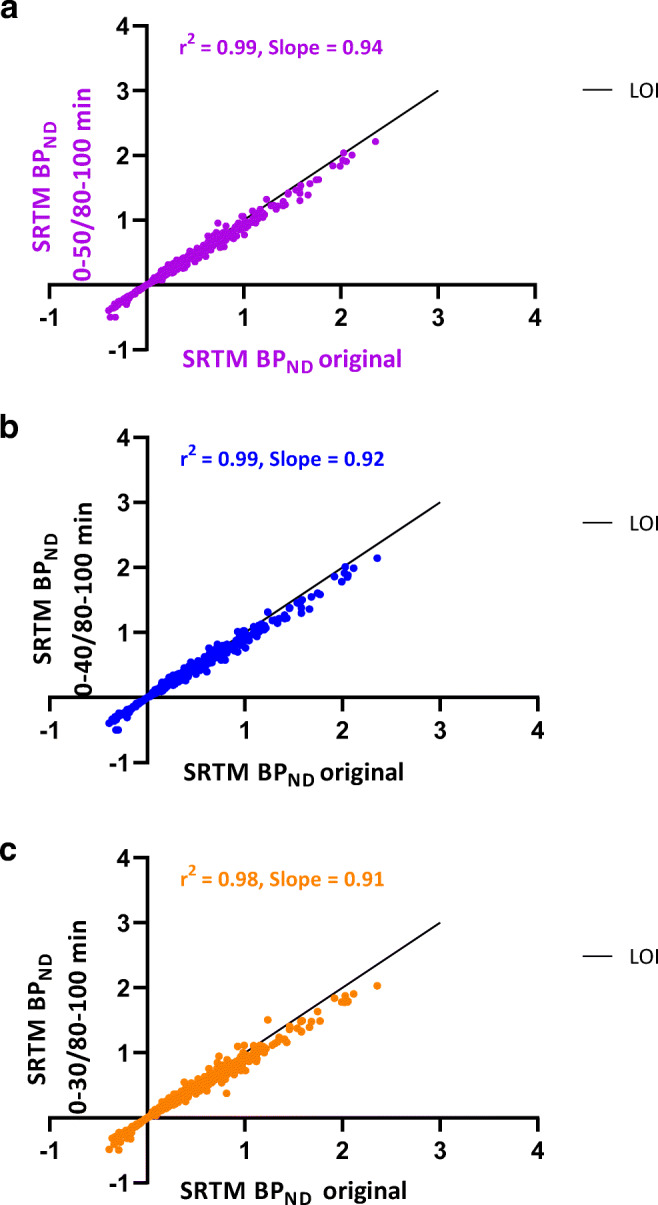
Two study cohorts with Alzheimer's disease (AD) patients and healthy controls (HC) were included. All subjects underwent a 130-min dynamic [F]flortaucipir PET scan consisting of two parts (0-60/80-130 min) post-injection. Arterial sampling was acquired during scanning of the first cohort only. For the second cohort, a second PET scan was acquired within 1-4 weeks of the first PET scan to assess test-retest repeatability (TRT). Three alternative time intervals were explored for the second part of the scan: 80-120, 80-110 and 80-100 min. Furthermore, the first part of the scan was also varied: 0-50, 0-40 and 0-30 min time intervals were assessed. The gap in the reference TACs was interpolated using four different interpolation methods: population-based input function 2T4k_V (POP-IP_2T4k_V), cubic, linear and exponential. Regional binding potential (BP) and relative tracer delivery (R) values estimated using simplified reference tissue model (SRTM) and/or receptor parametric mapping (RPM). The different scan protocols were compared to the respective values estimated using the original scan acquisition. In addition, TRT of the RPM BP and R values estimated using the optimal shortest scan duration was also assessed.
RPM BP and R obtained using 0-30/80-100 min scan and POP-IP_2T4k_V reference region interpolation had an excellent correlation with the respective parametric values estimated using the original scan duration (r > 0.95). The TRT of RPM BP and R using the shortest scan duration was - 1 ± 5 % and - 1 ± 6 % respectively.
This study demonstrated that [F]flortaucipir PET scan can be acquired with sufficient quantitative accuracy using only 50 min of dual-time-window scanning time.
动态正电子发射断层扫描(PET)方案可实现[F]flortaucipir 特异性结合的准确定量。然而,由于需要 130 分钟的扫描时长,动态采集具有一定挑战性。本研究评估了缩短[F]flortaucipir 扫描方案对其定量准确性的影响。
纳入了阿尔茨海默病(AD)患者和健康对照(HC)的两个研究队列。所有受试者在注射后进行 130 分钟的动态[F]flortaucipir PET 扫描,扫描分为两部分(0-60/80-130 分钟)。仅在第一队列的扫描过程中采集动脉血样。对于第二队列,在第一次 PET 扫描后 1-4 周内进行第二次 PET 扫描,以评估测试-重测重复性(TRT)。为扫描的第二部分探索了三种替代时间间隔:80-120、80-110 和 80-100 分钟。此外,还改变了扫描的第一部分:评估了 0-50、0-40 和 0-30 分钟的时间间隔。使用四种不同的内插方法对参考 TAC 中的间隙进行内插:基于群体的输入函数 2T4k_V(POP-IP_2T4k_V)、立方、线性和指数。使用简化参考组织模型(SRTM)和/或受体参数映射(RPM)估计局部结合潜能(BP)和相对示踪剂传递(R)值。将不同的扫描方案与使用原始扫描采集估计的相应值进行比较。此外,还评估了使用最佳最短扫描持续时间估计的 RPM BP 和 R 值的 TRT。
使用 0-30/80-100 分钟扫描和 POP-IP_2T4k_V 参考区内插获得的 RPM BP 和 R 值与使用原始扫描持续时间估计的相应参数值具有极好的相关性(r>0.95)。使用最短扫描持续时间的 RPM BP 和 R 的 TRT 分别为-1±5%和-1±6%。
本研究表明,仅使用 50 分钟的双时窗扫描时间即可获得[F]flortaucipir PET 扫描的充分定量准确性。