Nordén Einar Sjaastad, Bendiksen Bård Andre, Andresen Henriette, Bergo Kaja Knudsen, Espe Emil Knut, Hasic Almira, Hauge-Iversen Ida Marie, Veras Ioanni, Hussain Rizwan I, Sjaastad Ivar, Christensen Geir, Cataliotti Alessandro
Institute for Experimental Medical Research, Oslo University Hospital and University of Oslo, Oslo, Norway.
Department for Health Sciences, Bjørknes University College, Oslo, Norway.
ESC Heart Fail. 2021 Apr;8(2):918-927. doi: 10.1002/ehf2.13177. Epub 2021 Jan 26.
Sacubitril/valsartan (sac/val) has shown superior effect compared with blockade of the renin-angiotensin-aldosterone system in heart failure with reduced ejection fraction. We aimed to investigate effects of sac/val compared with valsartan in a pressure overload model of heart failure with preserved ejection fraction (HFpEF).
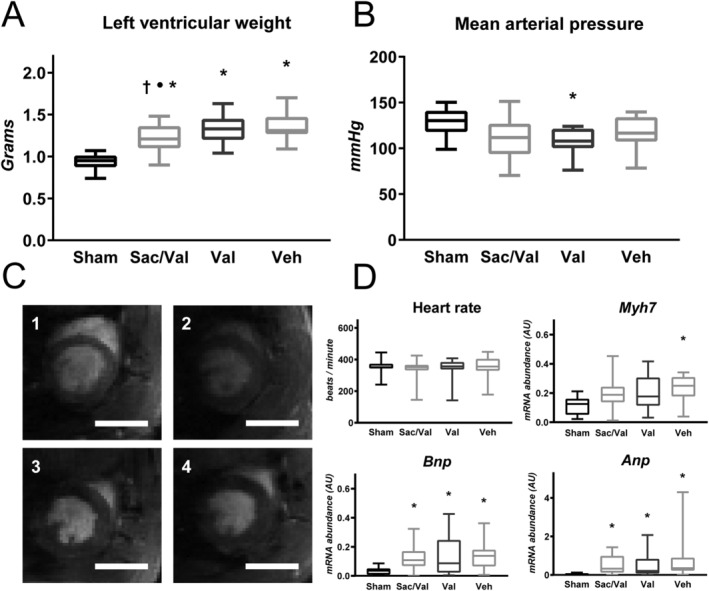
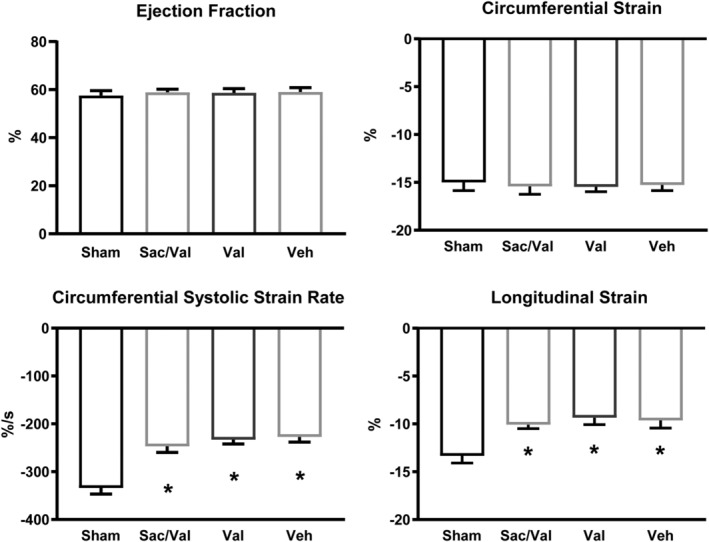
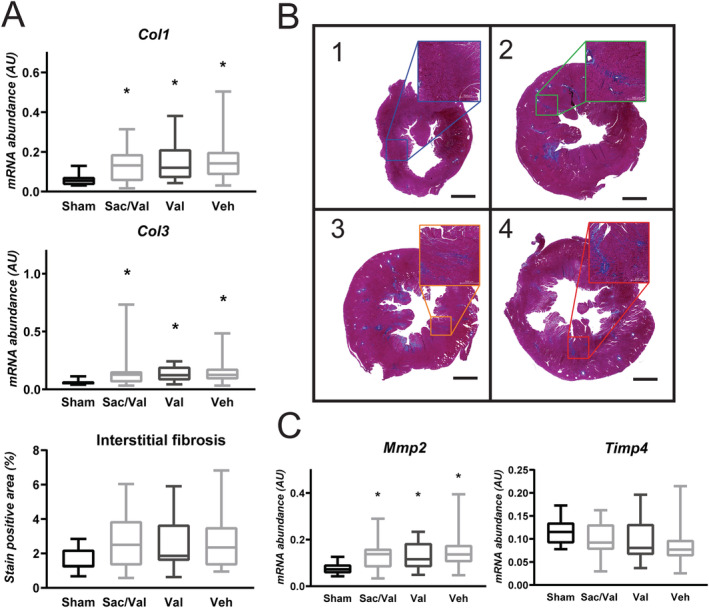
Sprague-Dawley rats underwent aortic banding or sham (n = 16) surgery and were randomized to sac/val (n = 28), valsartan (n = 29), or vehicle (n = 26) treatment for 8 weeks. Sac/val reduced left ventricular weight by 11% compared with vehicle (P = 0.01) and 9% compared with valsartan alone (P = 0.04). Only valsartan reduced blood pressure compared with sham (P = 0.02). Longitudinal early diastolic strain rate was preserved in sac/val compared with sham, while it was reduced by 23% in vehicle (P = 0.03) and 24% in valsartan (P = 0.02). Diastolic dysfunction, measured by E/e'SR, increased by 68% in vehicle (P < 0.01) and 80% in valsartan alone (P < 0.001), while sac/val showed no increase. Neither sac/val nor valsartan prevented interstitial fibrosis. Although ejection fraction was preserved, we observed mild systolic dysfunction, with vehicle showing a 28% decrease in longitudinal strain (P < 0.01). Neither sac/val nor valsartan treatment improved this dysfunction.
In a model of HFpEF induced by cardiac pressure overload, sac/val reduced hypertrophy compared with valsartan alone and ameliorated diastolic dysfunction. These effects were independent of blood pressure. Early systolic dysfunction was not affected, supporting the notion that sac/val has the largest potential in conditions characterized by reduced ejection fraction. Observed anti-hypertrophic effects in preserved ejection fraction implicate potential benefit of sac/val in the clinical setting of hypertrophic remodelling and impaired diastolic function.
与肾素 - 血管紧张素 - 醛固酮系统阻滞剂相比,沙库巴曲缬沙坦(沙库/缬)在射血分数降低的心力衰竭中显示出更优疗效。我们旨在研究在射血分数保留的压力超负荷心力衰竭模型中,沙库/缬与缬沙坦相比的疗效。
将Sprague - Dawley大鼠进行主动脉缩窄或假手术(n = 16),并随机分为沙库/缬组(n = 28)、缬沙坦组(n = 29)或溶剂对照组(n = 26),治疗8周。与溶剂对照组相比,沙库/缬使左心室重量降低了11%(P = 0.01),与单独使用缬沙坦相比降低了9%(P = 0.04)。与假手术组相比,只有缬沙坦降低了血压(P = 0.02)。与假手术组相比,沙库/缬组纵向舒张早期应变率得以保留,而溶剂对照组降低了23%(P = 0.03),缬沙坦组降低了24%(P = 0.02)。以E/e'SR衡量的舒张功能障碍,在溶剂对照组中增加了68%(P < 0.01),在单独使用缬沙坦组中增加了80%(P < 0.001),而沙库/缬组未增加。沙库/缬和缬沙坦均未预防间质纤维化。尽管射血分数得以保留,但我们观察到轻度收缩功能障碍,溶剂对照组纵向应变降低了28%(P < 0.01)。沙库/缬和缬沙坦治疗均未改善这种功能障碍。
在心脏压力超负荷诱导的射血分数保留的心力衰竭模型中,与单独使用缬沙坦相比,沙库/缬减轻了心肌肥厚并改善了舒张功能障碍。这些作用独立于血压。早期收缩功能障碍未受影响,支持了沙库/缬在以射血分数降低为特征的情况下具有最大潜力的观点。在射血分数保留情况下观察到的抗肥厚作用提示沙库/缬在肥厚性重塑和舒张功能受损的临床环境中可能有益。