Ali Khan Muhammad Usman, Raad Raad, Tubbal Faisel, Theoharis Panagiotis Ioannis, Liu Sining, Foroughi Javad
School of Electrical Computer and Telecommunication Engineering, University of Wollongong, Wollongong, NSW 2522, Australia.
Westgerman Heart and Vascular Center, University of Duisburg-Essen, 45122 Essen, Germany.
Polymers (Basel). 2021 Jan 22;13(3):357. doi: 10.3390/polym13030357.
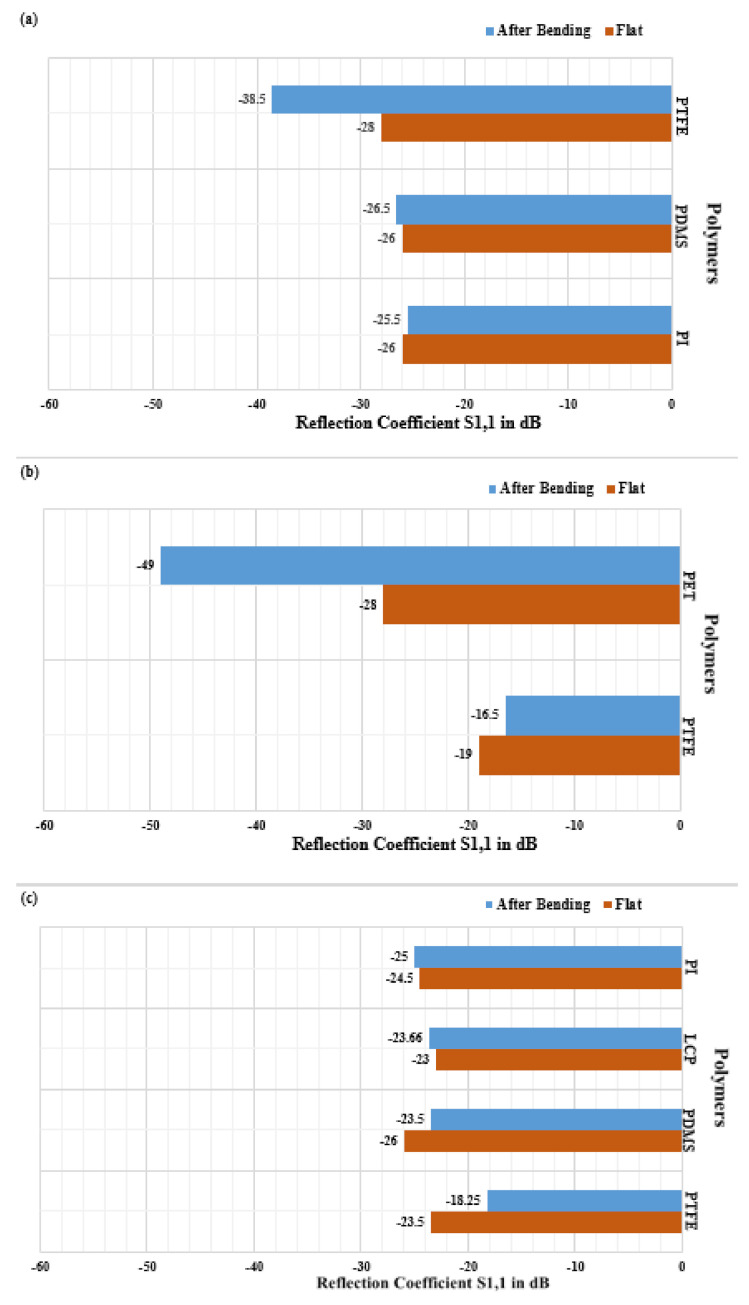
Flexible substrates have become essential in order to provide increased flexibility in wearable sensors, including polymers, plastic, paper, textiles and fabrics. This study is to comprehensively summarize the bending capabilities of flexible polymer substrate for general Internet of Things (IoTs) applications. The basic premise is to investigate the flexibility and bending ability of polymer materials as well as their tendency to withstand deformation. We start by providing a chronological order of flexible materials which have been used during the last few decades. In the future, the IoT is expected to support a diverse set of technologies to enable new applications through wireless connectivity. For wearable IoTs, flexibility and bending capabilities of materials are required. This paper provides an overview of some abundantly used polymer substrates and compares their physical, electrical and mechanical properties. It also studies the bending effects on the radiation performance of antenna designs that use polymer substrates. Moreover, we explore a selection of flexible materials for flexible antennas in IoT applications, namely Polyimides (PI), Polyethylene Terephthalate (PET), Polydimethylsiloxane (PDMS), Polytetrafluoroethylene (PTFE), Rogers RT/Duroid and Liquid Crystal Polymer (LCP). The study includes a complete analysis of bending and folding effects on the radiation characteristics such as S-parameters, resonant frequency deviation and the impedance mismatch with feedline of the flexible polymer substrate microstrip antennas. These flexible polymer substrates are useful for future wearable devices and general IoT applications.
为了提高可穿戴传感器的灵活性,柔性基板已变得至关重要,这些基板包括聚合物、塑料、纸张、纺织品和织物。本研究旨在全面总结用于一般物联网(IoT)应用的柔性聚合物基板的弯曲能力。基本前提是研究聚合物材料的柔韧性和弯曲能力以及它们承受变形的趋势。我们首先按时间顺序介绍过去几十年中使用过的柔性材料。未来,物联网有望支持多种技术,通过无线连接实现新的应用。对于可穿戴物联网来说,材料的柔韧性和弯曲能力是必需的。本文概述了一些大量使用的聚合物基板,并比较了它们的物理、电气和机械性能。它还研究了弯曲对使用聚合物基板的天线设计辐射性能的影响。此外,我们探索了一些用于物联网应用中柔性天线的柔性材料,即聚酰亚胺(PI)、聚对苯二甲酸乙二酯(PET)、聚二甲基硅氧烷(PDMS)、聚四氟乙烯(PTFE)、罗杰斯RT/杜罗伊德和液晶聚合物(LCP)。该研究全面分析了弯曲和折叠对辐射特性的影响,如柔性聚合物基板微带天线的S参数、谐振频率偏差以及与馈线的阻抗失配。这些柔性聚合物基板对未来的可穿戴设备和一般物联网应用很有用。