Department of Child and Adolescent Healthcare, MOE-Shanghai Key Laboratory of Children's Environmental Health, Xinhua Hospital Affiliated to Shanghai Jiao Tong University School of Medicine, No. 1665 Kongjiang Road, Yangpu Shanghai, 200092, China.
Department of Children Healthcare, Quanzhou Women's and Children's Hospital, Quanzhou, 362000, Fujian, China.
BMC Immunol. 2021 Jan 26;22(1):8. doi: 10.1186/s12865-021-00398-9.
The role of serum S100A8/A9 in intestinal inflammation has been confirmed, and its role in food allergy is currently being investigated.
To explore the levels of S100A8/A9 and inflammatory factors, including Toll-like receptors 4 (TLR4), Nuclear transcription factors (NF-κB) and Tumor necrosis factor α (TNF-α), in mild food allergies.
Eighty 3-week-old male Brown Norway rats were used. Forty rats were randomly assigned to the ovalbumin-sensitized experimental group, while 40 rats were assigned to the normal saline sham-sensitized control group. Body weight and length and the levels of serum ovalbumin-specific IgE (OVA-IgE), histamine, Th1-associated and Th2-associated factors, S100A8/A9 and inflammation-associated cytokines were compared.
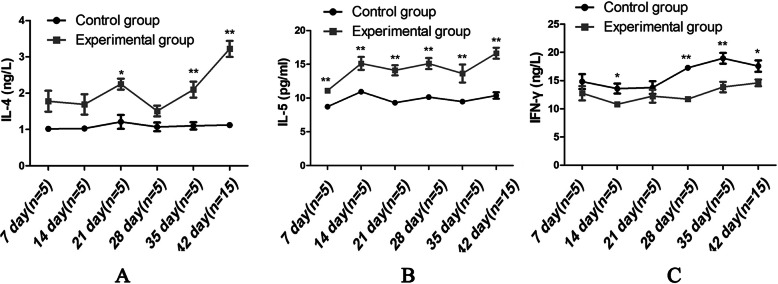
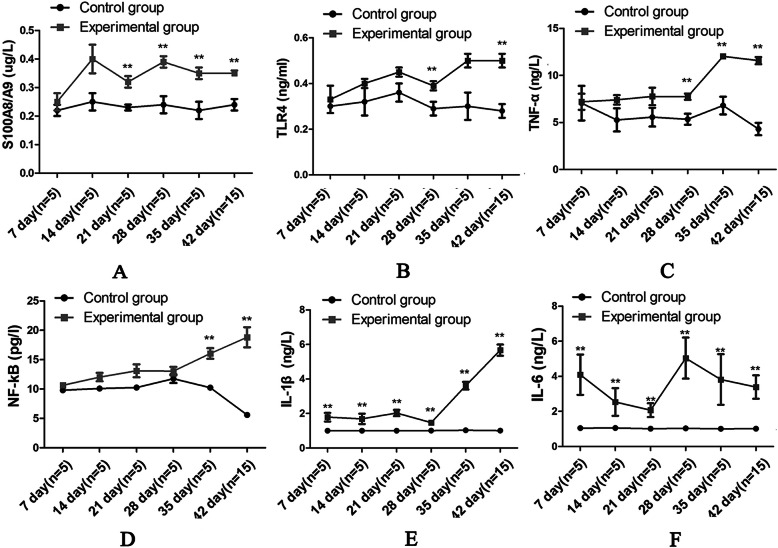
Through the evaluation of OVA-IgE level and Th1/Th2 balance in the experimental group, a successful IgE-mediated food allergy model was constructed. Compared with the control group, the experimental group had higher serum S100A8/A9 levels on days 21, 28, 35 and 42 (all P < 0.05); higher TLR4 levels on days 28, 35 and 42 (all P < 0.05); higher TNF-α levels on days 28, 35 and 42 (all P < 0.05); higher NF-κB levels on days 35 and 42 (all P < 0.05); and higher IL-1β and IL-6 levels on days 7 to 42 (all P < 0.05). Moreover, positive correlations were found between the serum levels of S100A8/A9 and inflammation-associated cytokines [TNF-α: r = 0.378, P = 0.039; IL-1β: r = 0.679, P = 0.000; IL-6: r = 0.590, P = 0.001].
S100A8/A9 and inflammatory-related factors, including TLR4, NF-κB, TNF-α, IL-6 and IL-1β, is closely related to food allergies. Moreover, immune and inflammatory factors interact with each other in food allergies, which may provide insight into food allergy causes and treatments.
血清 S100A8/A9 在肠道炎症中的作用已得到证实,其在食物过敏中的作用目前正在研究中。
探讨轻度食物过敏患者 S100A8/A9 及炎症因子水平,包括 Toll 样受体 4(TLR4)、核转录因子(NF-κB)和肿瘤坏死因子-α(TNF-α)。
将 80 只 3 周龄雄性棕色挪威大鼠随机分为卵清蛋白致敏实验组和生理盐水假致敏对照组,每组 40 只。比较两组大鼠体重、体长,血清卵清蛋白特异性 IgE(OVA-IgE)、组胺、Th1 相关因子和 Th2 相关因子、S100A8/A9 及炎症相关细胞因子水平。
通过实验组 OVA-IgE 水平和 Th1/Th2 平衡的评价,成功构建 IgE 介导的食物过敏模型。与对照组相比,实验组大鼠在第 21、28、35 和 42 天血清 S100A8/A9 水平升高(均 P<0.05);在第 28、35 和 42 天 TLR4 水平升高(均 P<0.05);在第 28、35 和 42 天 TNF-α水平升高(均 P<0.05);在第 35 和 42 天 NF-κB 水平升高(均 P<0.05);在第 7 至 42 天 IL-1β和 IL-6 水平升高(均 P<0.05)。此外,S100A8/A9 与炎症相关细胞因子 [TNF-α:r=0.378,P=0.039;IL-1β:r=0.679,P=0.000;IL-6:r=0.590,P=0.001] 之间呈正相关。
S100A8/A9 与炎症相关因子,包括 TLR4、NF-κB、TNF-α、IL-6 和 IL-1β,与食物过敏密切相关。此外,食物过敏中免疫和炎症因子相互作用,可能为食物过敏的病因和治疗提供新的思路。