Rizzi Angela, Lo Presti Elena, Chini Raffaella, Gammeri Luca, Inchingolo Riccardo, Lohmeyer Franziska Michaela, Nucera Eleonora, Gangemi Sebastiano
UOSD Allergologia e Immunologia Clinica, Dipartimento Scienze Mediche e Chirurgiche, Fondazione Policlinico Universitario A. Gemelli IRCCS, 00168 Rome, Italy.
Institute for Biomedical Research and Innovation, National Research Council of Italy (IRIB-CNR), 90146 Palermo, Italy.
J Clin Med. 2023 Apr 4;12(7):2699. doi: 10.3390/jcm12072699.
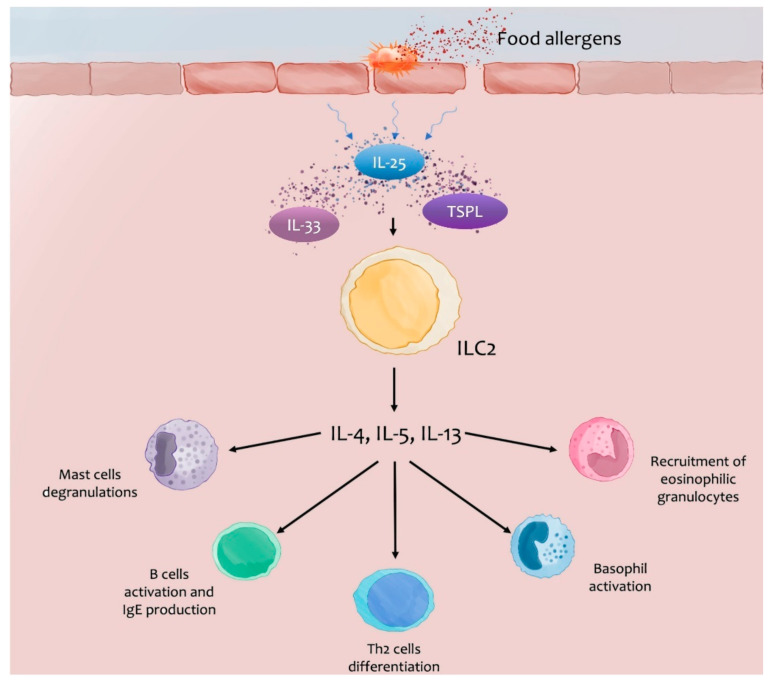
Food allergies are immuno-mediated adverse reactions to ingestion or contact with foods, representing a widespread health problem. The immune response can be IgE-mediated, non-IgE-mediated, or with a mixed mechanism. The role of innate immunity and alarmins in the pathogenesis of diseases such as asthma and atopic dermatitis is well known. Some authors have investigated the correlation between alarmins and food allergies, often obtaining interesting results. We analyzed articles published in English from the last 22 years present on PubMed concerning the role of alarmins in the pathogenesis of food allergies and their potential use as disease biomarkers, response biomarkers to therapy, or potential therapeutic targets. Nuclear alarmins (TSLP, IL-33, IL-25) appear to have a critical role in IgE-mediated allergies but are also implicated in entities such as eosinophilic esophagitis. Calprotectin and defensins may play a role as disease biomarkers and could help predict response to therapy, although results in the literature are often conflicting. Despite the promising results, more studies on humans still need to be conducted. Deepening our knowledge regarding alarmins and their involvement in food allergies could lead to the development of new biological therapies, significantly impacting patients' quality of life.
食物过敏是摄入或接触食物后由免疫介导的不良反应,是一个普遍存在的健康问题。免疫反应可以是IgE介导的、非IgE介导的或混合机制的。天然免疫和警报素在哮喘和特应性皮炎等疾病发病机制中的作用是众所周知的。一些作者研究了警报素与食物过敏之间的相关性,常常获得有趣的结果。我们分析了过去22年在PubMed上发表的英文文章,这些文章涉及警报素在食物过敏发病机制中的作用及其作为疾病生物标志物、治疗反应生物标志物或潜在治疗靶点的潜在用途。核警报素(TSLP、IL-33、IL-25)似乎在IgE介导的过敏中起关键作用,但也与嗜酸性食管炎等疾病有关。钙卫蛋白和防御素可能作为疾病生物标志物发挥作用,并有助于预测治疗反应,尽管文献中的结果往往相互矛盾。尽管有这些有前景的结果,但仍需要对人类进行更多研究。深入了解警报素及其在食物过敏中的作用可能会导致新生物疗法的开发,对患者的生活质量产生重大影响。