School of Nursing, Binzhou Medical University, No.346 Guanhai Road, Yantai, Shandong Province, China.
School of Nursing, CB 7460, University of North Carolina at Chapel Hill, Chapel Hill, USA.
BMC Psychiatry. 2021 Jan 26;21(1):58. doi: 10.1186/s12888-021-03058-9.
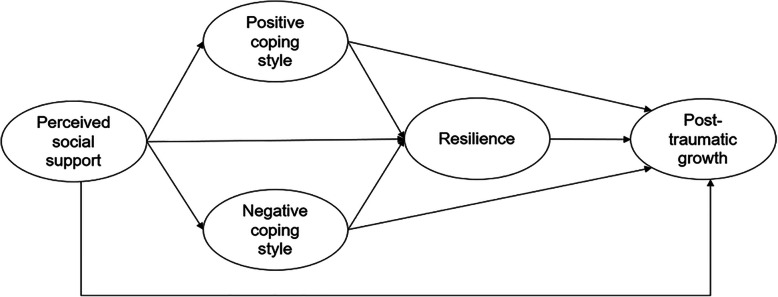
Despite the substantial burden of caring schizophrenic patients, primary caregivers can also experience posttraumatic growth (PTG) which may buffer their negative experience. Influencing factors of PTG and their functional pathways among primary caregivers of schizophrenic patients remain unclear. This study is designed to test the simple and serial mediating roles of coping styles and resilience in the relationship between perceived social support and PTG among those primary caregivers.
A cross-sectional study was conducted from October 2018 to January 2019, and 365 primary caregivers (self-reported) of schizophrenic patients were analyzed. Measures used to assess their perceived social support, coping styles, resilience, and PTG were the Perceived Social Support Scale, the Simplified Coping Style Questionnaire, the Connor-Davidson Resilience Scale, and the Posttraumatic Growth Inventory, respectively. Structural equation modeling was used to run the analysis.
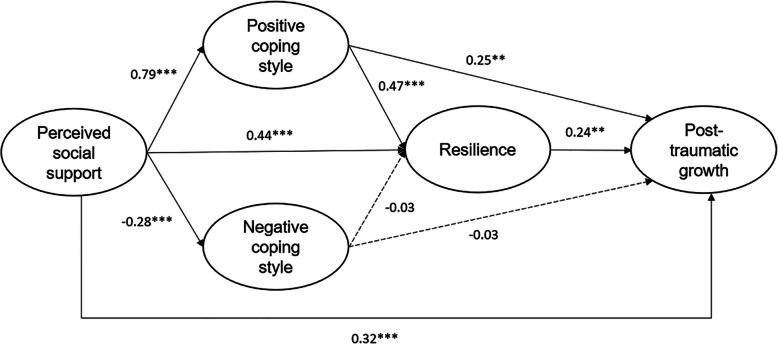
The average scores of PTG (range: 0-5), perceived social support (range: 1-7), positive coping style (range: 0-3), negative coping style (range: 0-3), resilience (range: 0-4) reported by primary caregivers was (2.91 ± 0.99), (4.80 ± 1.26), (1.79 ± 0.65), (1.49 ± 0.56), and (2.46 ± 0.66), respectively. The fitness indices of measurement and structural models were satisfactory. Three indirect pathways totally explained 55.56% variance of the PTG. The indirect effect of positive coping style between perceived social support and PTG was 0.20 [95% confidence interval (CI) 0.05 to 0.37], and this simple mediation pathway explained 27.78% variance of PTG. The indirect effect of resilience between perceived social support and PTG was 0.11 [95% CI 0.01 to 0.20], and this simple mediation pathway explained 15.28% variance of PTG. The indirect effect of positive coping style and then resilience between perceived social support and PTG was 0.09 [95% CI 0.01 to 0.17], and this serial mediation pathway explained 12.50% variance of PTG.
Both simple and serial mediation roles of positive coping style and resilience are established in the relationship between perceived social support and PTG among primary caregivers of schizophrenic patients. Positive coping style and resilience are two important targets for future interventional studies, and interventions on them may bring the synergistic effect on improving PTG.
尽管照顾精神分裂症患者的负担很大,但初级照顾者也可能经历创伤后成长(PTG),这可能会缓冲他们的负面体验。精神分裂症患者初级照顾者的 PTG 影响因素及其功能途径仍不清楚。本研究旨在测试初级照顾者中应对方式和韧性在感知社会支持与 PTG 之间的简单和连续中介作用。
这是一项横断面研究,于 2018 年 10 月至 2019 年 1 月进行,共分析了 365 名精神分裂症患者的初级照顾者(自我报告)。用于评估他们感知社会支持、应对方式、韧性和创伤后成长的措施分别是感知社会支持量表、简化应对方式问卷、康纳-戴维森韧性量表和创伤后成长量表。结构方程模型用于运行分析。
初级照顾者报告的 PTG(范围:0-5)、感知社会支持(范围:1-7)、积极应对方式(范围:0-3)、消极应对方式(范围:0-3)、韧性(范围:0-4)的平均得分分别为(2.91±0.99)、(4.80±1.26)、(1.79±0.65)、(1.49±0.56)和(2.46±0.66)。测量和结构模型的拟合指数均令人满意。三个间接途径共解释了 PTG 55.56%的方差。感知社会支持与 PTG 之间积极应对方式的间接效应为 0.20[95%置信区间(CI)0.05 至 0.37],此简单中介途径解释了 PTG 27.78%的方差。感知社会支持与 PTG 之间韧性的间接效应为 0.11[95%CI 0.01 至 0.20],此简单中介途径解释了 PTG 15.28%的方差。感知社会支持与 PTG 之间积极应对方式和韧性的间接效应为 0.09[95%CI 0.01 至 0.17],此序列中介途径解释了 PTG 12.50%的方差。
在精神分裂症患者初级照顾者的感知社会支持与 PTG 之间,既存在积极应对方式的简单中介作用,也存在韧性的简单中介作用。积极应对方式和韧性是未来干预研究的两个重要目标,对它们的干预可能会带来提高 PTG 的协同效应。