Georgilas Ioannis, Dagnino Giulio, Alves Martins Beatriz, Tarassoli Payam, Morad Samir, Georgilas Konstantinos, Koehler Paul, Atkins Roger, Dogramadzi Sanja
Department of Mechanical Engineering, University of Bath, Bath, United Kingdom.
The Hamlyn Centre for Robotic Surgery, Imperial College London, London, United Kingdom.
Front Robot AI. 2019 Oct 30;6:103. doi: 10.3389/frobt.2019.00103. eCollection 2019.
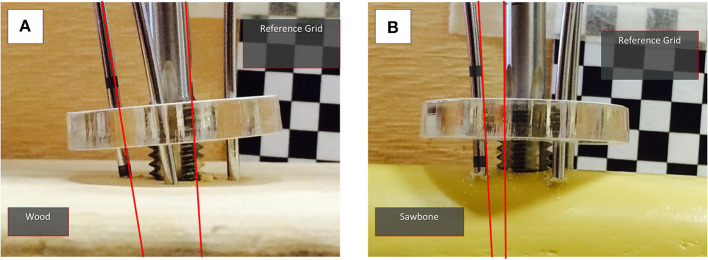
Reduction of fractures in the minimally invasive (MI) manner can avoid risks associated with open fracture surgery. The MI approach requires specialized tools called percutaneous fragment manipulation devices (PFMD) to enable surgeons to safely grasp and manipulate fragments. PFMDs developed for long-bone manipulation are not suitable for intra-articular fractures where small bone fragments are involved. With this study, we offer a solution to potentially move the current fracture management practice closer to the use of a MI approach. We investigate the design and testing of a new PFMD design for manual as well as robot-assisted manipulation of small bone fragments. This new PFMD design is simulated using FEA in three loading scenarios (force/torque: 0 N/2.6 Nm, 75.7 N/3.5 N, 147 N/6.8 Nm) assessing structural properties, breaking points, and maximum bending deformations. The PFMD is tested in a laboratory setting on Sawbones models (0 N/2.6 Nm), and on swine samples ( = 80 N ± 8 N, = 150 ± 15 N). A commercial optical tracking system was used for measuring PFMD deformations under external loading and the results were verified with an electromagnetic tracking system. The average error difference between the tracking systems was 0.5 mm, being within their accuracy limits. Final results from reduction maneuvers performed both manually and with the robot assistance are obtained from 7 human cadavers with reduction forces in the range of ( = 80 N ± 8 N, = 150 ± 15 N, respectively). The results show that structurally, the system performs as predicted by the simulation results. The PFMD did not break during and cadaveric trials. Simulation, laboratory, and cadaveric tests produced similar results regarding the PFMD bending. Specifically, for forces applied perpendicularly to the axis of the PFMD of 80 N ± 8 N deformations of 2.8, 2.97, and 3.06 mm are measured on the PFMD, while forces of 150 ± 15 N produced deformations of 5.8, 4.44, and 5.19 mm. This study has demonstrated that the proposed PFMD undergoes predictable deformations under typical bone manipulation loads. Testing of the device on human cadavers proved that these deformations do not affect the anatomic reduction quality. The PFMD is, therefore, suitable to reliably achieve and maintain fracture reductions, and to, consequently, allow external fracture fixation.
以微创方式复位骨折可避免开放性骨折手术相关的风险。微创方法需要称为经皮碎骨片操作装置(PFMD)的专门工具,以使外科医生能够安全地抓取和操作碎骨片。为长骨操作开发的PFMD不适用于涉及小骨碎片的关节内骨折。通过本研究,我们提供了一种解决方案,有可能使当前的骨折治疗实践更接近采用微创方法。我们研究了一种用于手动以及机器人辅助操作小骨碎片的新型PFMD设计及其测试。使用有限元分析(FEA)在三种加载场景(力/扭矩:0 N/2.6 Nm、75.7 N/3.5 N、147 N/6.8 Nm)下模拟这种新型PFMD设计,评估其结构特性、断裂点和最大弯曲变形。在实验室环境中,在Sawbones模型(0 N/2.6 Nm)以及猪样本( = 80 N ± 8 N, = 150 ± 15 N)上对PFMD进行测试。使用商业光学跟踪系统测量PFMD在外部加载下的变形,并通过电磁跟踪系统验证结果。跟踪系统之间的平均误差差异为0.5 mm,在其精度范围内。从7具人类尸体获得了手动和机器人辅助进行复位操作的最终结果,复位力分别在( = 80 N ± 8 N, = 150 ± 15 N)范围内。结果表明,在结构上,该系统的表现与模拟结果预测的一致。在 和尸体试验中,PFMD均未断裂。关于PFMD弯曲,模拟、实验室和尸体测试产生了相似的结果。具体而言,对于垂直于PFMD轴施加80 N ± 8 N的力,在PFMD上测量到的变形分别为2.8、2.97和3.06 mm,而150 ± 15 N的力产生的变形为5.8、4.44和5.19 mm。本研究表明,所提出的PFMD在典型的骨操作载荷下会发生可预测的变形。在人类尸体上对该装置进行测试证明,这些变形不会影响解剖复位质量。因此,PFMD适合可靠地实现和维持骨折复位,并因此允许进行外部骨折固定。