Schadenberg Bob R, Reidsma Dennis, Heylen Dirk K J, Evers Vanessa
Human Media Interaction, University of Twente, Enschede, Netherlands.
Institute of Science and Technology for Humanity, Nanyang Technological University, Singapore, Singapore.
Front Robot AI. 2020 Mar 5;7:28. doi: 10.3389/frobt.2020.00028. eCollection 2020.
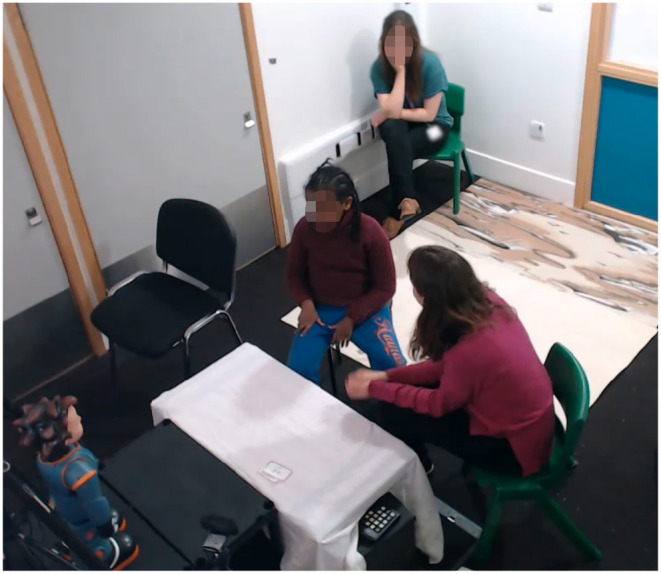
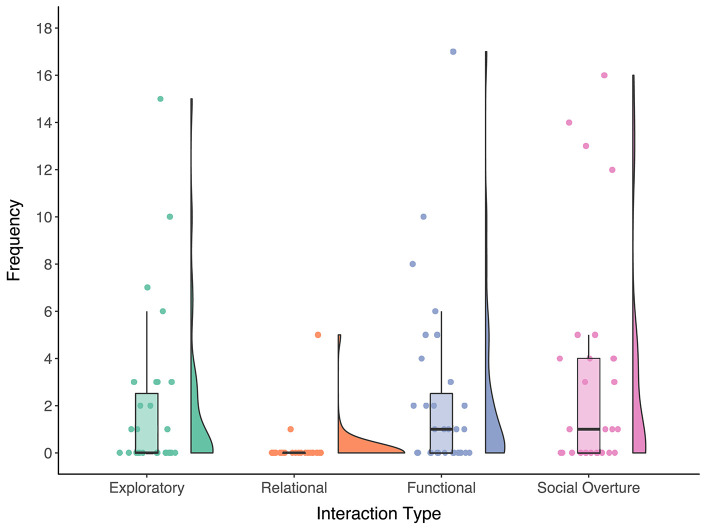
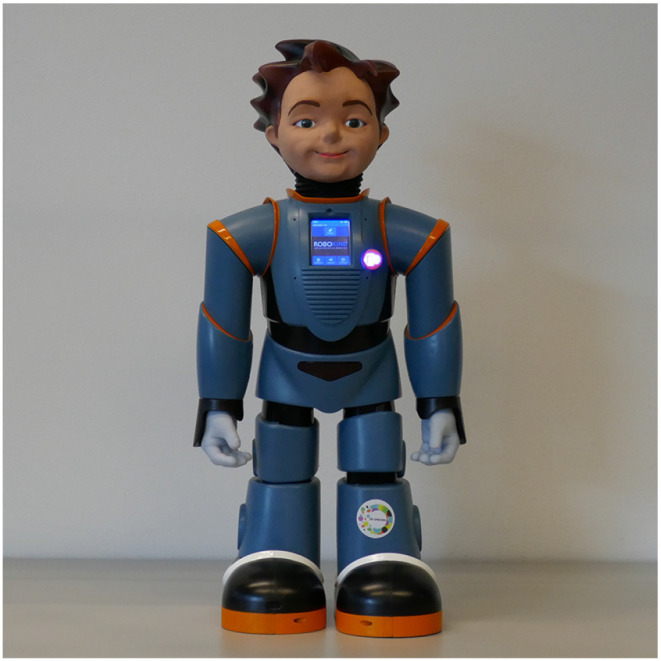
Robots are promising tools for promoting engagement of autistic children in interventions and thereby increasing the amount of learning opportunities. However, designing deliberate robot behavior aimed at engaging autistic children remains challenging. Our current understanding of what interactions with a robot, or facilitated by a robot, are particularly motivating to autistic children is limited to qualitative reports with small sample sizes. Translating insights from these reports to design is difficult due to the large individual differences among autistic children in their needs, interests, and abilities. To address these issues, we conducted a descriptive study and report on an analysis of how 31 autistic children spontaneously interacted with a humanoid robot and an adult within the context of a robot-assisted intervention, as well as which individual characteristics were associated with the observed interactions. For this analysis, we used video recordings of autistic children engaged in a robot-assisted intervention that were recorded as part of the DE-ENIGMA database. The results showed that the autistic children frequently engaged in exploratory and functional interactions with the robot spontaneously, as well as in interactions with the adult that were elicited by the robot. In particular, we observed autistic children frequently initiating interactions aimed at making the robot do a certain action. Autistic children with stronger language ability, social functioning, and fewer autism spectrum-related symptoms, initiated more functional interactions with the robot and more robot-elicited interactions with the adult. We conclude that the children's individual characteristics, in particular the child's language ability, can be indicative of which types of interaction they are more likely to find interesting. Taking these into account for the design of deliberate robot behavior, coupled with providing more autonomy over the robot's behavior to the autistic children, appears promising for promoting engagement and facilitating more learning opportunities.
机器人是促进自闭症儿童参与干预从而增加学习机会的有前景的工具。然而,设计旨在吸引自闭症儿童的刻意机器人行为仍然具有挑战性。我们目前对于与机器人互动或由机器人促成的哪些互动对自闭症儿童特别有激励作用的理解,仅限于小样本量的定性报告。由于自闭症儿童在需求、兴趣和能力方面存在巨大个体差异,将这些报告中的见解转化为设计很困难。为了解决这些问题,我们进行了一项描述性研究,并报告了对31名自闭症儿童在机器人辅助干预背景下如何与类人机器人和成人自发互动的分析,以及哪些个体特征与观察到的互动相关。对于此分析,我们使用了作为DE - ENIGMA数据库一部分记录的自闭症儿童参与机器人辅助干预的视频记录。结果表明,自闭症儿童经常自发地与机器人进行探索性和功能性互动,以及与由机器人引发的成人进行互动。特别是,我们观察到自闭症儿童经常发起旨在让机器人做特定动作的互动。语言能力更强、社交功能更好且自闭症谱系相关症状较少的自闭症儿童,与机器人发起的功能性互动以及与成人的机器人引发互动更多。我们得出结论,儿童的个体特征,特别是儿童的语言能力,可以表明他们更可能觉得哪种类型的互动有趣。在设计刻意的机器人行为时考虑这些因素,再加上给予自闭症儿童对机器人行为更多的自主权,似乎有望促进参与并提供更多学习机会。