Mitrokhin Anton, Sutor Peter, Summers-Stay Douglas, Fermüller Cornelia, Aloimonos Yiannis
Computer Vision Laboratory, Department of Computer Science, University of Maryland Institute for Advanced Computer Studies, University of Maryland, College Park, MD, United States.
Computational and Information Sciences Directorate, Army Research Laboratory, Adelphi, MD, United States.
Front Robot AI. 2020 Jun 9;7:63. doi: 10.3389/frobt.2020.00063. eCollection 2020.
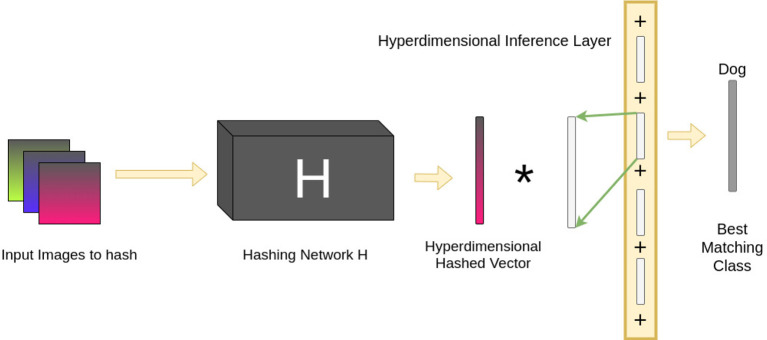
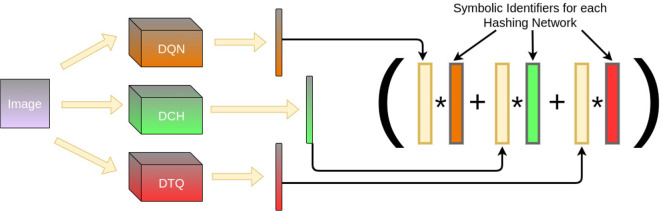
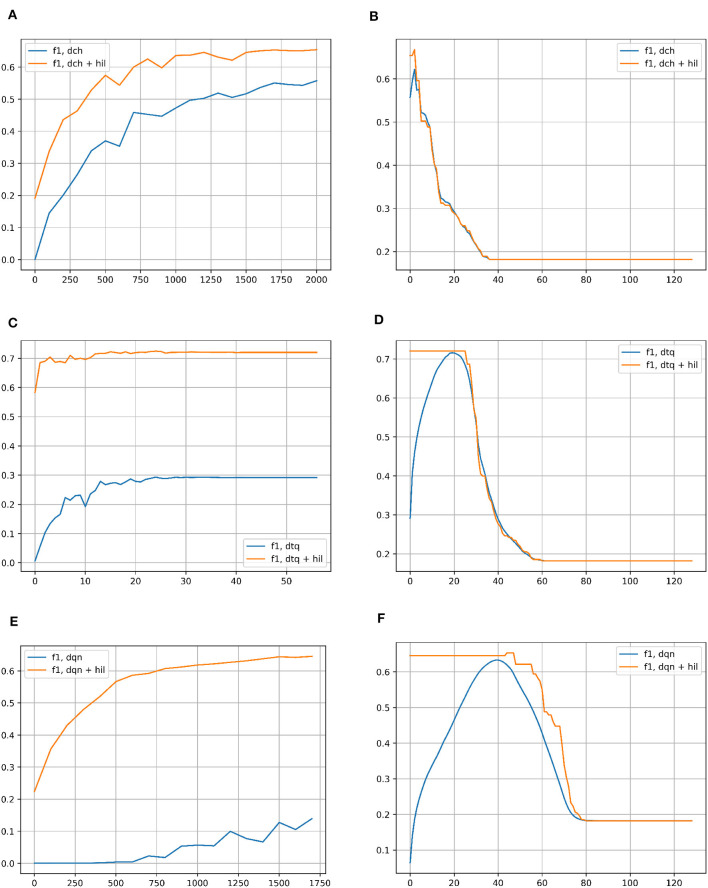
It has been proposed that machine learning techniques can benefit from symbolic representations and reasoning systems. We describe a method in which the two can be combined in a natural and direct way by use of hyperdimensional vectors and hyperdimensional computing. By using hashing neural networks to produce binary vector representations of images, we show how hyperdimensional vectors can be constructed such that vector-symbolic inference arises naturally out of their output. We design the Hyperdimensional Inference Layer (HIL) to facilitate this process and evaluate its performance compared to baseline hashing networks. In addition to this, we show that separate network outputs can directly be fused at the vector symbolic level within HILs to improve performance and robustness of the overall model. Furthermore, to the best of our knowledge, this is the first instance in which meaningful hyperdimensional representations of images are created on real data, while still maintaining hyperdimensionality.
有人提出,机器学习技术可以从符号表示和推理系统中受益。我们描述了一种方法,通过使用超维向量和超维计算,可以以自然而直接的方式将两者结合起来。通过使用哈希神经网络生成图像的二进制向量表示,我们展示了如何构建超维向量,使得向量符号推理能够自然地从其输出中产生。我们设计了超维推理层(HIL)来促进这一过程,并与基线哈希网络相比评估其性能。除此之外,我们还表明,在HIL中可以直接在向量符号级别融合单独的网络输出,以提高整体模型的性能和鲁棒性。此外,据我们所知,这是首次在真实数据上创建有意义的图像超维表示,同时仍保持超维性。