University of Cambridge Metabolic Research Laboratories and MRC Metabolic Diseases Unit, Wellcome Trust-MRC Institute of Metabolic Science, Addenbrooke's Hospital, Cambridge, UK.
Obesity and Comorbidities Research Center, Faculty of Medical Sciences, State University of Campinas, São Paulo, Brazil.
Diabetologia. 2021 Apr;64(4):890-902. doi: 10.1007/s00125-020-05357-4. Epub 2021 Jan 27.
AIMS/HYPOTHESIS: Levels of the microRNA (miRNA) miR-126-3p are programmed cell-autonomously in visceral adipose tissue of adult offspring born to obese female C57BL/6J mice. The spectrum of miR-126-3p targets and thus the consequences of its dysregulation for adipocyte metabolism are unknown. Therefore, the aim of the current study was to identify novel targets of miR-126-3p in vitro and then establish the outcomes of their dysregulation on adipocyte metabolism in vivo using a well-established maternal obesity mouse model.
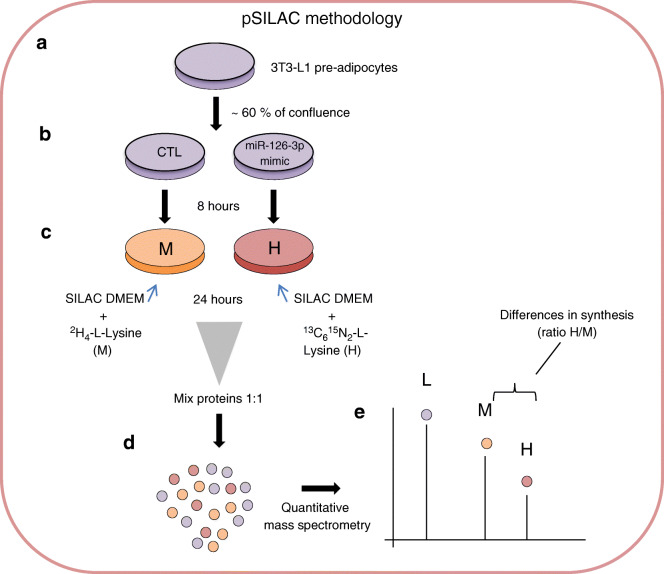
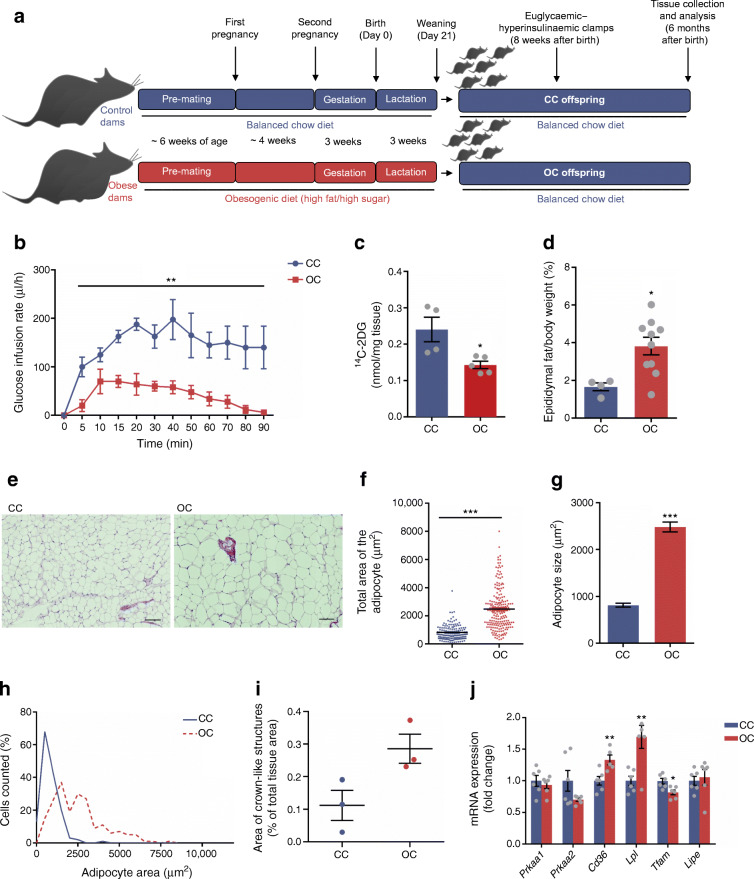
miR-126-3p overexpression in 3T3-L1 pre-adipocytes followed by pulsed stable isotope labelling by amino acids in culture (pSILAC) was performed to identify novel targets of the miRNA. Well-established bioinformatics algorithms and luciferase assays were then employed to confirm those that were direct targets of miR-126-3p. Selected knockdown experiments were performed in vitro to define the consequences of target dysregulation. Quantitative real-time PCR, immunoblotting, histology, euglycaemic-hyperinsulinaemic clamps and glucose tolerance tests were performed to determine the phenotypic and functional outcomes of maternal programmed miR-126-3p levels in offspring adipose tissue.
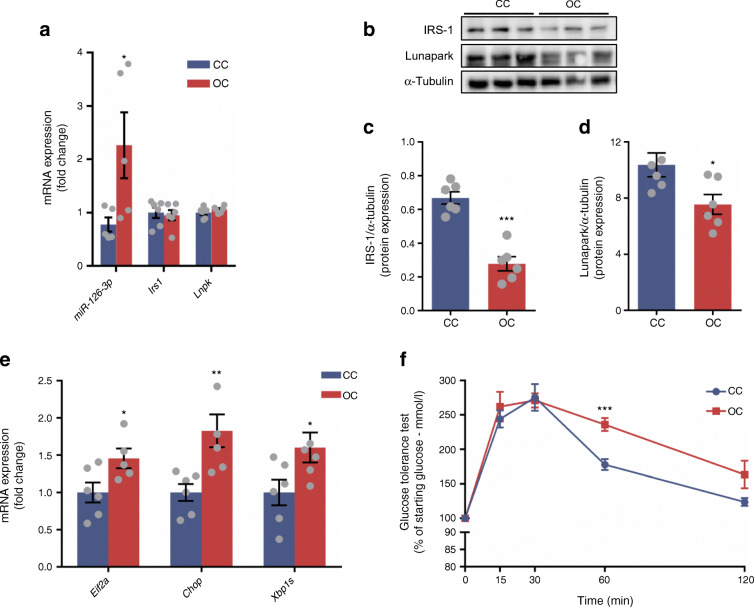
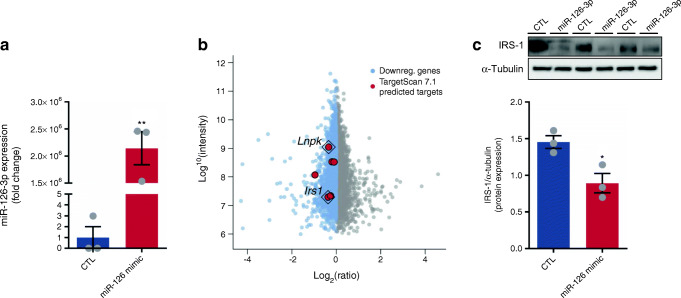
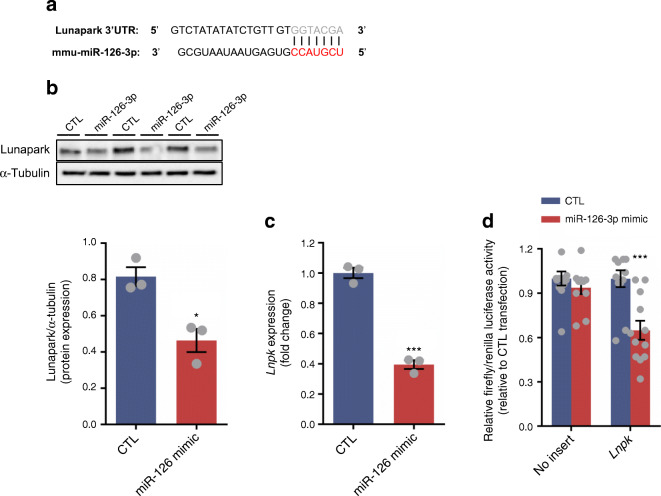
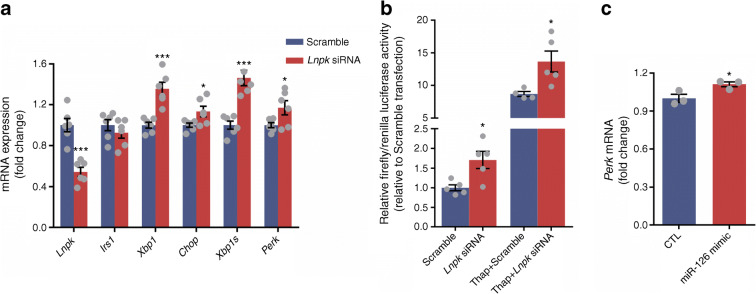
The proteomic approach confirmed the identity of known targets of miR-126-3p (including IRS-1) and identified Lunapark, an endoplasmic reticulum (ER) protein, as a novel one. We confirmed by luciferase assay that Lunapark was a direct target of miR-126-3p. Overexpression of miR-126-3p in vitro led to a reduction in Lunapark protein levels and increased Perk (also known as Eif2ak3) mRNA levels and small interference-RNA mediated knockdown of Lunapark led to increased Xbp1, spliced Xbp1, Chop (also known as Ddit3) and Perk mRNA levels and an ER stress transcriptional response in 3T3-L1 pre-adipocytes. Consistent with the results found in vitro, increased miR-126-3p expression in adipose tissue from adult mouse offspring born to obese dams was accompanied by decreased Lunapark and IRS-1 protein levels and increased markers of ER stress. At the whole-body level the animals displayed glucose intolerance.
CONCLUSIONS/INTERPRETATION: Concurrently targeting IRS-1 and Lunapark, a nutritionally programmed increase in miR-126-3p causes adipose tissue insulin resistance and an ER stress response, both of which may contribute to impaired glucose tolerance. These findings provide a novel mechanism by which obesity during pregnancy leads to increased risk of type 2 diabetes in the offspring and therefore identify miR-126-3p as a potential therapeutic target.
目的/假设:肥胖雌性 C57BL/6J 小鼠所生的成年后代内脏脂肪组织中的 microRNA(miRNA)miR-126-3p 水平是自主程序性的。miR-126-3p 靶标的范围及其对脂肪细胞代谢失调的后果尚不清楚。因此,本研究的目的是在体外鉴定 miR-126-3p 的新靶标,然后使用成熟的母体肥胖小鼠模型,在体内建立其靶标失调对脂肪细胞代谢的结果。
在 3T3-L1 前脂肪细胞中过表达 miR-126-3p,然后进行脉冲稳定同位素标记的氨基酸培养(pSILAC),以鉴定 miRNA 的新靶标。然后使用成熟的生物信息学算法和荧光素酶测定法来确认那些是 miR-126-3p 的直接靶标。在体外进行了选定的敲低实验,以确定靶标失调的后果。进行定量实时 PCR、免疫印迹、组织学、血糖正常-高胰岛素钳夹和葡萄糖耐量试验,以确定后代脂肪组织中母系程序性 miR-126-3p 水平的表型和功能结果。
蛋白质组学方法证实了 miR-126-3p 的已知靶标(包括 IRS-1)的身份,并确定 Lunapark 是一种新型内质网(ER)蛋白。我们通过荧光素酶测定证实 Lunapark 是 miR-126-3p 的直接靶标。体外过表达 miR-126-3p 导致 Lunapark 蛋白水平降低,Perk(也称为 Eif2ak3)mRNA 水平升高,而 Lunapark 的小干扰 RNA 敲低导致 Xbp1、剪接 Xbp1、Chop(也称为 Ddit3)和 Perk mRNA 水平升高,以及 3T3-L1 前脂肪细胞中的 ER 应激转录反应。与体外结果一致,肥胖母鼠所生的成年小鼠后代脂肪组织中 miR-126-3p 的表达增加,同时伴有 Lunapark 和 IRS-1 蛋白水平降低以及 ER 应激标志物增加。在整体水平上,动物表现出葡萄糖耐量受损。
结论/解释:同时靶向 IRS-1 和 Lunapark,营养编程性 miR-126-3p 的增加导致脂肪组织胰岛素抵抗和 ER 应激反应,这两者都可能导致葡萄糖耐量受损。这些发现为肥胖孕妇导致后代 2 型糖尿病风险增加提供了一种新的机制,因此确定 miR-126-3p 为潜在的治疗靶点。