Hwa Mei Hospital, University of Chinese Academy of Sciences, Ningbo, Zhejiang, PR China.
Department of Global Health, Ningbo Institute of Life and Health Industry, University of Chinese Academy of Sciences, Ningbo, Zhejiang, PR China.
Hum Reprod. 2021 Mar 18;36(4):1108-1119. doi: 10.1093/humrep/deaa371.
What is the current burden of polycystic ovary syndrome (PCOS) at the global, regional, and country-specific levels in 194 countries and territories according to age and socio-demographic index (SDI)?
Slight increases in age-standardized incidence of PCOS and associated disability-adjusted life-years (DALYs) were evidenced among women of reproductive age (15-49 years) from 2007 to 2017 at the global level, and in most regions and countries.
No detailed quantitative estimates of the PCOS incidence and DALYs by age and SDI in these 194 countries and territories have been published previously.
STUDY DESIGN, SIZE, DURATION: An age- and SDI-stratified systematic analysis of the PCOS incidence and DALYs across 194 countries and territories has been performed.
PARTICIPANTS/MATERIALS, SETTING, METHODS: We used data from the Global Burden of Diseases, Injuries and Risk Factors Study (GBD) 2017 to estimate the total and age-standard PCOS incidence rates and DALYs rates among women of reproductive age in both 2007 and 2017, and the trends in these parameters from 2007 to 2017.
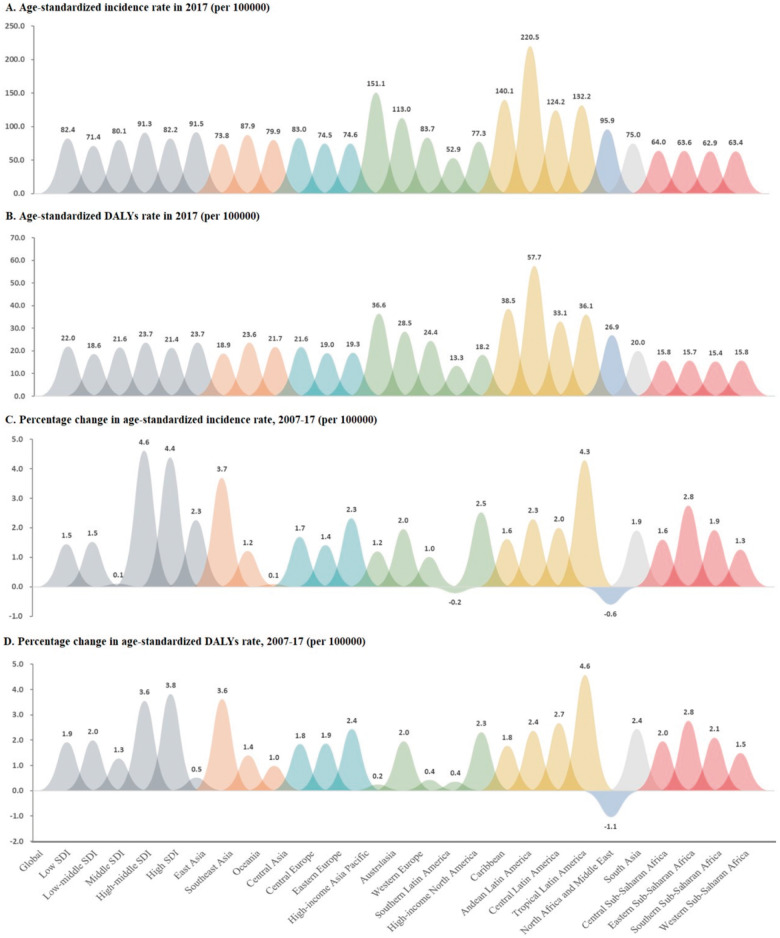
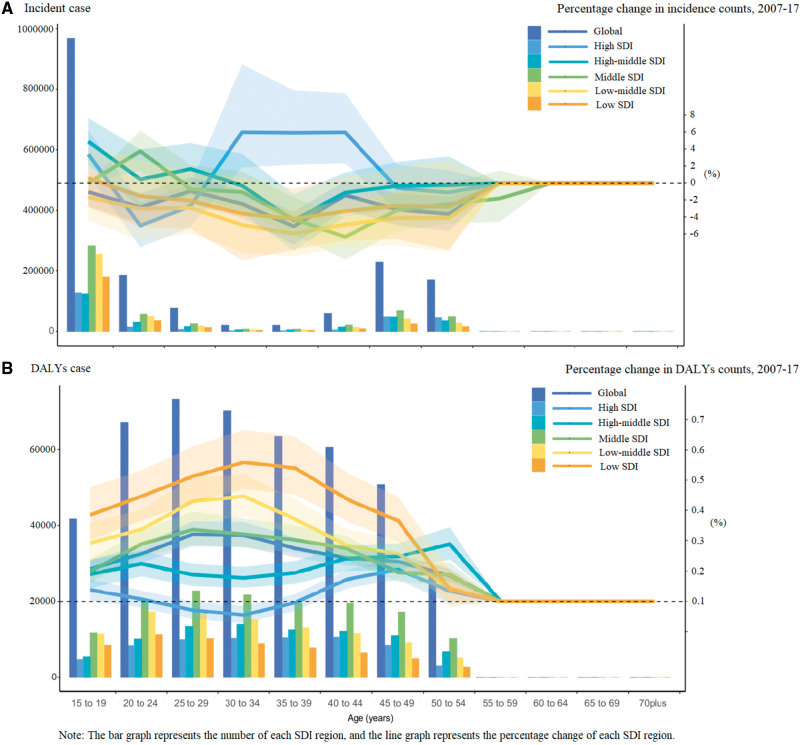
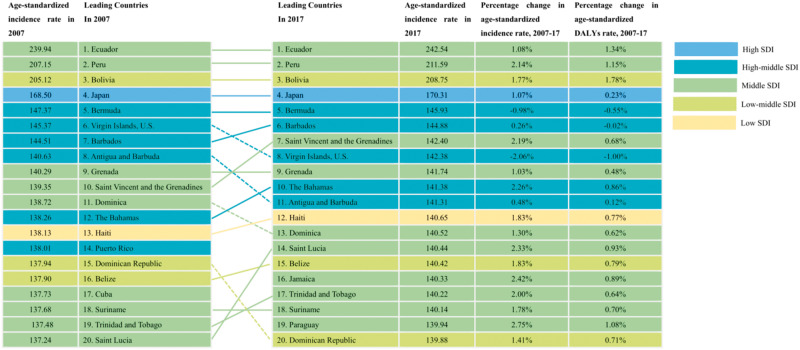
Globally, women of reproductive age accounted for 1.55 million (95% uncertainty intervals (UIs): 1.19-2.08) incident cases of PCOS and 0.43 million (0.19-0.82) associated DALYs. The global age-standardized PCOS incidence rate among women of reproductive age increased to 82.44 (64.65-100.24) per 100 000 population in 2017, representing an increase of 1.45% (1.43-1.47%) from 2007 to 2017. The rate of age-standardized DALYs increased to 21.96 (12.78-31.15) per 100 000 population in 2017, representing an increase of 1.91% (1.89-1.93%) from 2007 to 2017. Over the study period, the greatest increase in the age-standardized PCOS incidence and DALYs rates were observed in the middle-SDI and high-middle SDI regions, respectively. At the GBD regional level, the highest age-standardized incidence and DALY rates in 2017 were observed in Andean Latin America, whereas the largest percentage increases in both rates from 2007 to 2017 were observed in Tropical Latin America. At the national level, Ecuador, Peru, Bolivia, Japan, and Bermuda had the highest age-standardized incidence rates and DALYs rates in both 2007 and 2017. The highest increases in both the age-standardized incidence rates and DALYs rates from 2007 to 2017 were observed in Ethiopia, Brazil, and China.
LIMITATIONS, REASONS FOR CAUTION: Although the GBD (2017) study aimed to gather all published and unpublished data, the limited availability of data in some regions might have led to the estimation of wide UIs. Additionally, the PCOS phenotype is complicated and the diagnostic criteria are constantly changing. Consequently, the incidence of PCOS might have been underestimated.
Knowledge about the differences in the PCOS burden across various locations will be valuable for the allocation of resources and formulation of effective preventive strategies.
STUDY FUNDING/COMPETING INTEREST(S): The study was supported by grants from the Innovative Talent Support Plan of the Medical and Health Technology Project in Zhejiang Province (2021422878), Ningbo Science and Technology Project (202002N3152), Ningbo Health Branding Subject Fund (PPXK2018-02), Sanming Project of Medicine in Shen-zhen (SZSM201803080), and National Social Science Foundation (19AZD013). No potential conflicts of interest relevant to this article were reported.
N/A.
在全球 194 个国家和地区,根据年龄和社会人口指数(SDI),2007 年至 2017 年,15-49 岁生育年龄女性中多囊卵巢综合征(PCOS)的当前负担是多少,包括发病率和与疾病相关的伤残调整生命年(DALY)?
在全球范围内,2007 年至 2017 年,生育年龄女性的年龄标准化 PCOS 发病率和相关 DALY 呈轻微上升趋势,在大多数地区和国家也是如此。
以前没有发表过这些 194 个国家和地区中按年龄和 SDI 划分的 PCOS 发病率和 DALY 的详细定量估计。
研究设计、规模、持续时间:对全球 194 个国家和地区的 PCOS 发病率和 DALY 进行了年龄和 SDI 分层的系统分析。
参与者/材料、设置、方法:我们使用了全球疾病、伤害和危险因素研究(GBD)2017 年的数据,以估计生育年龄女性在 2007 年和 2017 年的总 PCOS 发病率和年龄标准化发病率以及相关 DALY 率,以及 2007 年至 2017 年期间这些参数的趋势。
在全球范围内,生育年龄的女性中有 155 万例(95%不确定区间(UI):1.19-2.08)PCOS 新发病例和 43 万例(0.19-0.82)相关 DALY。2017 年,生育年龄女性的全球年龄标准化 PCOS 发病率上升至每 10 万人 82.44 例(64.65-100.24),比 2007 年增加了 1.45%(1.43-1.47%)。2017 年,年龄标准化 DALY 率上升至每 10 万人 21.96 例(12.78-31.15),比 2007 年增加了 1.91%(1.89-1.93%)。在研究期间,中 SDI 和高-中 SDI 地区的年龄标准化 PCOS 发病率和 DALY 率增幅最大。在全球区域水平上,2017 年安第斯拉丁美洲的年龄标准化发病率和 DALY 率最高,而 2007 年至 2017 年这两个率的百分比增幅最大的是热带拉丁美洲。在国家层面上,2007 年和 2017 年,厄瓜多尔、秘鲁、玻利维亚、日本和百慕大的年龄标准化发病率和 DALY 率最高。2007 年至 2017 年,发病率和 DALY 率增幅最大的是埃塞俄比亚、巴西和中国。
限制因素、谨慎的原因:尽管 GBD(2017)研究旨在收集所有已发表和未发表的数据,但在某些地区数据的有限可用性可能导致广泛的不确定区间。此外,PCOS 表型复杂,诊断标准不断变化。因此,PCOS 的发病率可能被低估了。
了解不同地区 PCOS 负担的差异对于资源配置和制定有效的预防策略将是有价值的。
研究资金/利益冲突:这项研究得到了浙江省医疗卫生技术项目创新人才支持计划(2021422878)、宁波科技项目(202002N3152)、宁波健康品牌主题基金(PPXK2018-02)、深圳三铭项目(201803080)和国家社会科学基金(19AZD013)的资助。没有与本研究相关的潜在利益冲突。
无。