Department of Mechanical and Aerospace Engineering, Princeton University, Princeton, NJ, 08544, USA.
Department of Geosciences, Princeton University, Princeton, NJ, 08544, USA.
Nat Commun. 2021 Jan 27;12(1):622. doi: 10.1038/s41467-020-20798-6.
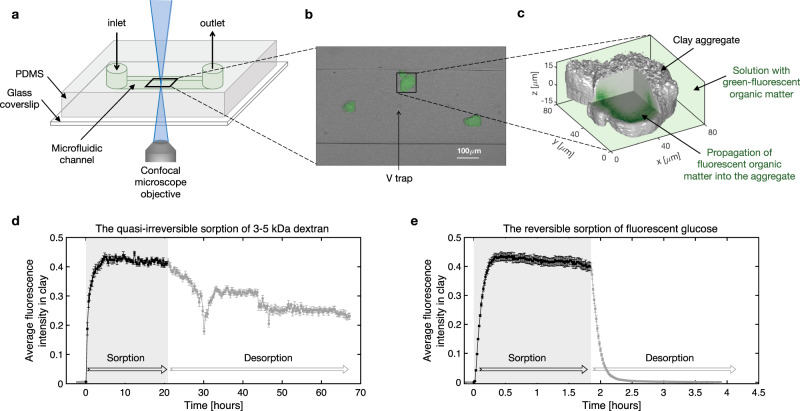
Soil absorbs about 20% of anthropogenic carbon emissions annually, and clay is one of the key carbon-capture materials. Although sorption to clay is widely assumed to strongly retard the microbial decomposition of soil organic matter, enhanced degradation of clay-associated organic carbon has been observed under certain conditions. The conditions in which clay influences microbial decomposition remain uncertain because the mechanisms of clay-organic carbon interactions are not fully understood. Here we reveal the spatiotemporal dynamics of carbon sorption and release within model clay aggregates and the role of enzymatic decomposition by directly imaging a transparent smectite clay on a microfluidic chip. We demonstrate that clay-carbon protection is due to the quasi-irreversible sorption of high molecular-weight sugars within clay aggregates and the exclusion of bacteria from these aggregates. We show that this physically-protected carbon can be enzymatically broken down into fragments that are released into solution. Further, we suggest improvements relevant to soil carbon models.
土壤每年吸收约 20%的人为碳排放,而粘土是关键的碳捕获材料之一。尽管人们普遍认为粘土对土壤有机质的微生物分解具有很强的抑制作用,但在某些条件下,与粘土相关的有机碳的降解增强已被观察到。由于不完全了解粘土与有机碳相互作用的机制,粘土影响微生物分解的条件仍不确定。在这里,我们通过在微流控芯片上直接对蒙脱石粘土进行成像,揭示了模型粘土聚集体中碳吸附和释放的时空动态以及酶分解的作用。我们证明,粘土-碳的保护是由于高分子量糖在粘土聚集体中的准不可逆吸附以及细菌被排斥在这些聚集体之外。我们表明,这种受物理保护的碳可以被酶分解成片段并释放到溶液中。此外,我们提出了与土壤碳模型相关的改进建议。