MRC Integrative Epidemiology Unit, University of Bristol, Bristol, BS8 2BN, UK.
Department of Population Health Sciences, Bristol Medical School, University of Bristol, Bristol, BS8 1UD, UK.
Sci Rep. 2021 Jan 27;11(1):2329. doi: 10.1038/s41598-021-82169-5.
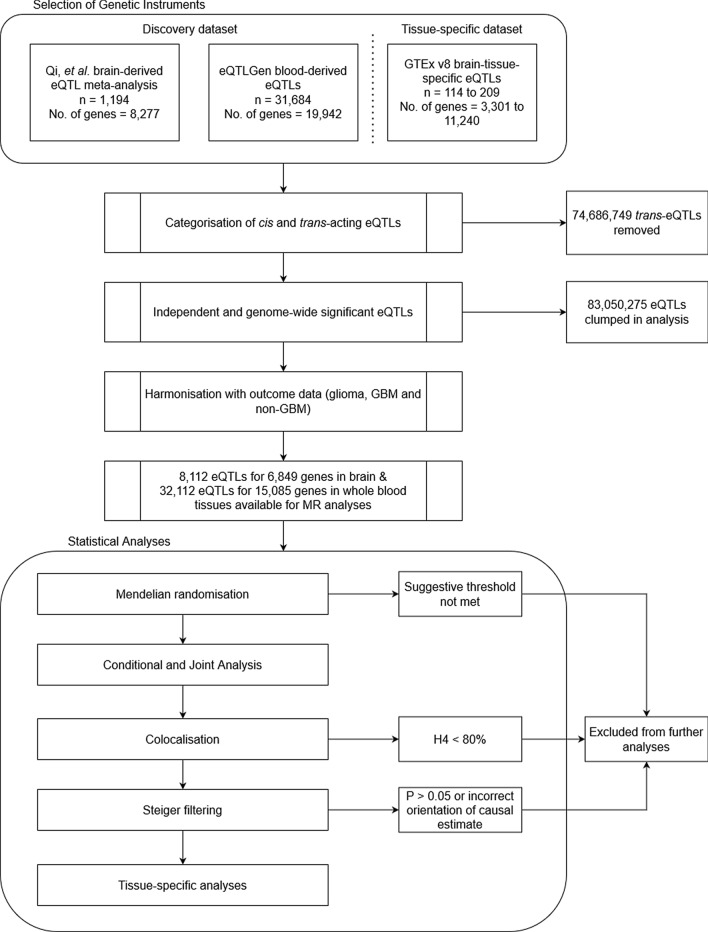
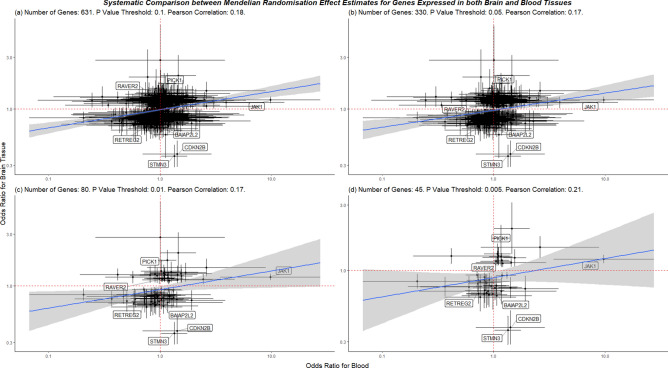
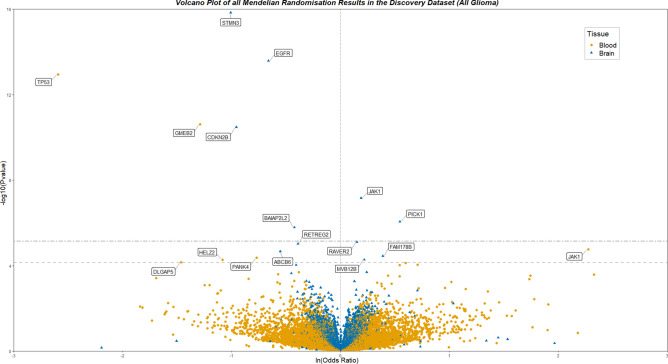
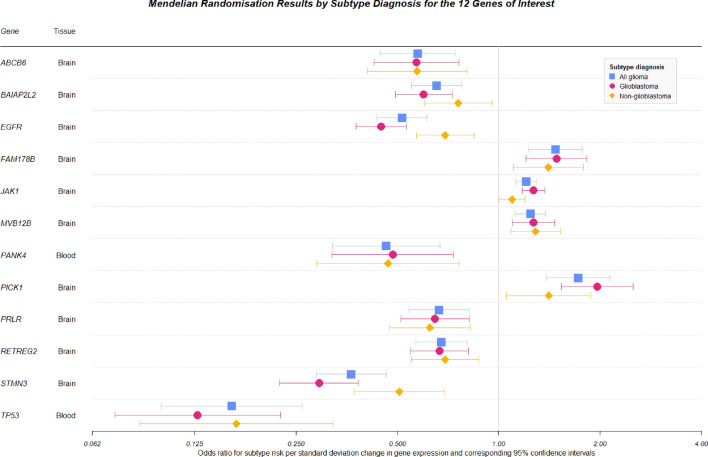
Genome-wide association studies (GWAS) have discovered 27 loci associated with glioma risk. Whether these loci are causally implicated in glioma risk, and how risk differs across tissues, has yet to be systematically explored. We integrated multi-tissue expression quantitative trait loci (eQTLs) and glioma GWAS data using a combined Mendelian randomisation (MR) and colocalisation approach. We investigated how genetically predicted gene expression affects risk across tissue type (brain, estimated effective n = 1194 and whole blood, n = 31,684) and glioma subtype (all glioma (7400 cases, 8257 controls) glioblastoma (GBM, 3112 cases) and non-GBM gliomas (2411 cases)). We also leveraged tissue-specific eQTLs collected from 13 brain tissues (n = 114 to 209). The MR and colocalisation results suggested that genetically predicted increased gene expression of 12 genes were associated with glioma, GBM and/or non-GBM risk, three of which are novel glioma susceptibility genes (RETREG2/FAM134A, FAM178B and MVB12B/FAM125B). The effect of gene expression appears to be relatively consistent across glioma subtype diagnoses. Examining how risk differed across 13 brain tissues highlighted five candidate tissues (cerebellum, cortex, and the putamen, nucleus accumbens and caudate basal ganglia) and four previously implicated genes (JAK1, STMN3, PICK1 and EGFR). These analyses identified robust causal evidence for 12 genes and glioma risk, three of which are novel. The correlation of MR estimates in brain and blood are consistently low which suggested that tissue specificity needs to be carefully considered for glioma. Our results have implicated genes yet to be associated with glioma susceptibility and provided insight into putatively causal pathways for glioma risk.
全基因组关联研究(GWAS)已经发现了 27 个与胶质瘤风险相关的位点。这些位点是否与胶质瘤风险有因果关系,以及风险在不同组织中的差异如何,尚未得到系统的探索。我们使用联合孟德尔随机化(MR)和共定位方法整合了多组织表达数量性状基因座(eQTL)和胶质瘤 GWAS 数据。我们研究了遗传预测的基因表达如何影响不同组织类型(大脑,估计有效 n=1194 和全血,n=31684)和胶质瘤亚型(所有胶质瘤(7400 例,8257 例对照)胶质母细胞瘤(GBM,3112 例)和非 GBM 胶质瘤(2411 例))的风险。我们还利用了从 13 个脑组织中收集的组织特异性 eQTL(n=114 至 209)。MR 和共定位结果表明,12 个基因的遗传预测表达增加与胶质瘤、GBM 和/或非 GBM 风险相关,其中三个是新的胶质瘤易感性基因(RETREG2/FAM134A、FAM178B 和 MVB12B/FAM125B)。基因表达的作用似乎在胶质瘤亚型诊断中相对一致。研究风险在 13 个脑组织中的差异突出了五个候选组织(小脑、皮层和壳核、伏隔核和尾状核基底节)和四个先前涉及的基因(JAK1、STMN3、PICK1 和 EGFR)。这些分析确定了 12 个基因和胶质瘤风险的强有力的因果证据,其中三个是新的。大脑和血液中的 MR 估计相关性一直很低,这表明需要仔细考虑组织特异性来研究胶质瘤。我们的研究结果表明了尚未与胶质瘤易感性相关的基因,并为胶质瘤风险的潜在因果途径提供了见解。