• 文献检索
  • 文档翻译
  • 深度研究
  • 学术资讯
  • Suppr Zotero 插件Zotero 插件
  • 邀请有礼
  • 套餐&价格
  • 历史记录
应用&插件
Suppr Zotero 插件Zotero 插件浏览器插件Mac 客户端Windows 客户端微信小程序
定价
高级版会员购买积分包购买API积分包
服务
文献检索文档翻译深度研究API 文档MCP 服务
关于我们
关于 Suppr公司介绍联系我们用户协议隐私条款
关注我们

Suppr 超能文献

核心技术专利:CN118964589B侵权必究
粤ICP备2023148730 号-1Suppr @ 2026

文献检索

告别复杂PubMed语法,用中文像聊天一样搜索,搜遍4000万医学文献。AI智能推荐,让科研检索更轻松。

立即免费搜索

文件翻译

保留排版,准确专业,支持PDF/Word/PPT等文件格式,支持 12+语言互译。

免费翻译文档

深度研究

AI帮你快速写综述,25分钟生成高质量综述,智能提取关键信息,辅助科研写作。

立即免费体验

用于心房性心动过速的电解剖标测的改良兴趣窗。

An improved window of interest for electroanatomical mapping of atrial tachycardia.

机构信息

Ramsay Santé, Hôpital Privé Clairval, Service Cardiologie-Rythmologie, Marseille, France.

Departement of Cardiology, Pasteur University Hospital, Nice, France.

出版信息

J Interv Card Electrophysiol. 2022 Jan;63(1):29-37. doi: 10.1007/s10840-021-00940-0. Epub 2021 Jan 27.

DOI:10.1007/s10840-021-00940-0
PMID:33506319
原文链接:https://pmc.ncbi.nlm.nih.gov/articles/PMC8755667/
Abstract

PURPOSE

Diagnosis of atrial tachycardia (AT) with 3D mapping system remains challenging due to fibrosis or previous ablation. This study aims to evaluate a new electroanatomical mapping annotation setting using a window of interest adjusted at the end of the P wave (WOI) to identify the AT mechanism more accurately.

METHODS

Twenty patients with successful ablation of left AT using navigation system CARTO3 were evaluated. Two maps for each patient were generated offline using either conventional settings of WOI (WOI) or WOI. Three investigators from two centres analysed the maps blindly.

RESULTS

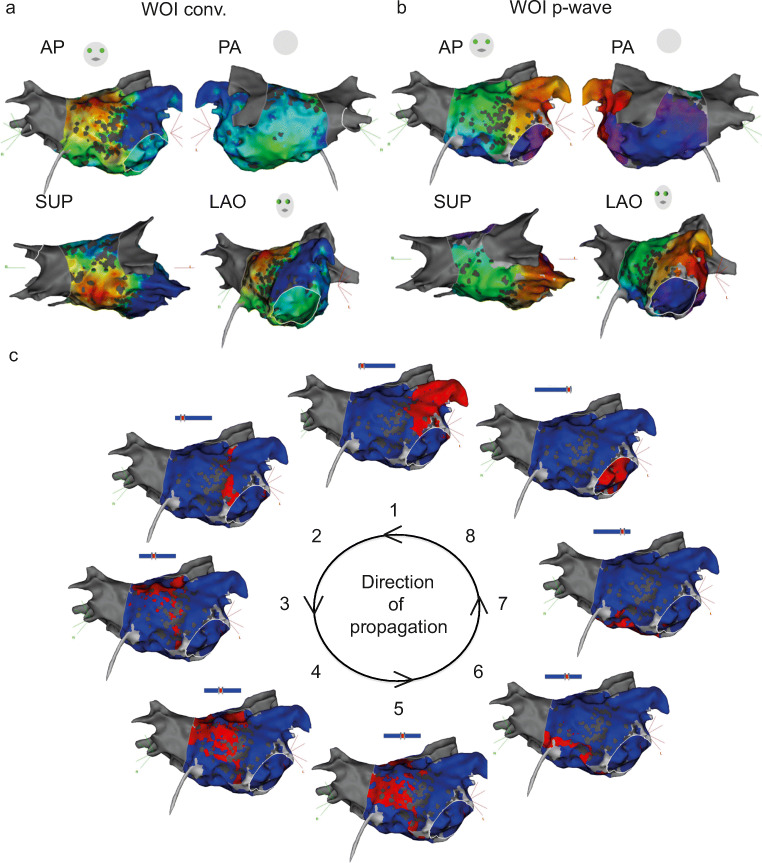
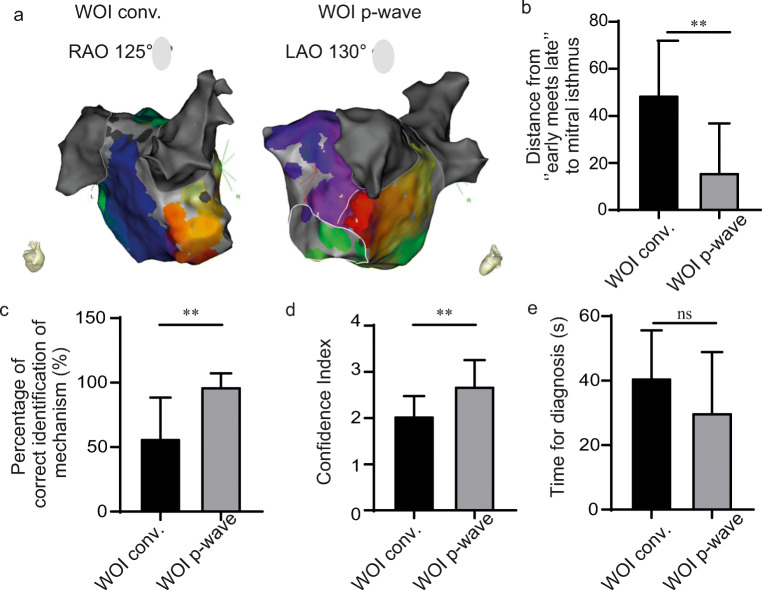
Mechanisms of AT were macroreentrant in 14/20 patients (70%) and focal in 6/20 (30%). WOI resulted in a significant increase in the percentage of correct identification of the mechanism based on mapping alone (93.3 ± 13.7% vs 58.3 ± 33.9%; p = 0.0003) compared with WOI. Diagnoses based on mapping were arrived at faster (27.8 ± 16.4 s vs 38.97 ± 13.64 s, respectively; p = 0.0231) and with a greater confidence in the diagnosis (confidence index 2.57 ± 0.45 vs 2.12 ± 0.45, respectively; p = 0.0024). With perimitral re-entry specifically "early meets late" was closer to the anatomical region of the mitral isthmus (15.9 ± 20.9 mm vs 48.77 ± 23.23 mm, respectively; p = 0.0028).

CONCLUSIONS

This study found that electroanatomical mapping acquisition with a window of interest set at the end of the P wave improves the ability to diagnose the arrhythmia mechanism based on the initial map. It is particularly beneficial in identifying area of interest for ablation in perimitral AT.

摘要

目的

由于纤维化或先前的消融,使用 3D 映射系统诊断房性心动过速(AT)仍然具有挑战性。本研究旨在评估一种新的电解剖映射注释设置,该设置使用在 P 波结束时调整的感兴趣窗口(WOI),以更准确地识别 AT 机制。

方法

评估了 20 例使用导航系统 CARTO3 成功消融左房 AT 的患者。对每位患者生成了两个离线地图,分别使用常规 WOI(WOI)或 WOI 设置。来自两个中心的三位调查员进行了盲法分析。

结果

AT 的机制在 20 例患者中有 14 例(70%)为大折返性,6 例(30%)为局灶性。WOI 显著提高了基于映射单独识别机制的准确性百分比(93.3±13.7%比 58.3±33.9%;p=0.0003)。基于映射的诊断更快(分别为 27.8±16.4 秒和 38.97±13.64 秒;p=0.0231),并且诊断的置信度更高(置信指数分别为 2.57±0.45 和 2.12±0.45;p=0.0024)。对于围绕二尖瓣峡部的周边折返性心动过速,特别是“早相遇晚”,更接近二尖瓣峡部的解剖区域(分别为 15.9±20.9 毫米和 48.77±23.23 毫米;p=0.0028)。

结论

这项研究发现,在 P 波结束时设置感兴趣窗口的电解剖图采集可以提高根据初始图诊断心律失常机制的能力。它特别有利于识别周边 AT 消融的兴趣区域。
https://cdn.ncbi.nlm.nih.gov/pmc/blobs/e7a1/8755667/f2694280b17d/10840_2021_940_Fig5_HTML.jpg
https://cdn.ncbi.nlm.nih.gov/pmc/blobs/e7a1/8755667/ae0baccc098b/10840_2021_940_Fig1_HTML.jpg
https://cdn.ncbi.nlm.nih.gov/pmc/blobs/e7a1/8755667/9c8e5bd0f356/10840_2021_940_Fig2_HTML.jpg
https://cdn.ncbi.nlm.nih.gov/pmc/blobs/e7a1/8755667/9e214a9630ee/10840_2021_940_Fig3_HTML.jpg
https://cdn.ncbi.nlm.nih.gov/pmc/blobs/e7a1/8755667/0f3c48e79948/10840_2021_940_Fig4_HTML.jpg
https://cdn.ncbi.nlm.nih.gov/pmc/blobs/e7a1/8755667/f2694280b17d/10840_2021_940_Fig5_HTML.jpg
https://cdn.ncbi.nlm.nih.gov/pmc/blobs/e7a1/8755667/ae0baccc098b/10840_2021_940_Fig1_HTML.jpg
https://cdn.ncbi.nlm.nih.gov/pmc/blobs/e7a1/8755667/9c8e5bd0f356/10840_2021_940_Fig2_HTML.jpg
https://cdn.ncbi.nlm.nih.gov/pmc/blobs/e7a1/8755667/9e214a9630ee/10840_2021_940_Fig3_HTML.jpg
https://cdn.ncbi.nlm.nih.gov/pmc/blobs/e7a1/8755667/0f3c48e79948/10840_2021_940_Fig4_HTML.jpg
https://cdn.ncbi.nlm.nih.gov/pmc/blobs/e7a1/8755667/f2694280b17d/10840_2021_940_Fig5_HTML.jpg

相似文献

1
An improved window of interest for electroanatomical mapping of atrial tachycardia.用于心房性心动过速的电解剖标测的改良兴趣窗。
J Interv Card Electrophysiol. 2022 Jan;63(1):29-37. doi: 10.1007/s10840-021-00940-0. Epub 2021 Jan 27.
2
Timing of critical isthmus from end of P wave and usefulness of activation mapping with window of interest from end to end of P wave in reentrant atrial tachycardia.折返性房性心动过速中关键峡部距P波终点的时间以及使用从P波起点到终点的感兴趣窗进行激动标测的实用性。
Heart Vessels. 2024 Apr;39(4):319-327. doi: 10.1007/s00380-023-02335-9. Epub 2023 Nov 28.
3
Mapping and ablation of clinical spontaneous perimitral atrial tachycardias using an ultra-high-resolution mapping system.使用超高分辨率标测系统对临床自发性周边型房性心动过速进行标测和消融。
Heart Rhythm. 2021 Feb;18(2):189-198. doi: 10.1016/j.hrthm.2020.09.016. Epub 2020 Sep 30.
4
Utility of a ripple map for the interpretation of atrial propagation during atrial tachycardia.用于解释房性心动过速期间心房传导的波动图的效用。
J Interv Card Electrophysiol. 2019 Dec;56(3):249-257. doi: 10.1007/s10840-019-00638-4. Epub 2019 Oct 25.
5
Identification of critical isthmus using coherent mapping in patients with scar-related atrial tachycardia.利用相干标测识别与瘢痕相关的房性心动过速患者的关键峡部。
J Cardiovasc Electrophysiol. 2020 Jun;31(6):1436-1447. doi: 10.1111/jce.14457. Epub 2020 Apr 6.
6
[Non-fluoroscopic electroanatomical mapping (CARTO system) in the ablation of atrial tachycardias].[非荧光透视电解剖标测(CARTO系统)在房性心动过速消融中的应用]
Rev Esp Cardiol. 2004 Jan;57(1):37-44.
7
Mapping of focal atrial tachycardia with an uninterpretable activation map after extensive atrial ablation: tricks and tips.广泛心房消融后无法解释的激动图标测局灶性房性心动过速:技巧与窍门。
Circ Arrhythm Electrophysiol. 2014 Aug;7(4):598-604. doi: 10.1161/CIRCEP.114.001508. Epub 2014 Jul 13.
8
[Electroanatomical mapping and radiofrequency ablation of tachycardia originating in pulmonary vein in an adult patient].[成年患者肺静脉起源性心动过速的电解剖标测与射频消融]
Orv Hetil. 2011 Aug 21;152(34):1374-8. doi: 10.1556/OH.2011.29194.
9
Characteristics of macroreentrant atrial tachycardias using an anatomical bypass: Pseudo-focal atrial tachycardia case series.解剖旁路引发的大折返性房性心动过速的特征:拟似局灶性房性心动过速病例系列。
J Cardiovasc Electrophysiol. 2021 Sep;32(9):2451-2461. doi: 10.1111/jce.15186. Epub 2021 Aug 8.
10
Catheter ablation for atrial tachycardias: How to interpret the unclear activation map?导管消融治疗房性心动过速:如何解读不清晰的激动图?
Pacing Clin Electrophysiol. 2021 Feb;44(2):274-283. doi: 10.1111/pace.14083. Epub 2021 Jan 12.

引用本文的文献

1
Localizing the origin of focal atrial tachycardia by combining clinical characteristics with P-wave morphology.通过结合临床特征与P波形态来定位局灶性房性心动过速的起源。
Heart Rhythm O2. 2025 Jan 29;6(4):463-472. doi: 10.1016/j.hroo.2025.01.012. eCollection 2025 Apr.
2
Strategy to achieve mitral isthmus flutter ablation by radiofrequency: the SHERIFF plan.实现二尖瓣峡部颤动消融的策略:SHERIFF 计划。
J Interv Card Electrophysiol. 2024 Oct;67(7):1557-1562. doi: 10.1007/s10840-024-01804-z. Epub 2024 Apr 11.

本文引用的文献

1
2019 APHRS expert consensus statement on three-dimensional mapping systems for tachycardia developed in collaboration with HRS, EHRA, and LAHRS.2019年亚太心脏节律学会与美国心律学会、欧洲心律协会及拉丁美洲心律学会合作制定的关于心动过速三维标测系统的专家共识声明。
J Arrhythm. 2020 Mar 9;36(2):215-270. doi: 10.1002/joa3.12308. eCollection 2020 Apr.
2
A Novel Annotation Technique During Mapping to Facilitate the Termination of Atrial Tachycardia Following Ablation for Atrial Fibrillation.一种在标测过程中的新型标记技术,以促进房颤消融术后房性心动过速的终止。
J Cardiovasc Electrophysiol. 2016 Nov;27(11):1274-1281. doi: 10.1111/jce.13063. Epub 2016 Sep 6.
3
Electroanatomic characteristics of the mitral isthmus associated with successful mitral isthmus ablation.
与二尖瓣峡部成功消融相关的二尖瓣峡部电解剖特征。
Europace. 2016 Feb;18(2):274-80. doi: 10.1093/europace/euv097. Epub 2015 Dec 23.
4
Atrial flutter: more than just one of a kind.心房颤动:不只是一种类型。
Eur Heart J. 2015 Sep 14;36(35):2356-63. doi: 10.1093/eurheartj/ehv118. Epub 2015 Apr 2.
5
Chasing red herrings: making sense of the colors while mapping.追逐转移注意力的事物:在绘制地图时理解颜色的含义。
Circ Arrhythm Electrophysiol. 2014 Jun;7(3):553-6. doi: 10.1161/CIRCEP.113.001391.
6
Three-dimensional mapping of cardiac arrhythmias: what do the colors really mean?心脏心律失常的三维标测:这些颜色究竟代表什么?
Circ Arrhythm Electrophysiol. 2010 Dec;3(6):e6-11. doi: 10.1161/CIRCEP.110.960161.
7
Electroanatomic contact mapping: how to use optimally to recognise the arrhythmia mechanism?电解剖标测:如何最佳地用于识别心律失常机制?
Indian Pacing Electrophysiol J. 2010 Jan 7;10(1):1-7.
8
Atrial tachycardia after ablation of persistent atrial fibrillation: identification of the critical isthmus with a combination of multielectrode activation mapping and targeted entrainment mapping.持续性心房颤动消融术后的房性心动过速:联合多电极激动标测与靶向拖带标测识别关键峡部
Circ Arrhythm Electrophysiol. 2008 Apr;1(1):14-22. doi: 10.1161/CIRCEP.107.748160.
9
Treatment of macro-re-entrant atrial tachycardia based on electroanatomic mapping: identification and ablation of the mid-diastolic isthmus.基于电解剖标测的大折返性房性心动过速治疗:舒张中期峡部的识别与消融
Europace. 2007 Jul;9(7):449-57. doi: 10.1093/europace/eum055. Epub 2007 May 3.
10
A classification of atrial flutter and regular atrial tachycardia according to electrophysiological mechanisms and anatomical bases; a Statement from a Joint Expert Group from The Working Group of Arrhythmias of the European Society of Cardiology and the North American Society of Pacing and Electrophysiology.根据电生理机制和解剖学基础对心房扑动和规则性房性心动过速进行的分类;欧洲心脏病学会心律失常工作组和北美起搏与电生理学会联合专家组声明
Eur Heart J. 2001 Jul;22(14):1162-82. doi: 10.1053/euhj.2001.2658.