Department of Neurosurgery, RWTH Aachen University, Pauwelstrasse 30, 52074, Aachen, Germany.
Department of Neuroradiology, RWTH Aachen University, Pauwelstrasse 30, 52074, Aachen, Germany.
Sci Rep. 2021 Jan 28;11(1):2497. doi: 10.1038/s41598-021-81766-8.
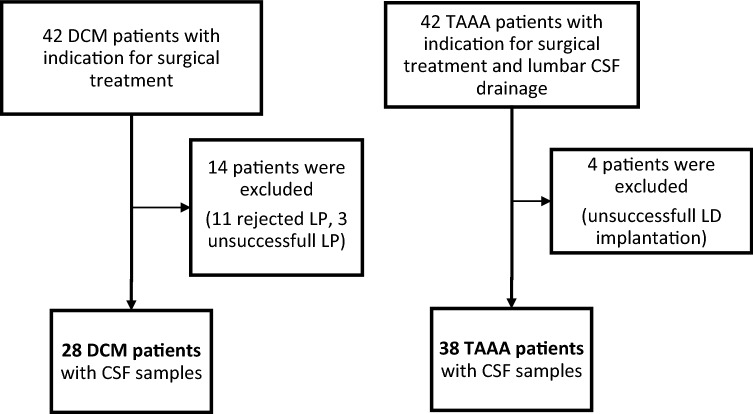
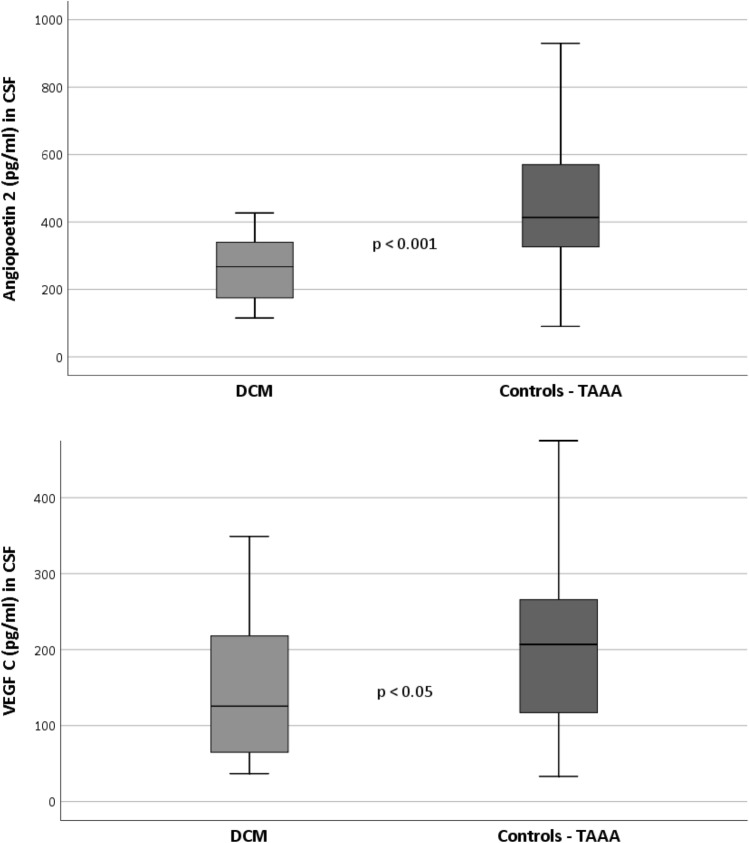
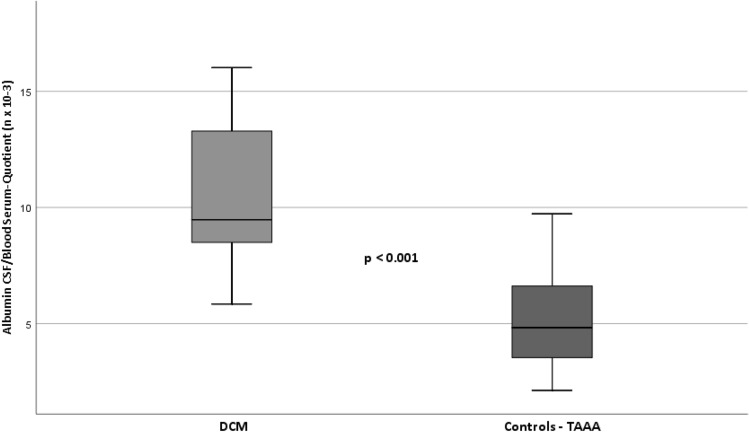
Endogenous immune mediated reactions of inflammation and angiogenesis are components of the spinal cord injury in patients with degenerative cervical myelopathy (DCM). The aim of this study was to identify alteration of certain mediators participating in angiogenetic and inflammatory reactions in patients with DCM. A consecutive series of 42 patients with DCM and indication for surgical decompression were enrolled for the study. 28 DCM patients were included, as CSF samples were taken preoperatively. We enrolled 42 patients requiring surgery for a thoracic abdominal aortic aneurysm (TAAA) as neurologically healthy controls. In 38 TAAA patients, CSF samples were taken prior to surgery and thus included. We evaluated the neurological status of patients and controls prior to surgery including NDI and mJOA. Protein-concentrations of factors with a crucial role in inflammation and angiogenesis were measured in CSF via ELISA testing (pg/ml): Angiopoietin 2, VEGF-A and C, RANTES, IL 1 beta and IL 8. Additionally, evaluated the status of the blood-spinal cord barrier (BSCB) by Reibers´diagnostic in all participants. Groups evidently differed in their neurological status (mJOA: DCM 10.1 ± 3.3, TAAA 17.3 ± 1.2, p < .001; NDI: DCM 47.4 ± 19.7, TAAA 5.3 ± 8.6, p < .001). There were no particular differences in age and gender distribution. However, we detected statistically significant differences in concentrations of mediators between the groups: Angiopoietin 2 (DCM 267.1.4 ± 81.9, TAAA 408.6 ± 177.1, p < .001) and VEGF C (DCM 152.2 ± 96.1, TAAA 222.4 ± 140.3, p = .04). DCM patients presented a mild to moderate BSCB disruption, controls had no signs of impairment. In patients with DCM, we measured decreased concentrations of angiogenic mediators. These results correspond to findings of immune mediated secondary harm in acute spinal cord injury. Reduced angiogenic activity could be a relevant part of the pathogenesis of DCM and secondary harm to the spinal cord.
内源性免疫介导的炎症和血管生成反应是退行性颈椎脊髓病(DCM)患者脊髓损伤的组成部分。本研究的目的是确定参与 DCM 患者血管生成和炎症反应的某些介质的变化。连续系列的 42 例 DCM 患者和手术减压适应证被纳入研究。28 例 DCM 患者在术前采集 CSF 样本。我们纳入了 42 例因胸腹部主动脉瘤(TAAA)需要手术的患者作为神经健康对照组。在 38 例 TAAA 患者中,在手术前采集了 CSF 样本,并将其纳入研究。我们在术前评估了患者和对照组的神经状态,包括 NDI 和 mJOA。通过 ELISA 测试(pg/ml)测量 CSF 中具有炎症和血管生成关键作用的因子的蛋白浓度:血管生成素 2、VEGF-A 和 C、RANTES、IL-1β 和 IL-8。此外,在所有参与者中通过 Reibers' 诊断评估了血脊髓屏障(BSCB)的状态。各组在神经状态方面明显不同(mJOA:DCM 10.1±3.3,TAAA 17.3±1.2,p<.001;NDI:DCM 47.4±19.7,TAAA 5.3±8.6,p<.001)。年龄和性别分布无明显差异。然而,我们在各组之间的介质浓度检测到具有统计学意义的差异:血管生成素 2(DCM 267.1.4±81.9,TAAA 408.6±177.1,p<.001)和 VEGF C(DCM 152.2±96.1,TAAA 222.4±140.3,p=.04)。DCM 患者表现出轻度至中度 BSCB 破坏,对照组无损伤迹象。在 DCM 患者中,我们测量到血管生成介质的浓度降低。这些结果与急性脊髓损伤中免疫介导的继发性损伤的发现相符。血管生成活性降低可能是 DCM 发病机制和脊髓继发性损伤的一个重要部分。