Niu Xiang-Ke, He Xiao-Feng
Department of Interventional Radiology, Nanfang Hospital, Southern Medical University, Guangzhou 510515, Guangdong Province, China.
World J Gastroenterol. 2021 Jan 14;27(2):189-207. doi: 10.3748/wjg.v27.i2.189.
Some patients with hepatocellular carcinoma (HCC) are more likely to experience disease progression despite continuous transarterial chemoembolization (TACE), which is called TACE refractoriness. At present, it is still difficult to predict TACE refractoriness, although some models/scoring systems have been developed. At present, radiological-based radiomics models have been successfully applied to predict cancer patient prognosis.
To develop and validate a computed tomography (CT)-based radiomics nomogram for the pre-treatment prediction of TACE refractoriness.
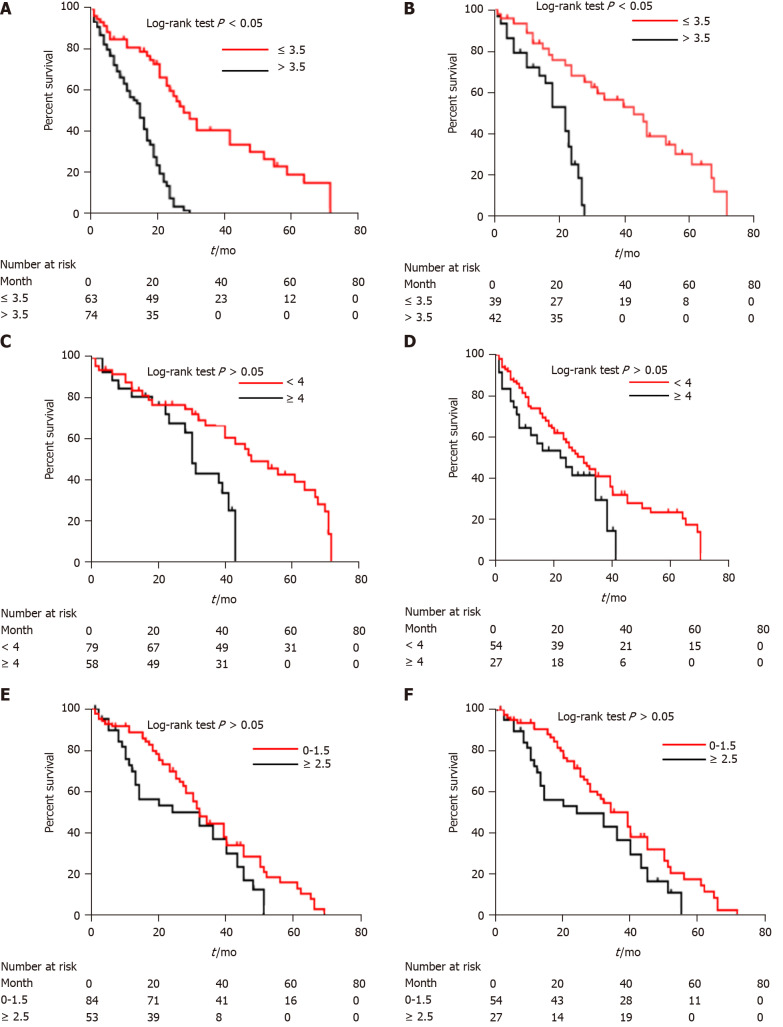
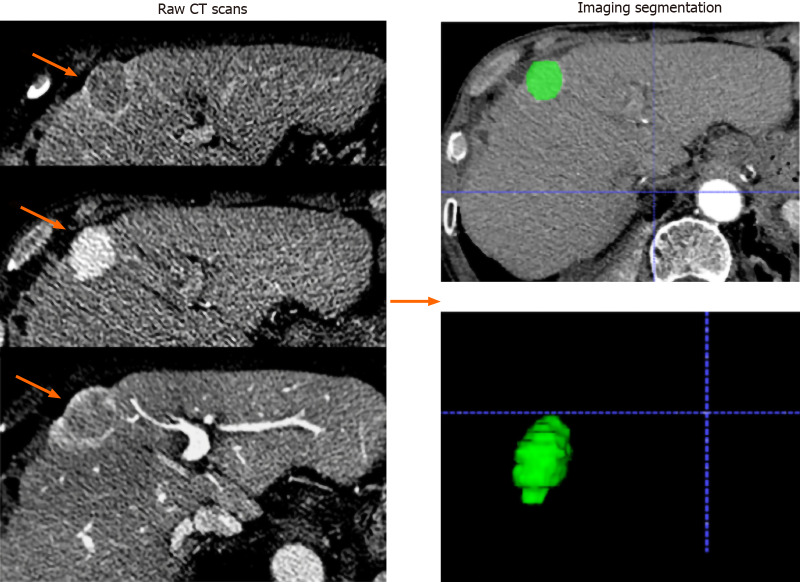
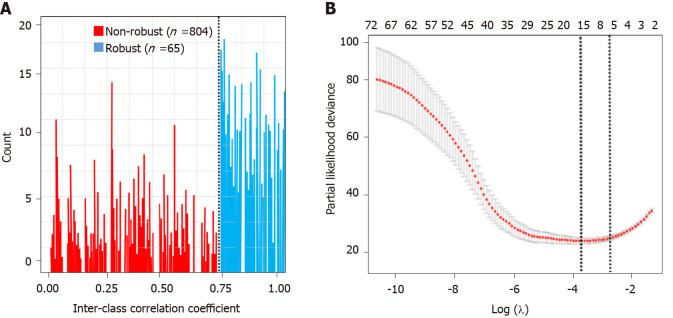
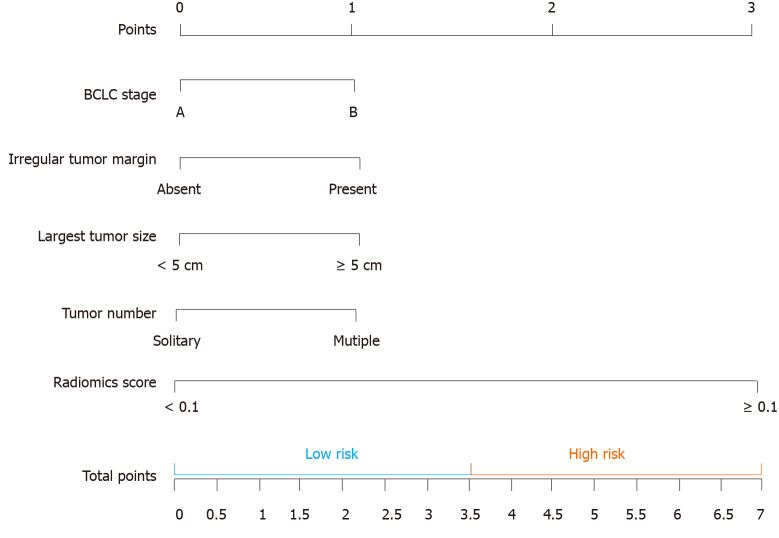
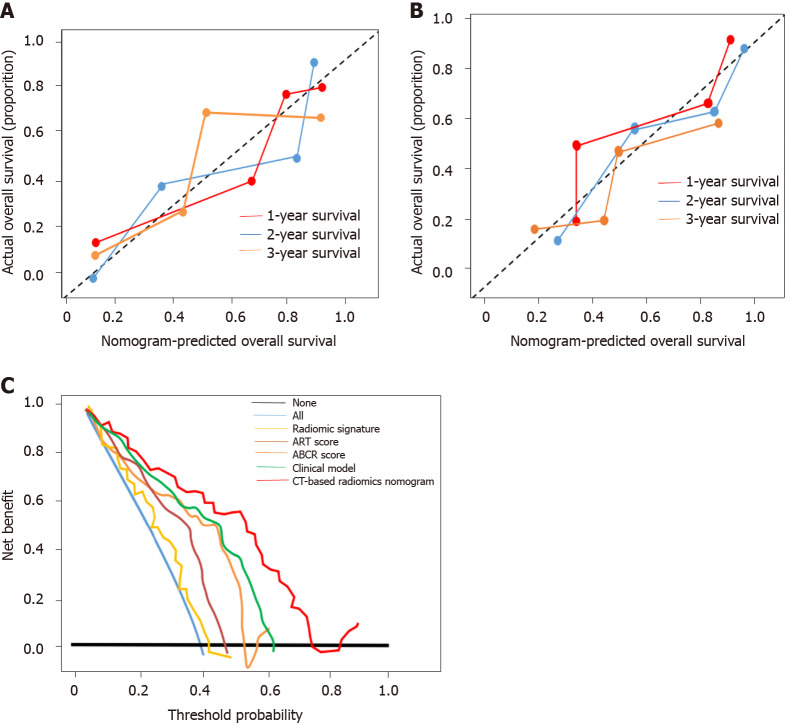
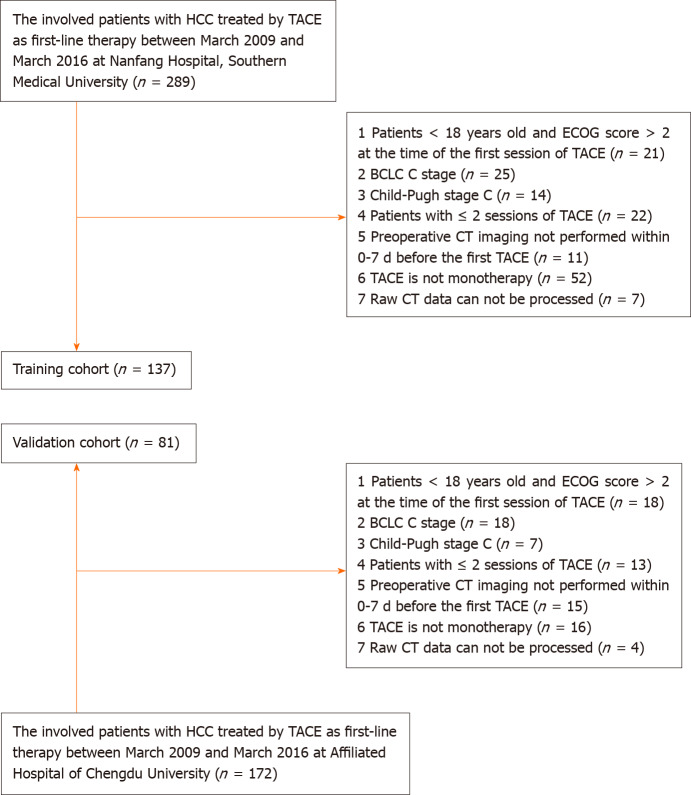
This retrospective study consisted of a training dataset ( = 137) and an external validation dataset ( = 81) of patients with clinically/pathologically confirmed HCC who underwent repeated TACE from March 2009 to March 2016. Radiomics features were retrospectively extracted from preoperative CT images of the arterial phase. The pre-treatment radiomics signature was generated using least absolute shrinkage and selection operator Cox regression analysis. A CT-based radiomics nomogram incorporating clinical risk factors and the radiomics signature was built and verified by calibration curve and decision curve analyses. The usefulness of the CT-based radiomics nomogram was assessed by Kaplan-Meier curve analysis. We used the concordance index to conduct head-to-head comparisons of the radiomics nomogram with the other four models (Assessment for Retreatment with Transarterial Chemoembolization score; α-fetoprotein, Barcelona Clinic Liver Cancer, Child-Pugh, and Response score; CT-based radiomics signature; and clinical model). All analyses were conducted according to the transparent reporting of a multivariable prediction model for individual prognosis or diagnosis statement.
The median duration of follow-up was 61.3 mo (interquartile range, 25.5-69.3 mo) for the training cohort and 67.1 mo (interquartile range, 32.4-71.3 mo) for the validation cohort. The median number of TACE sessions was 4 (range, 3-7) in both cohorts. Eight radiomics features were chosen from 869 candidate features to build a radiomics signature. The CT-based radiomics nomogram included the radiomics score (hazard ratio = 3.9, 95% confidence interval: 3.1-8.8, < 0.001) and four clinical factors and classified patients into high-risk (score > 3.5) and low-risk (score ≤ 3.5) groups with markedly different prognoses (overall survival: 12.3 mo 23.6 mo, < 0.001). The accuracy of the nomogram was considerably higher than that of the other four models. The calibration curve and decision curve analyses verified the usefulness of the CT-based radiomics nomogram for clinical practice.
The newly constructed CT-based radiomics nomogram can be used for the pre-treatment prediction of TACE refractoriness, which may provide better guidance for decision making regarding further TACE treatment.
一些肝细胞癌(HCC)患者尽管接受了持续的经动脉化疗栓塞术(TACE),但仍更有可能经历疾病进展,这被称为TACE难治性。目前,尽管已经开发了一些模型/评分系统,但预测TACE难治性仍然很困难。目前,基于放射学的放射组学模型已成功应用于预测癌症患者的预后。
开发并验证一种基于计算机断层扫描(CT)的放射组学列线图,用于TACE难治性的治疗前预测。
这项回顾性研究包括一个训练数据集(n = 137)和一个外部验证数据集(n = 81),这些患者均为临床/病理确诊的HCC患者,于2009年3月至2016年3月接受了多次TACE治疗。从动脉期术前CT图像中回顾性提取放射组学特征。使用最小绝对收缩和选择算子Cox回归分析生成治疗前放射组学特征。构建了一个包含临床危险因素和放射组学特征的基于CT的放射组学列线图,并通过校准曲线和决策曲线分析进行验证。通过Kaplan-Meier曲线分析评估基于CT的放射组学列线图的实用性。我们使用一致性指数对放射组学列线图与其他四个模型(经动脉化疗栓塞再治疗评估评分;甲胎蛋白-巴塞罗那临床肝癌-Child-Pugh-反应评分;基于CT的放射组学特征;以及临床模型)进行了直接比较。所有分析均根据个体预后或诊断声明的多变量预测模型的透明报告进行。
训练队列的中位随访时间为61.3个月(四分位间距,25.5 - 69.3个月),验证队列的中位随访时间为67.1个月(四分位间距,32.4 - 71.3个月)。两个队列中TACE治疗的中位次数均为4次(范围,3 - 7次)。从869个候选特征中选择了8个放射组学特征来构建放射组学特征。基于CT的放射组学列线图包括放射组学评分(风险比 = 3.9,95%置信区间:3.1 - 8.8,P < 0.001)和四个临床因素,并将患者分为预后明显不同的高风险(评分 > 3.5)和低风险(评分 ≤ 3.5)组(总生存期:12.3个月对23.6个月,P < 0.001)。列线图的准确性明显高于其他四个模型。校准曲线和决策曲线分析验证了基于CT的放射组学列线图在临床实践中的实用性。
新构建的基于CT的放射组学列线图可用于TACE难治性的治疗前预测,这可能为进一步TACE治疗的决策提供更好的指导。