McGarry Trudy, Hanlon Megan M, Marzaioli Viviana, Cunningham Clare C, Krishna Vinod, Murray Kieran, Hurson Conor, Gallagher Phil, Nagpal Sunil, Veale Douglas J, Fearon Ursula
Molecular Rheumatology Trinity Biomedical Sciences Institute Trinity College Dublin Dublin Ireland.
EULAR Centre of Excellence for Rheumatology Centre for Arthritis and Rheumatic Diseases St Vincent's University Hospital University College Dublin Dublin Ireland.
Clin Transl Immunology. 2021 Jan 19;10(1):e1237. doi: 10.1002/cti2.1237. eCollection 2021.
This study investigates the metabolic activity of circulating monocytes and their impact on pro-inflammatory responses in RA and explores whether this phenotype is already primed for inflammation before clinical manifestations of disease.
Blood was collected and CD14 monocytes isolated from healthy control donors (HC), individuals at-risk (IAR) and RA patients. Monocyte frequency in blood and synovial tissue was assessed by flow cytometry. Inflammatory responses and metabolic analysis ± specific inhibitors were quantified by RT-PCR, Western blot, migration assays, Seahorse-XFe-technology, mitotracker assays and transmission electron microscopy. Transcriptomic analysis was performed on HC, IAR and RA synovial tissue.
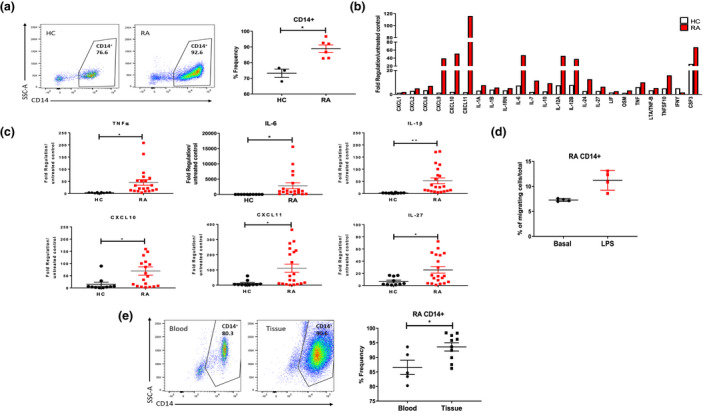
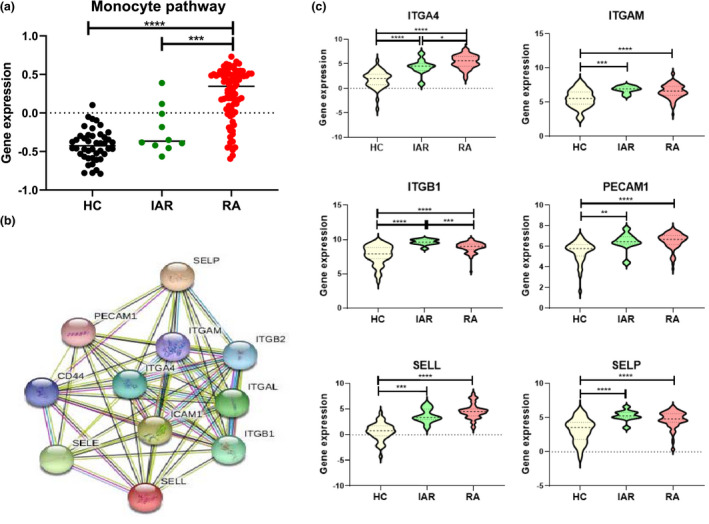
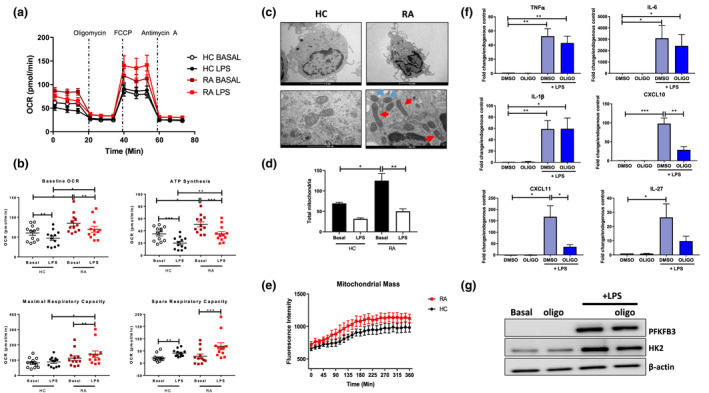
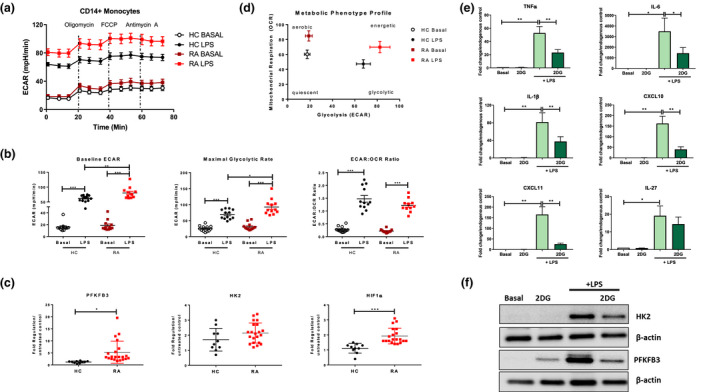
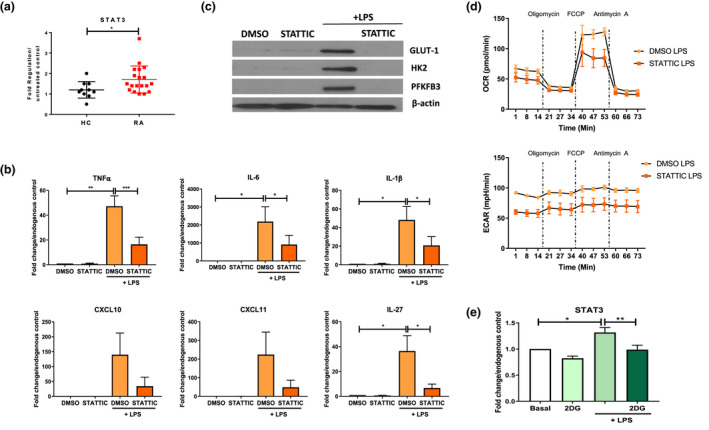
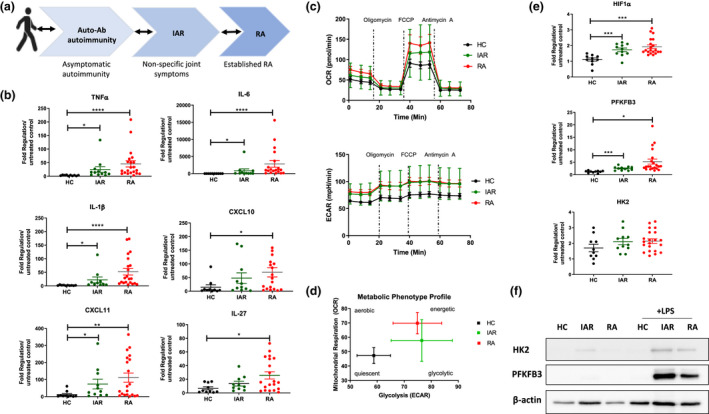
CD14 monocytes from RA patients are hyper-inflammatory following stimulation, with significantly higher expression of cytokines/chemokines than those from HC. LPS-induced RA monocyte migratory capacity is consistent with increased monocyte frequency in RA synovial tissue. RA CD14 monocytes show enhanced mitochondrial respiration, biogenesis and alterations in mitochondrial morphology. Furthermore, RA monocytes display increased levels of key glycolytic enzymes HIF1α, HK2 and PFKFB3 and demonstrate a reliance on glucose consumption, blockade of which abrogates pro-inflammatory mediator responses. Blockade of STAT3 activation inhibits this forced glycolytic flux resulting in metabolic reprogramming and resolution of inflammation. Interestingly, this highly activated monocytic phenotype is evident in IAR of developing disease, in addition to an enhanced monocyte gene signature observed in synovial tissue from IAR.
RA CD14 monocytes are metabolically re-programmed for sustained induction of pro-inflammatory responses, with STAT3 identified as a molecular regulator of metabolic dysfunction. This phenotype precedes clinical disease onset and may represent a potential pathway for therapeutic targeting early in disease.
本研究调查循环单核细胞的代谢活性及其对类风湿关节炎(RA)促炎反应的影响,并探讨这种表型在疾病临床表现出现之前是否已为炎症做好准备。
采集健康对照供体(HC)、疾病高危个体(IAR)和RA患者的血液,并分离出CD14单核细胞。通过流式细胞术评估血液和滑膜组织中的单核细胞频率。采用逆转录聚合酶链反应(RT-PCR)、蛋白质免疫印迹法、迁移试验、海马XFe技术、线粒体追踪试验和透射电子显微镜对炎症反应和代谢分析(±特异性抑制剂)进行定量。对HC、IAR和RA滑膜组织进行转录组分析。
RA患者的CD14单核细胞在受到刺激后具有高炎症性,细胞因子/趋化因子的表达明显高于HC患者的。脂多糖(LPS)诱导的RA单核细胞迁移能力与RA滑膜组织中单核细胞频率增加一致。RA CD14单核细胞显示线粒体呼吸、生物发生增强以及线粒体形态改变。此外,RA单核细胞中关键糖酵解酶HIF1α、HK2和PFKFB3的水平升高,并表现出对葡萄糖消耗的依赖性,阻断葡萄糖消耗可消除促炎介质反应。阻断信号转导和转录激活因子3(STAT3)激活可抑制这种强制性糖酵解通量,导致代谢重编程和炎症消退。有趣的是,这种高度活化的单核细胞表型在疾病发展的IAR中很明显,此外在IAR的滑膜组织中观察到单核细胞基因特征增强。
RA CD14单核细胞在代谢上被重新编程以持续诱导促炎反应,STAT3被确定为代谢功能障碍的分子调节因子。这种表型在临床疾病发作之前就已出现,可能代表疾病早期治疗靶点的潜在途径。