Furukawa Satomi, Hirano Rie, Sugawara Ai, Fujimura Satoshi, Tanaka Rica
Division of Regenerative Therapy, Juntendo University Graduate School of Medicine, Tokyo, Japan.
Center for Genomic and Regenerative Medicine, Juntendo University Graduate School of Medicine, Tokyo, Japan.
J Plast Reconstr Surg. 2024 May 10;3(4):157-164. doi: 10.53045/jprs.2022-0050. eCollection 2024 Oct 27.
The number and quality of endothelial progenitor cells decrease in patients with connective tissue diseases. This limits the efficacy of mononuclear cell therapy for ischemic ulcers associated with connective tissue diseases. To overcome these problems, we developed a serum-free quality and quantity control culture method that potentially improves the function of endothelial progenitor cells and expands their numbers. Here, we show the effect of quality and quantity control culture on mononuclear cells from patients with connective tissue diseases.
Peripheral blood mononuclear cells were isolated from C57BL/6JJmsSlc- mice with systemic lupus erythematosus, patients with connective tissue diseases, and healthy volunteers. Mononuclear cells were cultured using the quality and quantity control culture method, and the number of endothelial progenitor cells was analyzed using flow cytometry, an endothelial progenitor cell culture assay, and an endothelial progenitor cell colony-forming assay. Flow cytometry was also used to examine mononuclear cell subpopulations. A human umbilical vein endothelial cell tube-forming assay was used to examine the function of quality and quantity control cultured mononuclear cells.
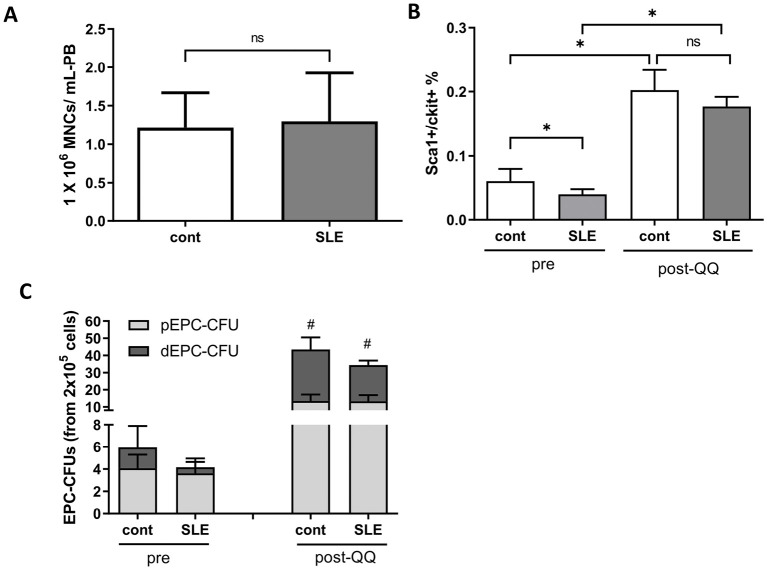
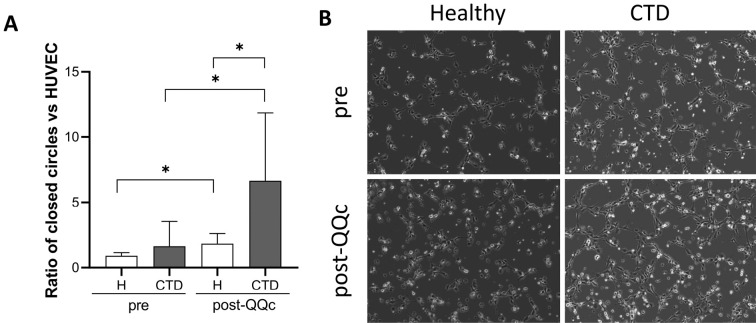
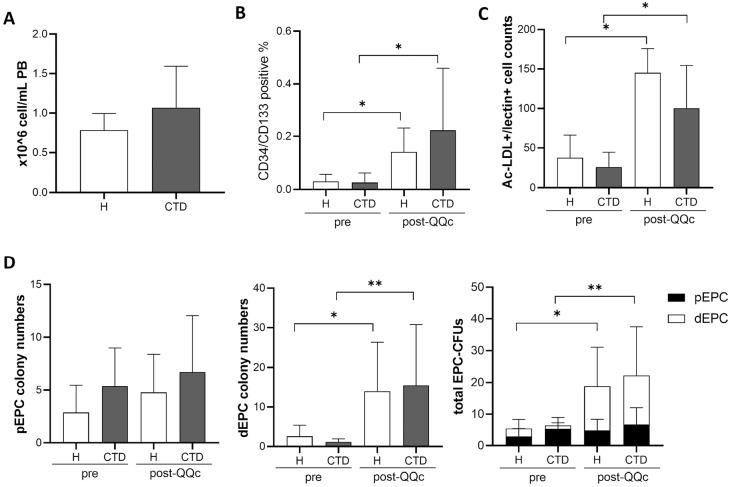
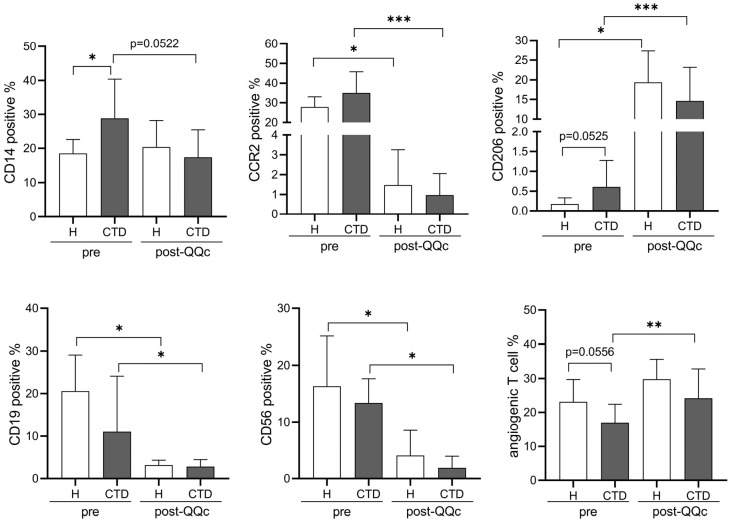
Mice with systemic lupus erythematosus showed a significantly lower number of endothelial progenitor cells, which increased to the same levels as those of the control mice after quality and quantity control culture. In humans, the numbers of endothelial progenitor cells and M2 macrophages were significantly increased and the number of proinflammatory cells was decreased after quality and quantity control culture in both healthy volunteers and patients with connective tissue diseases. The human umbilical vein endothelial cell tube formation assay showed higher angiogenic potential in quality and quantity control cultured mononuclear cells from patients with connective tissue diseases than that in quality and quantity control cultured mononuclear cells from healthy controls.
Our study suggests that the quality and quantity control culture method is effective in recovering the angiogenic ability of mononuclear cells from patients with connective tissue diseases.
结缔组织病患者体内内皮祖细胞的数量和质量会下降。这限制了单核细胞疗法对结缔组织病相关缺血性溃疡的疗效。为克服这些问题,我们开发了一种无血清的质量和数量控制培养方法,该方法有可能改善内皮祖细胞的功能并增加其数量。在此,我们展示了质量和数量控制培养对结缔组织病患者单核细胞的影响。
从患有系统性红斑狼疮的C57BL/6JJmsSlc-小鼠、结缔组织病患者和健康志愿者中分离外周血单核细胞。使用质量和数量控制培养方法培养单核细胞,并通过流式细胞术、内皮祖细胞培养测定法和内皮祖细胞集落形成测定法分析内皮祖细胞的数量。流式细胞术还用于检测单核细胞亚群。使用人脐静脉内皮细胞管形成测定法检测质量和数量控制培养的单核细胞的功能。
患有系统性红斑狼疮的小鼠内皮祖细胞数量显著降低,经过质量和数量控制培养后增加到与对照小鼠相同的水平。在人类中,健康志愿者和结缔组织病患者经过质量和数量控制培养后,内皮祖细胞和M2巨噬细胞的数量均显著增加,促炎细胞数量减少。人脐静脉内皮细胞管形成测定显示,结缔组织病患者经质量和数量控制培养的单核细胞比健康对照经质量和数量控制培养的单核细胞具有更高的血管生成潜力。
我们的研究表明,质量和数量控制培养方法可有效恢复结缔组织病患者单核细胞的血管生成能力。