Rashnonejad Afrooz, Amini-Chermahini Gholamhossein, Taylor Noah K, Wein Nicolas, Harper Scott Q
Center for Gene Therapy, The Abigail Wexner Research Institute at Nationwide Children's Hospital, 700 Children's Drive, Columbus, OH 43205, USA.
Department of Pediatrics, The Ohio State University, Columbus, OH, USA.
Mol Ther Nucleic Acids. 2020 Dec 10;23:476-486. doi: 10.1016/j.omtn.2020.12.004. eCollection 2021 Mar 5.
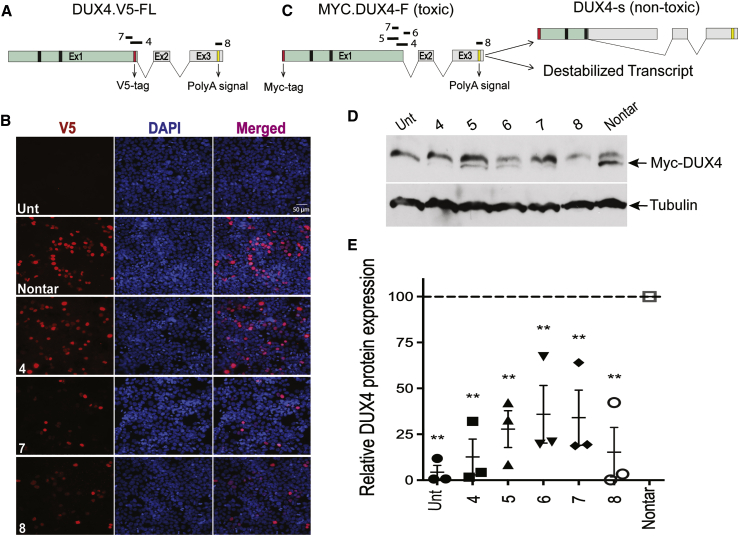
Facioscapulohumeral muscular dystrophy (FSHD) arises from epigenetic changes that de-repress the gene in muscle. The full-length DUX4 protein causes cell death and muscle toxicity, and therefore we hypothesize that FSHD therapies should center on inhibiting full-length expression. In this study, we developed a strategy to accomplish inhibition using U7-small nuclear RNA (snRNA) antisense expression cassettes (called U7-asDUX4). These non-coding RNAs were designed to inhibit production or maturation of the full-length pre-mRNA by masking the start codon, splice sites, or polyadenylation signal. In so doing, U7-asDUX4 snRNAs operate similarly to antisense oligonucleotides. However, in contrast to oligonucleotides, which are limited by poor uptake in muscle and a requirement for lifelong repeated dosing, U7-asDUX4 snRNAs can be packaged within myotropic gene therapy vectors and may require only a single administration when delivered to post-mitotic cells . We tested several U7-asDUX4s that reduced expression and improved DUX4-associated outcomes. Inhibition of expression via U7-snRNAs could be a new prospective gene therapy approach for FSHD or be used in combination with other strategies, like RNAi therapy, to maximize silencing in individuals with FSHD.
面肩肱型肌营养不良症(FSHD)源于肌肉中基因的表观遗传变化,这种变化会使基因去抑制。全长DUX4蛋白会导致细胞死亡和肌肉毒性,因此我们推测FSHD的治疗应以抑制全长DUX4的表达为核心。在本研究中,我们开发了一种策略,利用U7小核RNA(snRNA)反义表达盒(称为U7-asDUX4)来实现对DUX4的抑制。这些非编码RNA旨在通过掩盖DUX4起始密码子、剪接位点或聚腺苷酸化信号来抑制全长DUX4前体mRNA的产生或成熟。通过这种方式,U7-asDUX4 snRNAs的作用类似于反义寡核苷酸。然而,与寡核苷酸不同的是,寡核苷酸在肌肉中的摄取较差且需要终身重复给药,而U7-asDUX4 snRNAs可以包装在亲肌基因治疗载体中,并且在递送至有丝分裂后细胞时可能仅需单次给药。我们测试了几种能降低DUX4表达并改善与DUX4相关结果的U7-asDUX4。通过U7-snRNAs抑制DUX4表达可能是一种用于FSHD的新的前瞻性基因治疗方法,或者可与其他策略(如RNAi疗法)联合使用,以在FSHD患者中最大程度地实现DUX4沉默。