"L. Spallanzani" National Institute for Infection Diseases, IRCCS, Rome, Italy.
PLoS One. 2021 Jan 29;16(1):e0245656. doi: 10.1371/journal.pone.0245656. eCollection 2021.
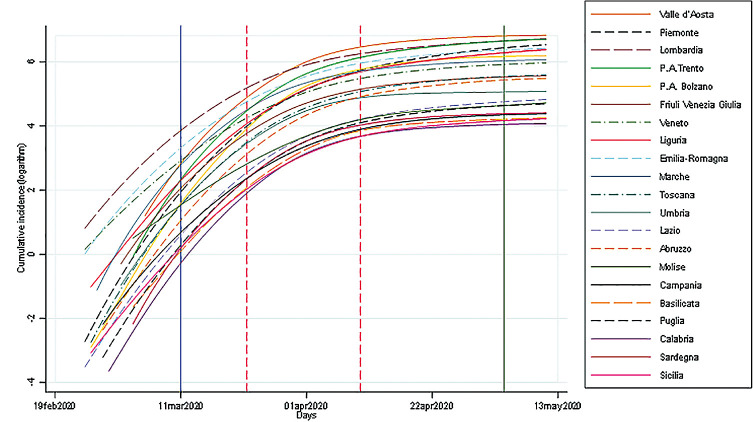
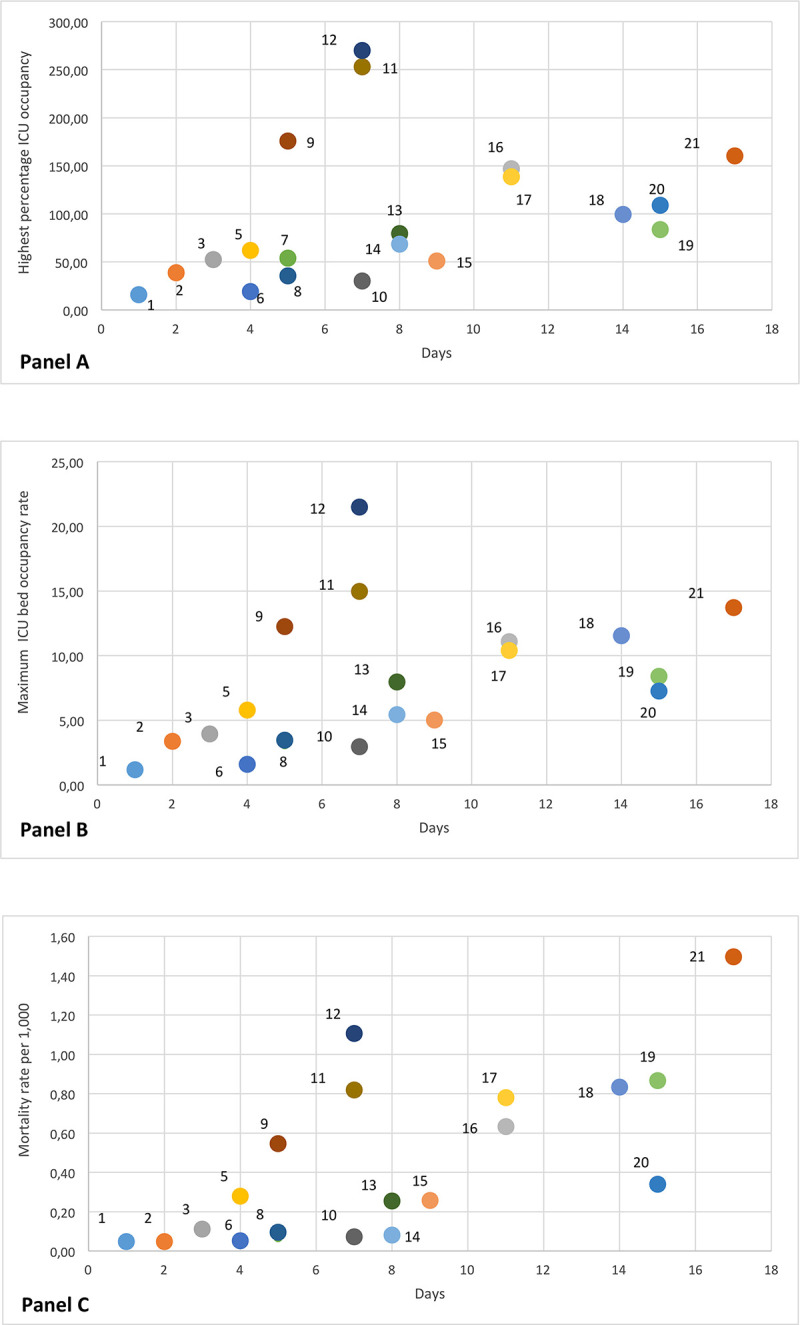
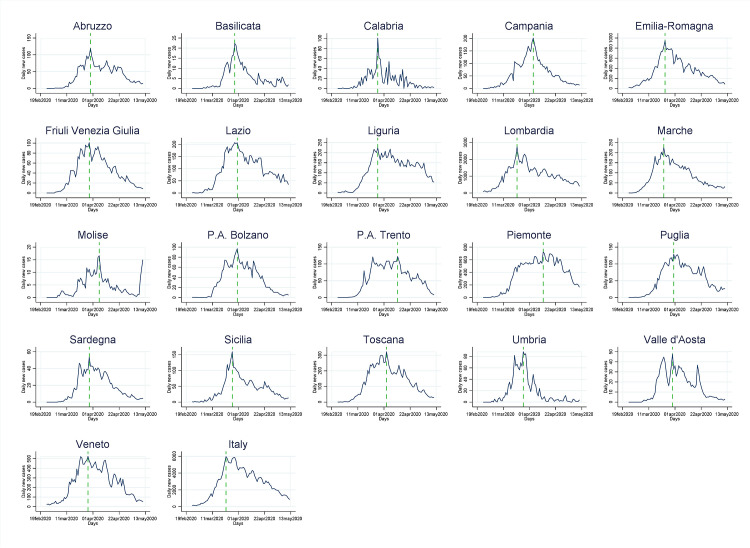
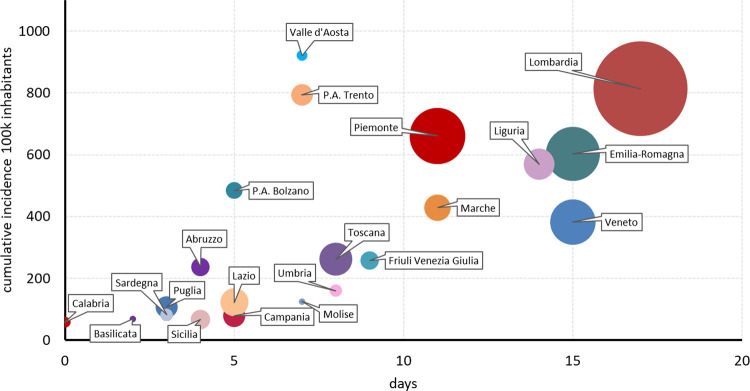
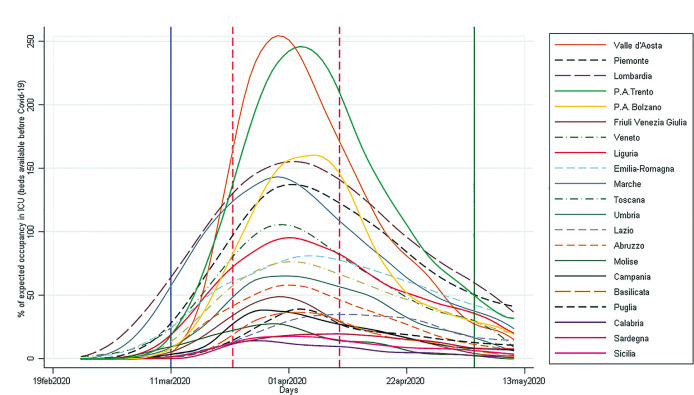
There is evidence that adoption of non-pharmaceutical containment measures (NPMs) may have had a major impact on Covid-19 epidemic dynamics, and mitigated its effect on healthcare system. Optimal timing of implementation of these measures however is not known. In Italy, a national lockdown was decided on March 11th 2020 and ended 4th of May. At that time, cumulative incidence (CI) was different in Italian regions which ranged from <5 cases/100,000 to >11 cases/100,000 inhabitants. In this paper, we aim to evaluate how level of incidence in different regions at the time of implementation of NPMs affected CI and had an impact on the healthcare system in terms of ICU bed occupancy and mortality rates. We used regional daily new COVID-19 diagnosed cases as well number of people hospitalized in ICU and number of deaths for period February 24-May 11 from all the 19 Italian regions and two autonomous provinces. For each region we calculated: temporal daily trend of cumulative cases of Covid-19/100,000 inhabitants, daily trend of ICU bed occupancy and mortality rate at the end of period. We found that the epidemic curves show similar trends for all regions and all tend to flatten between 11-32 days. However, after 2 months, regions with lower CI at lockdown remained at substantially lower CI (<265 cases/100,000), had a peak of percentage of cases hospitalized in ICU which did not exceed 79.4% and a mortality<0.27/1,000. On the other hand, in regions with higher incidence at lockdown, CI reached 382-921 cases/100,000, the peak of percentage of cases hospitalized in ICU and mortality rate reached 270%, and 1.5/1,000, respectively. Our data suggests that level of CI at the moment of lockdown is important to control the subsequent spread of infection so NPMs should be adopted very early during the course of Covid-19 epidemic, in order to mitigate the impact on the healthcare system and to reduce related mortality.
有证据表明,非药物干预措施(NPMs)的采用可能对 COVID-19 疫情动态产生重大影响,并减轻其对医疗系统的影响。然而,这些措施的最佳实施时间尚不清楚。在意大利,国家封锁于 2020 年 3 月 11 日决定,并于 5 月 4 日结束。当时,意大利各地区的累计发病率(CI)不同,范围从<5 例/10 万至>11 例/10 万居民。在本文中,我们旨在评估 NPMs 实施时不同地区的发病率水平如何影响 CI,并对 ICU 床位占用率和死亡率方面的医疗系统产生影响。我们使用了意大利 19 个地区和两个自治区的每日新增 COVID-19 确诊病例以及 ICU 住院人数和死亡人数。对于每个地区,我们计算了:2 月 24 日至 5 月 11 日期间每 10 万居民 COVID-19 累计病例的时间趋势、ICU 床位占用率和期末死亡率的每日趋势。我们发现,所有地区的疫情曲线均显示出相似的趋势,并且所有地区都在 11-32 天之间趋于平稳。然而,2 个月后,封锁时 CI 较低的地区仍保持在较低的 CI(<265 例/100,000),ICU 住院病例比例的峰值不超过 79.4%,死亡率<0.27/1000。另一方面,封锁时发病率较高的地区,CI 达到 382-921 例/100,000,ICU 住院病例比例和死亡率的峰值分别达到 270%和 1.5/1000。我们的数据表明,封锁时的 CI 水平对于控制感染的后续传播很重要,因此,NPMs 应该在 COVID-19 疫情的早期阶段采用,以减轻对医疗系统的影响并降低相关死亡率。