Department of Psychiatry, University of Texas at Austin Dell Medical School, Austin, Texas.
New Mexico Veterans Affairs Healthcare System, Albuquerque, New Mexico.
Biol Psychiatry. 2021 May 1;89(9):857-867. doi: 10.1016/j.biopsych.2020.11.021. Epub 2020 Dec 8.
Exposure-based psychotherapy is a first-line treatment for posttraumatic stress disorder (PTSD), but its mechanisms are poorly understood. Functional brain connectivity is a promising metric for identifying treatment mechanisms and biosignatures of therapeutic response. To this end, we assessed amygdala and insula treatment-related connectivity changes and their relationship to PTSD symptom improvements.
Individuals with a primary PTSD diagnosis (N = 66) participated in a randomized clinical trial of prolonged exposure therapy (n = 36) versus treatment waiting list (n = 30). Task-free functional magnetic resonance imaging was completed prior to randomization and 1 month following cessation of treatment/waiting list. Whole-brain blood oxygenation level-dependent responses were acquired. Intrinsic connectivity was assessed by subregion in the amygdala and insula, limbic structures key to the disorder pathophysiology. Dynamic causal modeling assessed evidence for effective connectivity changes in select nodes informed by intrinsic connectivity findings.
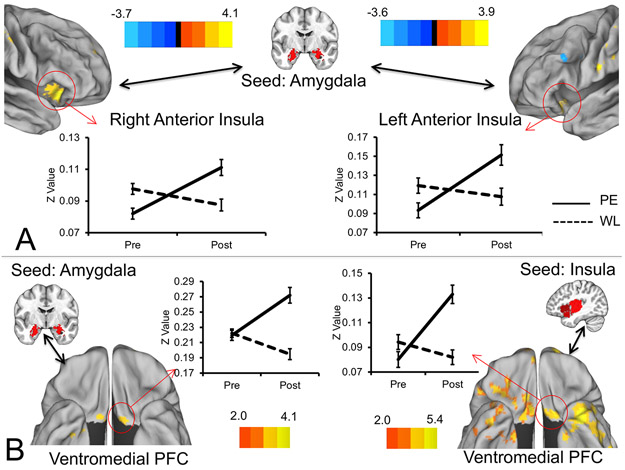
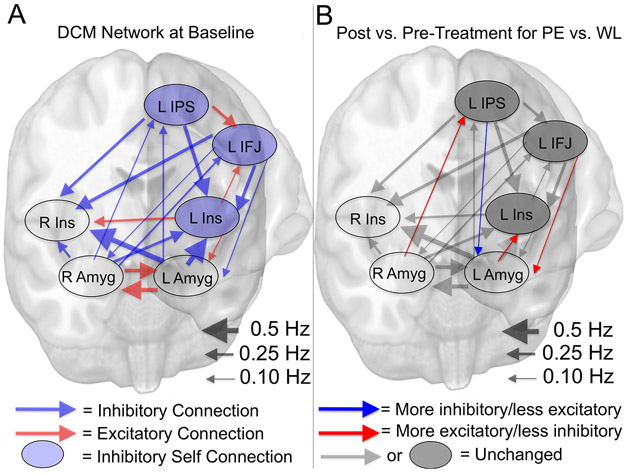
The amygdala and insula displayed widespread patterns of primarily subregion-uniform intrinsic connectivity change, including increased connectivity between the amygdala and insula; increased connectivity of both regions with the ventral prefrontal cortex and frontopolar and sensory cortices; and decreased connectivity of both regions with the left frontoparietal nodes of the executive control network. Larger decreases in amygdala-frontal connectivity and insula-parietal connectivity were associated with larger PTSD symptom reductions. Dynamic causal modeling evidence suggested that treatment decreased left frontal inhibition of the left amygdala, and larger decreases were associated with larger symptom reductions.
PTSD psychotherapy adaptively attenuates functional interactions between frontoparietal and limbic brain circuitry at rest, which may reflect a potential mechanism or biosignature of recovery.
暴露疗法是创伤后应激障碍(PTSD)的一线治疗方法,但其机制尚不清楚。功能脑连接是识别治疗机制和治疗反应生物标志物的有前途的指标。为此,我们评估了杏仁核和岛叶治疗相关的连接变化及其与 PTSD 症状改善的关系。
有原发性 PTSD 诊断的个体(N=66)参加了一项延长暴露疗法(n=36)与治疗等待名单(n=30)的随机临床试验。在随机分组前和治疗/等待名单结束后 1 个月完成了无任务功能磁共振成像。采集全脑血氧水平依赖反应。通过杏仁核和岛叶的亚区评估内在连接,这些结构是疾病病理生理学的关键。动态因果建模评估了基于内在连接发现的选择节点有效连接变化的证据。
杏仁核和岛叶显示出广泛的主要亚区均匀内在连接变化模式,包括杏仁核和岛叶之间的连接增加;两个区域与腹侧前额叶皮层和额极和感觉皮层的连接增加;两个区域与执行控制网络的左额顶节点的连接减少。杏仁核-前额叶连接和岛叶-顶叶连接的更大减少与 PTSD 症状的更大减少相关。动态因果建模证据表明,治疗降低了左杏仁核对左额叶的抑制,更大的减少与更大的症状减轻相关。
PTSD 心理治疗在休息时适应性地减弱了额顶叶和边缘大脑回路之间的功能相互作用,这可能反映了恢复的潜在机制或生物标志物。