Faculty of Epidemiology and Population Health, London School of Hygiene and Tropical Medicine, London, United Kingdom; Centre for Longitudinal Studies, University College London Social Research Institute, University College London, London, United Kingdom.
Faculty of Epidemiology and Population Health, London School of Hygiene and Tropical Medicine, London, United Kingdom.
J Allergy Clin Immunol. 2021 May;147(5):1753-1763. doi: 10.1016/j.jaci.2020.12.001. Epub 2021 Jan 27.
Atopic eczema affects up to 10% of adults and is becoming more common globally. Few studies have assessed whether atopic eczema increases the risk of death.
We aimed to determine whether adults with atopic eczema were at increased risk of death overall and by specific causes and to assess whether the risk varied by atopic eczema severity and activity.
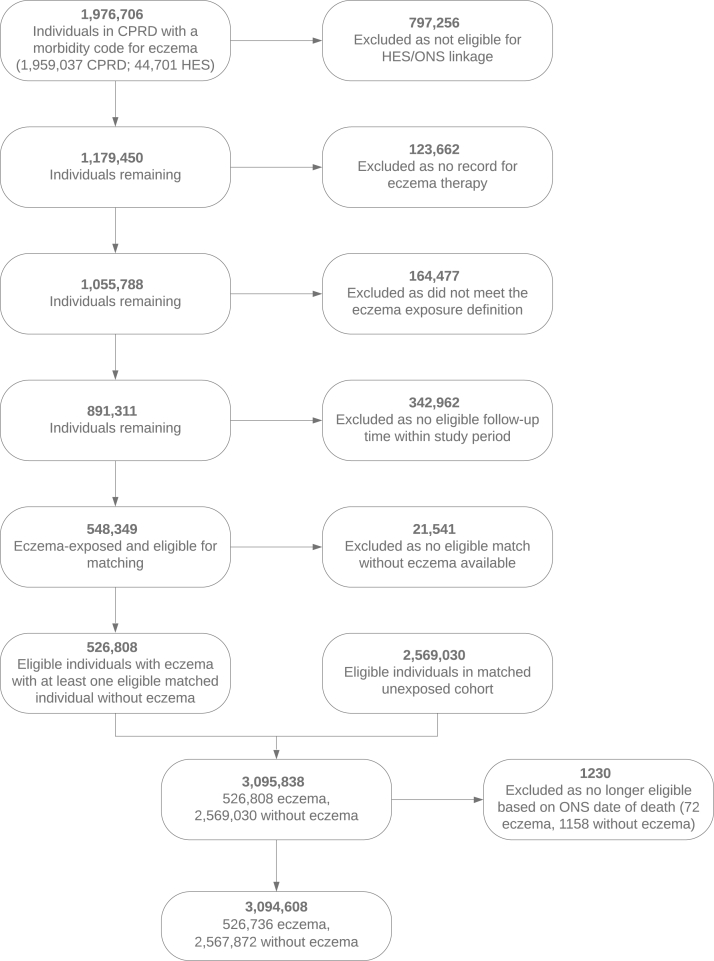
The study was a population-based matched cohort study using UK primary care electronic health care records from the Clinical Practice Research Datalink with linked hospitalization data from Hospital Episode Statistics and mortality data from the Office for National Statistics from 1998 to 2016.
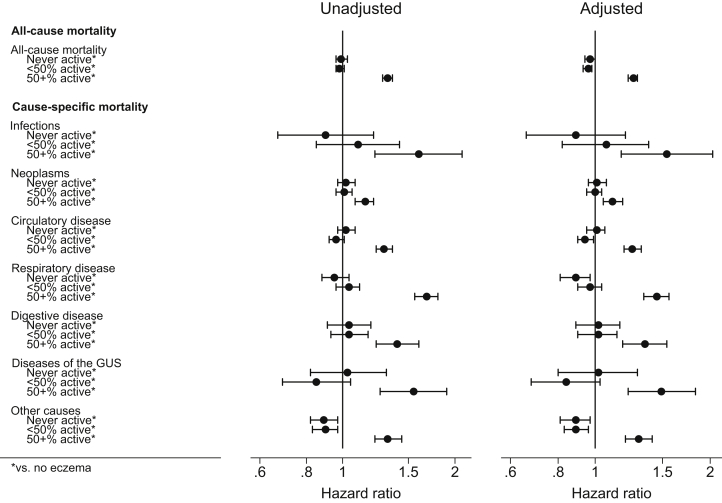
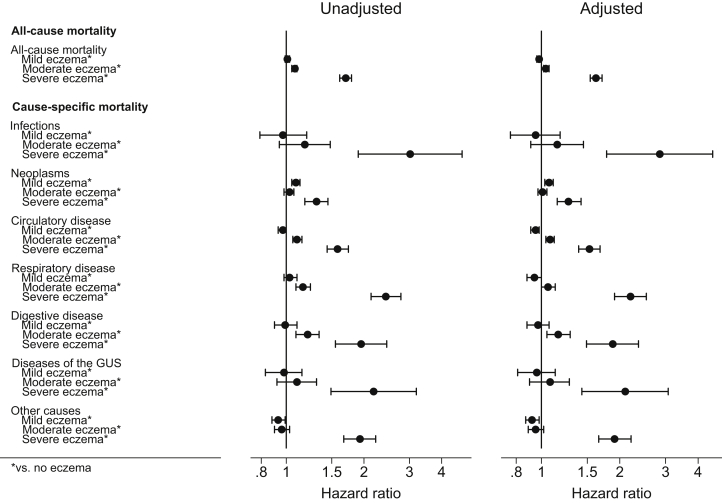
A total of 526,736 patients with atopic eczema were matched to 2,567,872 individuals without atopic eczema. The median age at entry was 41.8 years, and the median follow-up time was 4.5 years. There was limited evidence of increased hazard for all-cause mortality in those with atopic eczema (hazard ratio = 1.04; 99% CI = 1.03-1.06), but there were somewhat stronger associations (8%-14% increased hazard) for deaths due to infectious, digestive, and genitourinary causes. Differences on the absolute scale were modest owing to low overall mortality rates. Mortality risk increased markedly with eczema severity and activity. For example, patients with severe atopic eczema had a 62% increased hazard (hazard ratio = 1.62; 99% CI = 1.54-1.71) for mortality compared with those without eczema, with the strongest associations for infectious, respiratory, and genitourinary causes.
The increased hazards for all-cause and cause-specific mortality were largely restricted to those with the most severe or predominantly active atopic eczema. Understanding the reasons for these increased hazards for mortality is an urgent priority.
特应性皮炎影响多达 10%的成年人,且在全球范围内变得更为普遍。鲜有研究评估特应性皮炎是否会增加死亡风险。
我们旨在确定特应性皮炎患者的总体死亡风险是否增加,以及是否因具体病因而增加,并评估该风险是否因特应性皮炎的严重程度和活动程度而异。
这是一项基于人群的匹配队列研究,使用了英国临床实践研究数据链中的初级保健电子健康记录,并与医院事件统计数据中的住院数据以及国家统计局中的死亡率数据相链接,研究时间为 1998 年至 2016 年。
共纳入了 526736 例特应性皮炎患者,并与 2567872 例无特应性皮炎的患者相匹配。入组时的中位年龄为 41.8 岁,中位随访时间为 4.5 年。有有限的证据表明特应性皮炎患者的全因死亡率增加(风险比=1.04;99%置信区间为 1.03-1.06),但与传染性、消化系统和泌尿生殖系统病因相关的死亡率增加幅度更大(增加 8%-14%的风险)。由于整体死亡率较低,绝对规模上的差异较小。死亡率风险随湿疹严重程度和活动度的增加而显著增加。例如,与无湿疹患者相比,严重特应性皮炎患者的死亡率增加了 62%(风险比=1.62;99%置信区间为 1.54-1.71),与传染性、呼吸道和泌尿生殖系统病因的相关性最强。
全因和特定病因死亡率的增加风险主要局限于最严重或主要活跃的特应性皮炎患者。了解这些死亡率增加风险的原因是当务之急。