Pandkar Prasad Dilip, Sachdeva Vinay
Department of Kriya Sharir (Ayurveda Physiology), Bharati Vidyapeeth Deemed University, College of Ayurveda, Pune, India.
Department of Kriya Sharir (Ayurveda Physiology), Bharati Vidyapeeth Deemed University, College of Ayurveda, Pune, India.
J Ayurveda Integr Med. 2022 Jan-Mar;13(1):100380. doi: 10.1016/j.jaim.2020.11.010. Epub 2020 Dec 2.
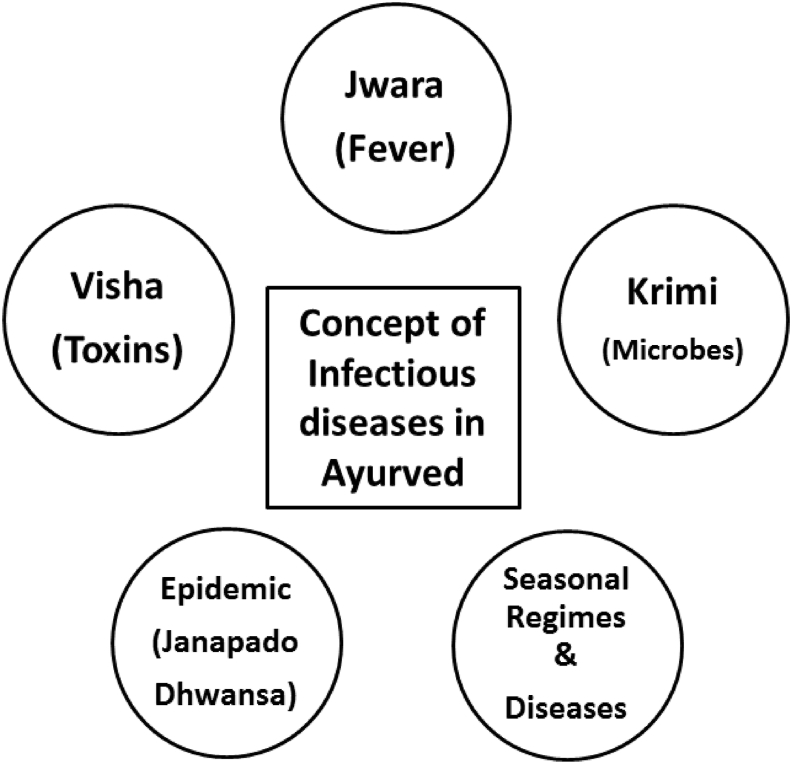
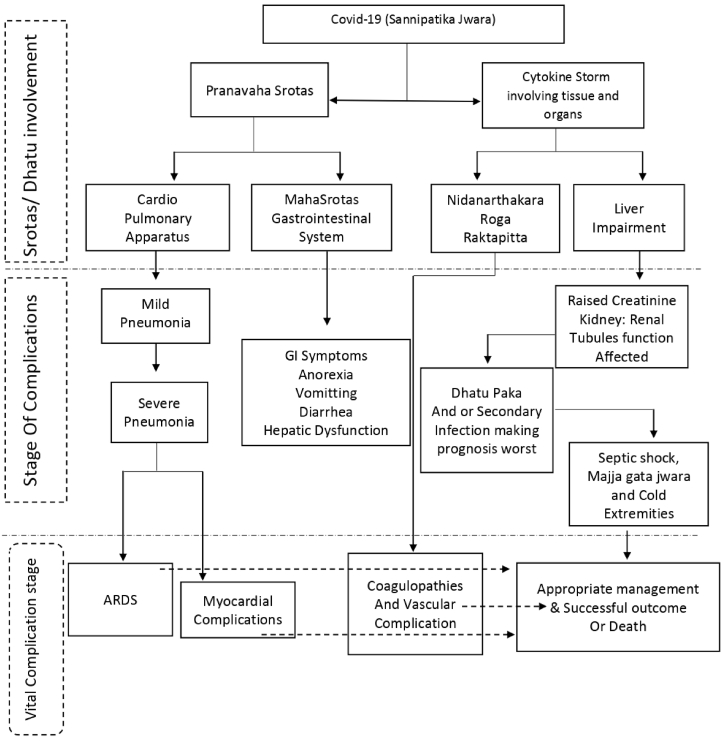
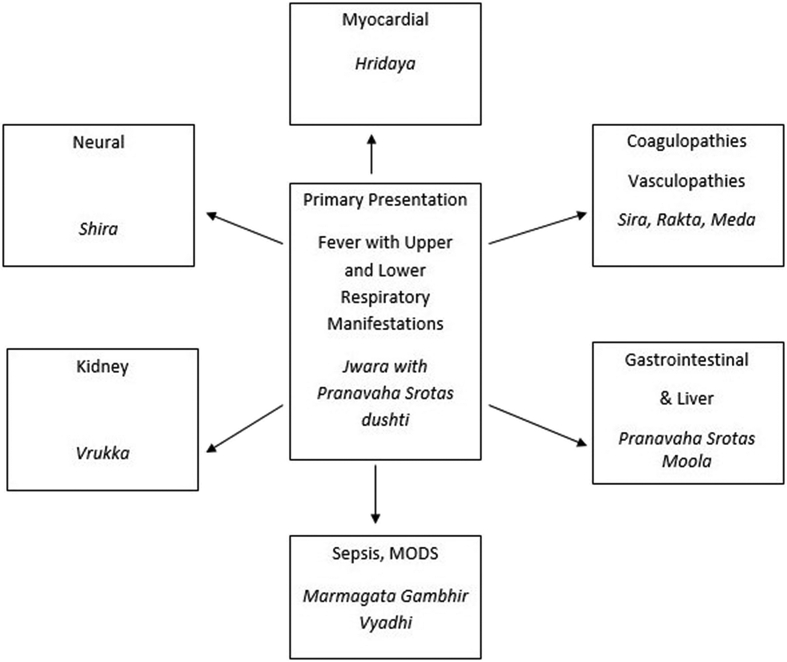
The world is facing a global crisis and health emergency of COVID-19. Understanding of COVID-19 pathophysiology in ayurvedic host centric framework is prerequisite for apt use of . This paper reviews COVID-19 pathophysiology, clinical presentations and prognosis in ayurvedic perspective. Concept of exogenous pathogenic diseases can be traced in fever, microbes, toxins, epidemics and seasonal regimens chapters of Such exogenous diseases later manifest multi-system presentation according to involvement of different ' and derangement of '. The pathology of COVID-19 is primarily that of (fever) with involvement of respiratory system. Secondary manifestations include coagulopathies, cardiovascular, neural, and renal complications. Gastrointestinal system is closely associated with respiratory mechanism in pathophysiological conceptualization of . Abnormal immune responses in COVID-19 are result of abnormalities of , (blood) and (Vital nectar). The initial phase is dominant whereas later stage of aggravated immune response is dominant. Alveolar damage, coagulopathies indicate vitiation. With this integrative understanding of COVID-19, we propose novel strategies for therapeutics and prophylaxis. Measures for 'Conservation of , 'Attainment of homeostasis and 'Protection of i.e. vital organs' can be important Host based strategies for reduction in the mortality in COVID-19 and for better clinical outcomes. This host centric approach can make paradigm shift in management of this epidemic.
世界正面临着新冠病毒的全球危机和健康紧急情况。在阿育吠陀以宿主为中心的框架内理解新冠病毒的病理生理学是恰当使用[相关内容]的先决条件。本文从阿育吠陀的角度综述了新冠病毒的病理生理学、临床表现和预后。外感致病疾病的概念可在[相关典籍]的发热、微生物、毒素、流行病和季节养生章节中找到。此类外感疾病随后根据不同的“[相关概念1]”受累情况和“[相关概念2]”紊乱情况表现出多系统症状。新冠病毒的病理学主要是伴有呼吸系统受累的“[相关概念3]”(发热)。次要表现包括凝血功能障碍、心血管、神经和肾脏并发症。在阿育吠陀的病理生理学概念中,胃肠道系统与呼吸机制密切相关。新冠病毒中异常的免疫反应是“[相关概念4]”、“[相关概念5]”(血液)和“[相关概念6]”(生命之液)异常的结果。初始阶段以“[相关概念7]”为主导,而免疫反应加重的后期阶段以“[相关概念8]”为主导。肺泡损伤、凝血功能障碍表明“[相关概念9]”受损。基于对新冠病毒的这种综合理解,我们提出了治疗和预防的新策略。“保护‘[相关概念10]’”、“实现‘[相关概念11]’内环境稳定”和“保护‘[相关概念12]’即重要器官”的措施可能是基于宿主的重要策略,可降低新冠病毒的死亡率并获得更好的临床结果。这种以宿主为中心的方法可在该流行病的管理中带来范式转变。