Wan Mingyue, Ye Yu, Lin Huiying, Xu Ying, Liang Shengxiang, Xia Rui, He Jianquan, Qiu Pingting, Huang Chengwu, Tao Jing, Chen Lidian, Zheng Guohua
College of Nursing and Health Management, Shanghai University of Medicine and Health Sciences, Shanghai, China.
College of Rehabilitation Medicine, Fujian University of Traditional Chinese Medicine, Fuzhou, China.
Front Aging Neurosci. 2021 Jan 13;12:615852. doi: 10.3389/fnagi.2020.615852. eCollection 2020.
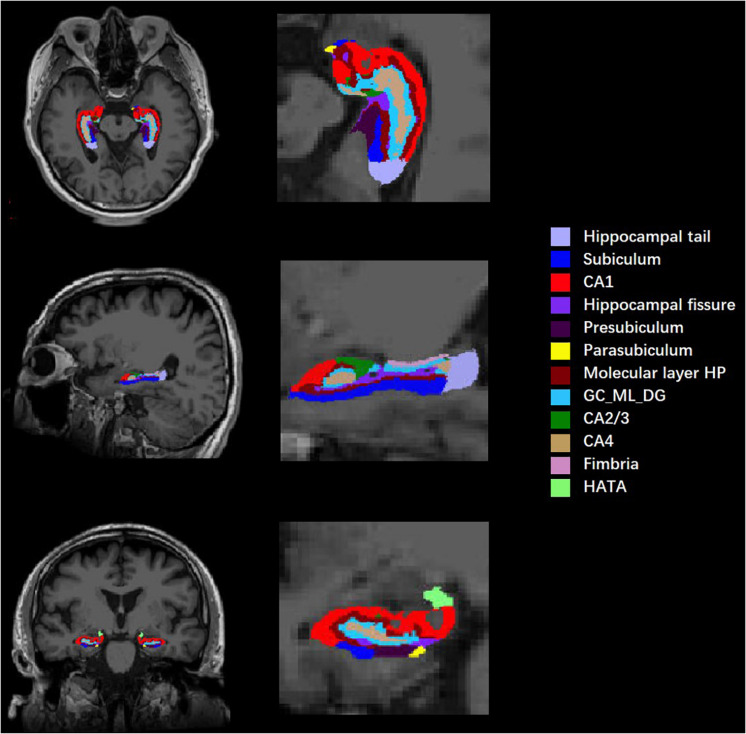
Cognitive frailty is a particular state of cognitive vulnerability toward dementia with neuropathological hallmarks. The hippocampus is a complex, heterogeneous structure closely relates to the cognitive impairment in elderly which is composed of 12 subregions. Atrophy of these subregions has been implicated in a variety of neurodegenerative diseases. The aim of this study was to explore the changes in hippocampal subregions in older adults with cognitive frailty and the relationship between subregions and cognitive impairment as well as physical frailty.
Twenty-six older adults with cognitive frailty and 26 matched healthy controls were included in this study. Cognitive function was evaluated by the Montreal Cognitive Assessment (MoCA) scale (Fuzhou version) and Wechsler Memory Scale-Revised Chinese version (WMS-RC), while physical frailty was tested with the Chinese version of the Edmonton Frailty Scale (EFS) and grip strength. The volume of the hippocampal subregions was measured with structural brain magnetic resonance imaging. Partial correlation analysis was carried out between the volumes of hippocampal subregions and MoCA scores, Wechsler's Memory Quotient and physical frailty indexes.
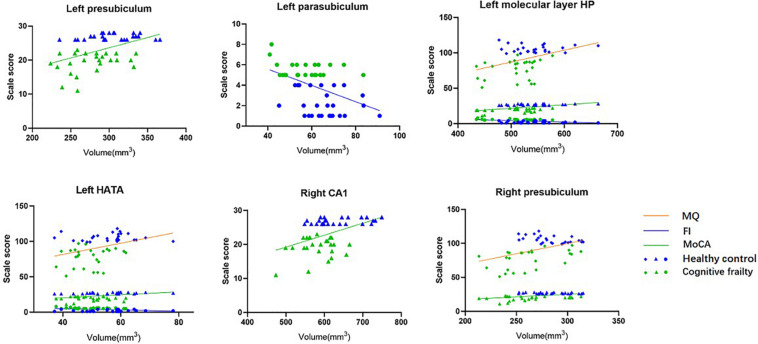
A significant volume decrease was found in six hippocampal subregions, including the bilateral presubiculum, the left parasubiculum, molecular layer of the hippocampus proper (molecular layer of the HP), and hippocampal amygdala transition area (HATA), and the right cornu ammonis subfield 1 (CA1) area, in older adults with cognitive frailty, while the proportion of brain parenchyma and total number of white matter fibers were lower than those in the healthy controls. Positive correlations were found between Wechsler's Memory Quotient and the size of the left molecular layer of the HP and HATA and the right presubiculum. The sizes of the left presubiculum, molecular of the layer HP, and HATA and right CA1 and presubiculum were found to be positively correlated with MoCA score. The sizes of the left parasubiculum, molecular layer of the HP and HATA were found to be negatively correlated with the physical frailty index.
Significant volume decrease occurs in hippocampal subregions of older adults with cognitive frailty, and these changes are correlated with cognitive impairment and physical frailty. Therefore, the atrophy of hippocampal subregions could participate in the pathological progression of cognitive frailty.
认知衰弱是一种对具有神经病理学特征的痴呆症具有认知易损性的特殊状态。海马体是一个复杂的异质结构,与老年人的认知障碍密切相关,它由12个亚区域组成。这些亚区域的萎缩与多种神经退行性疾病有关。本研究的目的是探讨认知衰弱老年人海马体亚区域的变化以及亚区域与认知障碍和身体衰弱之间的关系。
本研究纳入了26名认知衰弱的老年人和26名匹配的健康对照。通过蒙特利尔认知评估(MoCA)量表(福州版)和韦氏记忆量表修订中文版(WMS-RC)评估认知功能,同时用中文版埃德蒙顿衰弱量表(EFS)和握力测试身体衰弱情况。用结构性脑磁共振成像测量海马体亚区域的体积。对海马体亚区域的体积与MoCA评分、韦氏记忆商数和身体衰弱指数进行偏相关分析。
在认知衰弱的老年人中,发现六个海马体亚区域的体积显著减小,包括双侧前下托、左侧副下托、海马体固有分子层(HP分子层)、海马杏仁核过渡区(HATA)以及右侧海马角1区(CA1),而脑实质比例和白质纤维总数低于健康对照。韦氏记忆商数与左侧HP分子层、HATA以及右侧前下托的大小呈正相关。发现左侧前下托、HP分子层、HATA以及右侧CA1和前下托的大小与MoCA评分呈正相关。发现左侧副下托、HP分子层和HATA的大小与身体衰弱指数呈负相关。
认知衰弱的老年人海马体亚区域出现显著体积减小,且这些变化与认知障碍和身体衰弱相关。因此,海马体亚区域的萎缩可能参与了认知衰弱的病理进程。