Department of Psychiatric Research, Diakonhjemmet Hospital, Oslo, Norway.
Institute of Clinical Medicine, University of Oslo, NORMENT, Oslo, Norway.
Schizophr Bull. 2024 Jan 1;50(1):107-119. doi: 10.1093/schbul/sbad091.
The hippocampus is a heterogenous brain structure that differs between the sexes and has been implicated in the pathophysiology of psychiatric illnesses. Here, we explored sex and diagnostic group differences in hippocampal subfield volumes, in individuals with schizophrenia spectrum disorder (SZ), bipolar disorders (BD), and healthy controls (CTL).
One thousand and five hundred and twenty-one participants underwent T1-weighted magnetic resonance imaging (SZ, n = 452, mean age 30.7 ± 9.2 [SD] years, males 59.1%; BD, n = 316, 33.7 ± 11.4, 41.5%; CTL, n = 753, 34.1 ± 9.1, 55.6%). Total hippocampal, subfield, and intracranial volumes were estimated with Freesurfer (v6.0.0). Analysis of covariance and multiple regression models were fitted to examine sex-by-diagnostic (sub)group interactions in volume. In SZ and BD, separately, associations between volumes and clinical as well as cognitive measures were examined between the sexes using regression models.
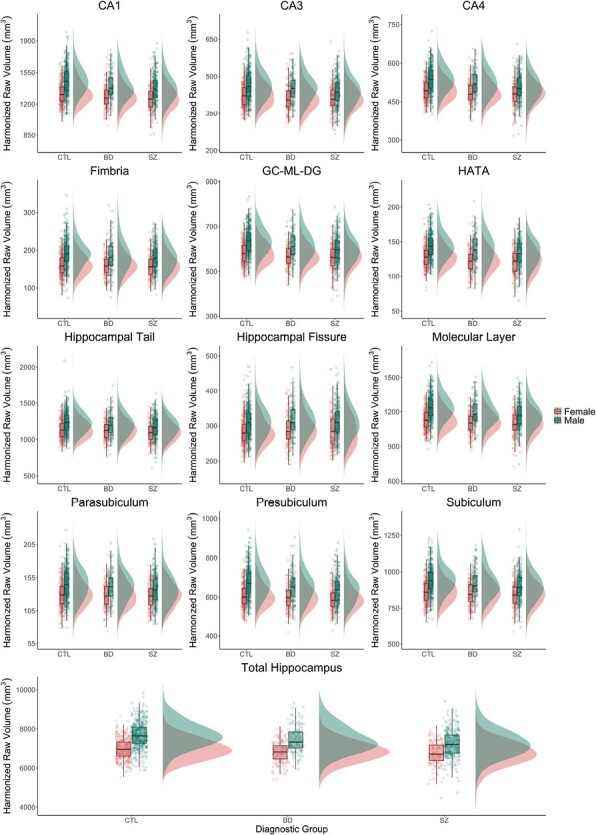
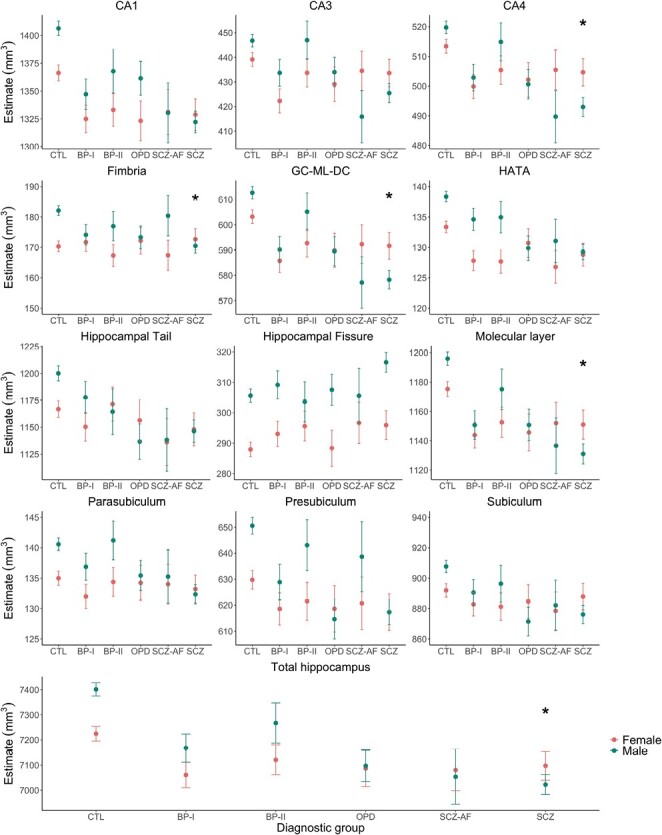
Significant sex-by-group interactions were found for the total hippocampus, dentate gyrus, molecular layer, presubiculum, fimbria, hippocampal-amygdaloid transition area, and CA4, indicating a larger volumetric deficit in male patients relative to female patients when compared with same-sex CTL. Subgroup analyses revealed that this interaction was driven by males with schizophrenia. Effect sizes were overall small (partial η < 0.02). We found no significant sex differences in the associations between hippocampal volumes and clinical or cognitive measures in SZ and BD.
Using a well-powered sample, our findings indicate that the pattern of morphological sex differences in hippocampal subfields is altered in individuals with schizophrenia relative to CTL, due to higher volumetric deficits in males.
海马体是一个异质性的脑结构,在性别之间存在差异,并与精神疾病的病理生理学有关。在这里,我们探索了精神分裂症谱系障碍(SZ)、双相情感障碍(BD)和健康对照组(CTL)个体中海马亚区体积的性别和诊断组差异。
1521 名参与者接受了 T1 加权磁共振成像(SZ,n=452,平均年龄 30.7±9.2[SD]岁,男性占 59.1%;BD,n=316,33.7±11.4,41.5%;CTL,n=753,34.1±9.1,55.6%)。使用 Freesurfer(v6.0.0)估计总海马体、亚区和颅内体积。采用协方差分析和多元回归模型来检查体积的性别-诊断(亚)组交互作用。在 SZ 和 BD 中,分别在性别之间使用回归模型检查体积与临床和认知测量之间的关联。
在总海马体、齿状回、分子层、前下托、伞形纤维、海马杏仁核过渡区和 CA4 中发现了显著的性别-组相互作用,这表明与同性 CTL 相比,男性患者的体积缺陷更大。亚组分析表明,这种相互作用是由男性精神分裂症患者驱动的。总体而言,效应大小较小(部分η<0.02)。我们没有发现 SZ 和 BD 中海马体积与临床或认知测量之间的关联存在显著的性别差异。
使用一个具有良好效能的样本,我们的研究结果表明,由于男性的体积缺陷更大,与 CTL 相比,精神分裂症患者的海马亚区形态性别差异模式发生了改变。