Arhuis-Inca Wendy, Ipanaqué-Zapata Miguel, Bazalar-Palacios Janina, Quevedo-Calderón Nancy, Gaete Jorge
Instituto de Investigación, Universidad Católica Los Ángeles de Chimbote, Chimbote, Peru.
Facultad de Educación y Humanidades, Escuela Profesional de Educación, Universidad Católica Los Ángeles de Chimbote, Satipo, Peru.
Front Psychol. 2021 Jan 13;11:543991. doi: 10.3389/fpsyg.2020.543991. eCollection 2020.
School violence and bullying are prevalent problems that affect health in general, especially through the development of emotional and behavioral problems, and can result in the deterioration of the academic performance of the student victim. The objective of this study was to determine the prevalence rates of aggressive behaviors according to types of school violence and bullying, sociodemographic characteristics, and variation by department, region, and time in the period between 2014 and 2018 in Peru.
The design was observational and cross-sectional based on data from the Specialized System for Reporting Cases of School Violence (Sistema Especializado en Reporte de Casos sobre Violencia Escolar-SíseVe) in Peru, which covers a population of 23,641 students at the initial, primary, and secondary levels of Basic Regular Education [Educación Básica Regular (EBR)], for the 2014-2018 period. The prevalence rates of the different types of school violence and bullying, the sociodemographic characteristics, and the variation by department, region, and time in the period between 2014 and 2018 were estimated.
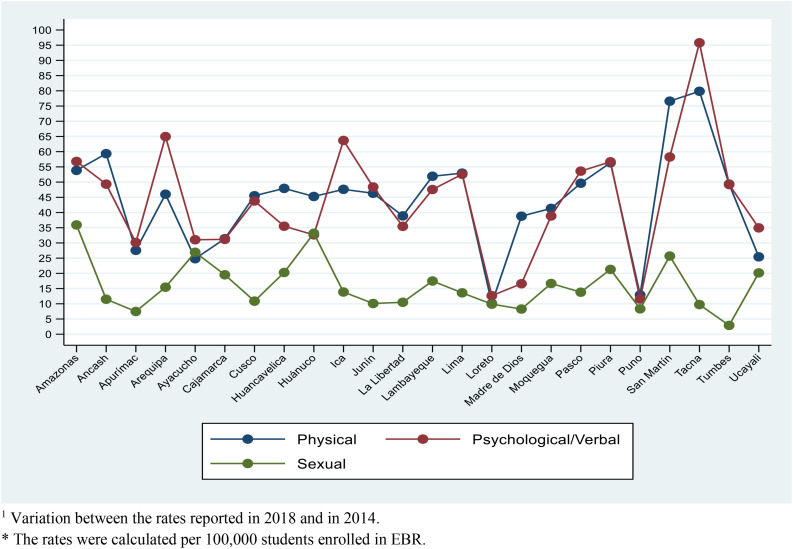
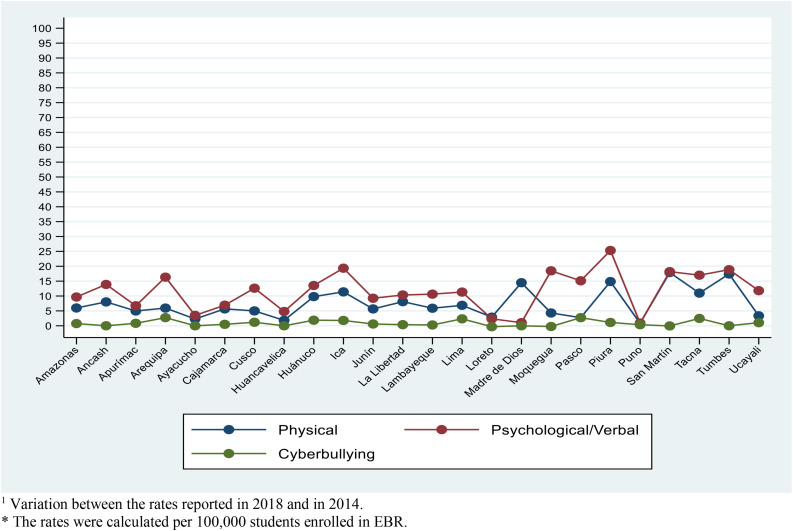
Psychological violence/bullying occurred at higher prevalence rates (185.8 and 62.6 per 100,000 residents). Women from public institutions reported greater sexual violence, mostly by teachers (67.8%) than by other students (32.2%). The Selva region had the highest prevalence rate of sexual violence (10.1 per 100,000 residents). The departments of Tacna and Piura had the highest and lowest rates of psychological/verbal violence and bullying in 2018 (95.79 and 25.31 per 100,000 residents).
Psychological/verbal violence and bullying is highly prevalent among students; women report being victims of sexual violence by administrative personnel of public institutions. The Selva region had the highest rate of sexual violence, and Piura and Tacna had the highest and lowest rates of violence and psychological/verbal bullying. Based on these results, it is suggested to conduct evidence-based prevention programs in Peruvian schools to reduce these social problems.
校园暴力和欺凌是普遍存在的问题,总体上会影响健康,尤其是通过引发情绪和行为问题,还可能导致受害学生学业成绩下降。本研究的目的是确定2014年至2018年期间秘鲁校园暴力和欺凌类型、社会人口学特征以及按部门、地区和时间划分的攻击行为患病率。
该设计基于秘鲁校园暴力案件报告专门系统(Sistema Especializado en Reporte de Casos sobre Violencia Escolar-SíseVe)的数据,为观察性横断面研究,涵盖2014 - 2018年期间基础正规教育(Educación Básica Regular,EBR)小学、初中阶段的23641名学生。估计了不同类型校园暴力和欺凌的患病率、社会人口学特征以及2014年至2018年期间按部门、地区和时间的变化情况。
心理暴力/欺凌的患病率较高(每10万居民中分别为185.8例和62.6例)。公立机构的女性报告遭受性暴力的情况更多,大多是教师实施的(占比67.8%),而非其他学生(占比32.2%)。塞尔瓦地区性暴力患病率最高(每10万居民中为10.1例)。2018年,塔克纳省和皮斯科省心理/言语暴力及欺凌的发生率分别为最高和最低(每10万居民中分别为95.79例和25.31例)。
心理/言语暴力和欺凌在学生中极为普遍;女性报告遭受公立机构行政人员的性暴力。塞尔瓦地区性暴力发生率最高,皮斯科省和塔克纳省的暴力及心理/言语欺凌发生率分别为最高和最低。基于这些结果,建议在秘鲁学校开展循证预防项目,以减少这些社会问题。