Prasansuklab Anchalee, Theerasri Atsadang, Rangsinth Panthakarn, Sillapachaiyaporn Chanin, Chuchawankul Siriporn, Tencomnao Tewin
College of Public Health Sciences, Chulalongkorn University, Bangkok, 10330, Thailand.
Graduate Program in Clinical Biochemistry and Molecular Medicine, Department of Clinical Chemistry, Faculty of Allied Health Sciences, Chulalongkorn University, Bangkok, 10330, Thailand.
J Tradit Complement Med. 2021 Mar;11(2):144-157. doi: 10.1016/j.jtcme.2020.12.001. Epub 2020 Dec 29.
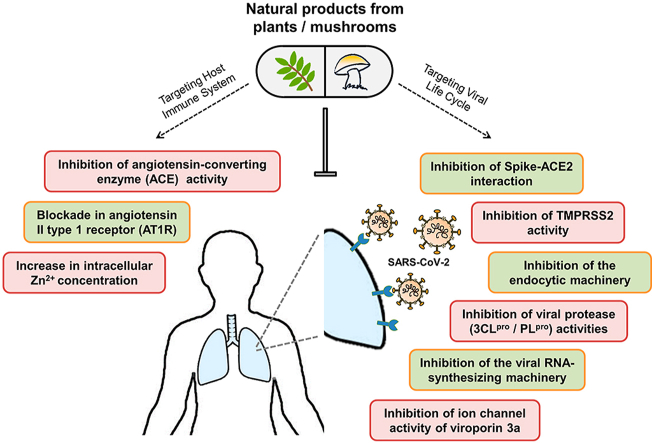
The novel coronavirus disease (COVID-19) caused by severe acute respiratory syndrome coronavirus 2 (SARS-CoV-2) is now become a worldwide pandemic bringing over 71 million confirmed cases, while the specific drugs and vaccines approved for this disease are still limited regarding their effectiveness and adverse events. Since virus incidences are still on rise, infectivity and mortality may also rise in the near future, natural products are highly considered to be valuable sources for the discovery of new antiviral drugs against SARS-CoV-2. This present review aims to comprehensively summarize the up-to-date scientific literatures on biological activities of plant- and mushroom-derived compounds relevant to mechanistic targets involved in SARS-CoV-2 infection and inflammatory-associated pathogenesis, including viral entry, replication and release, and the renin-angiotensin-aldosterone system (RAAS).
Data were retrieved from a literature search available on PubMed, Scopus and Google Scholar databases and collected until the end of May 2020. The findings from cell and non-cell based studies were considered, while the results of studies were excluded.
Based on the previous findings in SARS-CoV studies, except molecular docking analysis, herein, we provide a total of 150 natural compounds as potential candidates for development of new anti-COVID-19 drugs with higher efficacy and lower toxicity than the existing therapeutic agents. Several natural compounds have showed their promising actions on multiple therapeutic targets, which should be further explored. Among them, quercetin, one of the most abundant of plant flavonoids, is proposed as a lead candidate with its ability on the virus side to inhibit SARS-CoV spike protein-angiotensin-converting enzyme 2 (ACE2) interaction, viral protease and helicase activities, as well as on the host cell side to inhibit ACE activity and increase intracellular zinc level.
由严重急性呼吸综合征冠状病毒2(SARS-CoV-2)引起的新型冠状病毒病(COVID-19)现已成为全球大流行疾病,确诊病例超过7100万例,而针对该疾病获批的特效药物和疫苗在有效性及不良事件方面仍存在局限。鉴于病毒感染率仍在上升,近期传染性和死亡率可能也会升高,天然产物被高度认为是发现抗SARS-CoV-2新型抗病毒药物的宝贵来源。本综述旨在全面总结有关植物和蘑菇衍生化合物生物活性的最新科学文献,这些生物活性与SARS-CoV-2感染及炎症相关发病机制所涉及的作用靶点有关,包括病毒进入、复制与释放,以及肾素-血管紧张素-醛固酮系统(RAAS)。
从PubMed、Scopus和谷歌学术数据库中检索文献数据,收集至2020年5月底。纳入基于细胞和非细胞研究的结果,排除体外研究结果。
基于先前SARS-CoV研究的发现,除分子对接分析外,本文提供了总共150种天然化合物,作为开发新型抗COVID-19药物的潜在候选物,这些药物比现有治疗药物具有更高的疗效和更低的毒性。几种天然化合物已在多个治疗靶点上显示出有前景的作用,值得进一步探索。其中,槲皮素作为植物中最丰富的黄酮类化合物之一,被提议作为主要候选物,因为它在病毒方面能够抑制SARS-CoV刺突蛋白-血管紧张素转换酶2(ACE2)相互作用、病毒蛋白酶和螺旋酶活性,在宿主细胞方面能够抑制ACE活性并提高细胞内锌水平。