Ren Mengyuan, Pei Rongjuan, Jiangtulu Bahabaike, Chen Junxi, Xue Tao, Shen Guofeng, Yuan Xiaoru, Li Kexin, Lan Changxin, Chen Zhen, Chen Xinwen, Wang Yun, Jia Xiaoqian, Li Zewu, Rashid Audil, Prapamontol Tippawan, Zhao Xiuge, Dong Zhaomin, Zhang Yali, Zhang Le, Ye Rongwei, Li Zhiwen, Guan Wuxiang, Wang Bin
Institute of Reproductive and Child Health, Peking University/ Key Laboratory of Reproductive Health, National Health Commission of the People's Republic of China, Beijing 100191, P. R. China.
Department of Epidemiology and Biostatistics, School of Public Health, Peking University, Beijing 100191, P. R. China.
Innovation (Camb). 2021 Feb 28;2(1):100071. doi: 10.1016/j.xinn.2020.100071. Epub 2020 Dec 16.
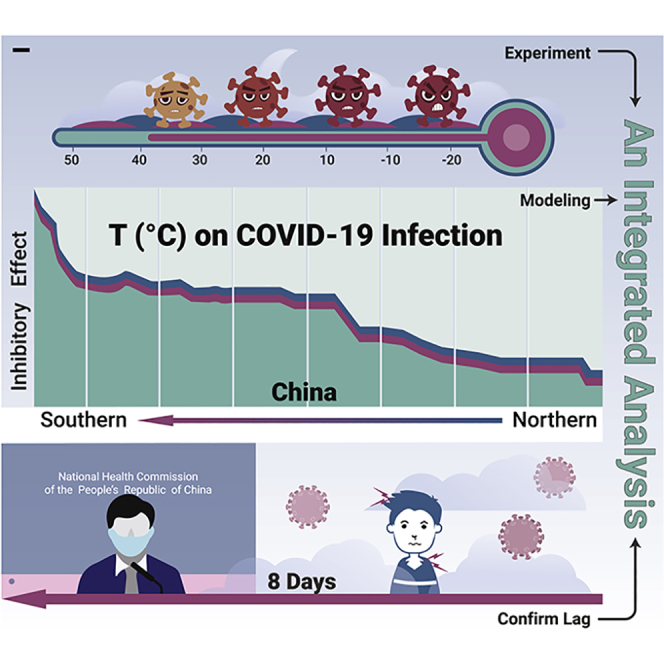
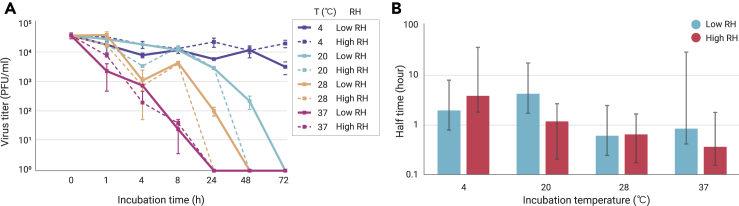
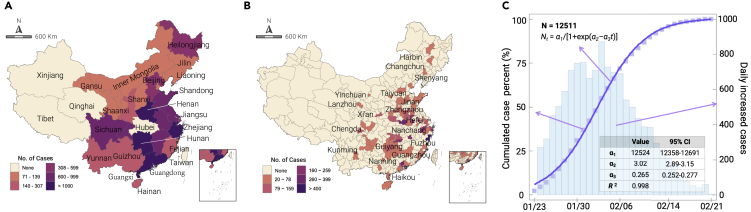
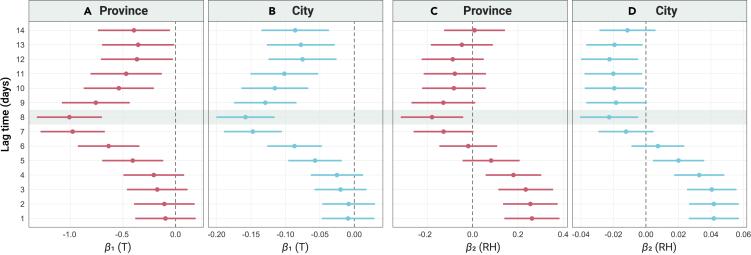
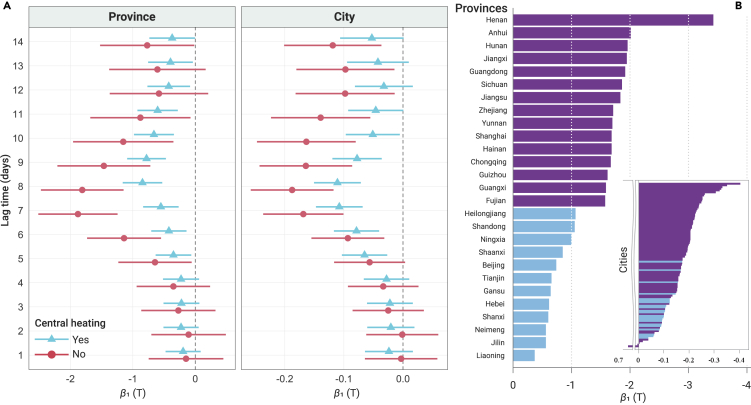
The COVID-19 outbreak has already become a global pandemic and containing this rapid worldwide transmission is of great challenge. The impacts of temperature and humidity on the COVID-19 transmission rate are still under discussion. Here, we elucidated these relationships by utilizing two unique scenarios, repeated measurement and natural experiment, using the COVID-19 cases reported from January 23 - February 21, 2020, in China. The modeling results revealed that higher temperature was most strongly associated with decreased COVID-19 transmission at a lag time of 8 days. Relative humidity (RH) appeared to have only a slight effect. These findings were verified by assessing SARS-CoV-2 infectivity under the relevant conditions of temperature (4°C-37°C) and RH (> 40%). We concluded that temperature increase made an important, but not determined, contribution to restrain the COVID-19 outbreak in China. It suggests that the emphasis of other effective controlling polices should be strictly implemented to restrain COVID-19 transmission in cold seasons.
新型冠状病毒肺炎(COVID-19)疫情已成为全球大流行,遏制这种在全球范围内的快速传播极具挑战。温度和湿度对COVID-19传播速率的影响仍在讨论之中。在此,我们利用重复测量和自然实验这两种独特情景,通过2020年1月23日至2月21日中国报告的COVID-19病例来阐明这些关系。建模结果显示,在滞后8天的情况下,较高温度与COVID-19传播减少的关联最为强烈。相对湿度(RH)似乎仅有轻微影响。通过评估在相关温度(4°C - 37°C)和RH(> 40%)条件下严重急性呼吸综合征冠状病毒2(SARS-CoV-2)的感染性,验证了这些发现。我们得出结论,温度升高对抑制中国的COVID-19疫情起到了重要但并非决定性的作用。这表明在寒冷季节应严格实施其他有效防控政策,以抑制COVID-19的传播。