Microbial Biology Graduate Program, Rutgers University, New Brunswick, NJ 08901, USA.
Metabolomics Shared Resource, Rutgers Cancer Institute of New Jersey, Rutgers University, New Brunswick, NJ 08901, USA.
Sci Adv. 2021 Jan 1;7(1). doi: 10.1126/sciadv.abd4210. Print 2021 Jan.
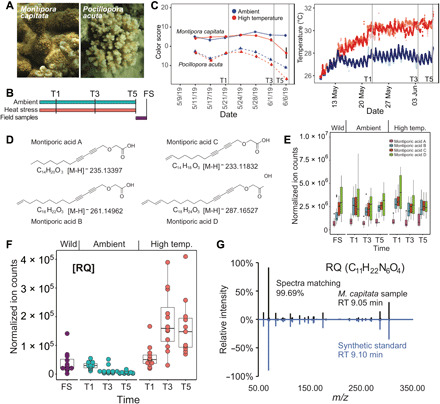
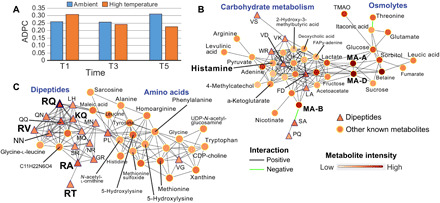
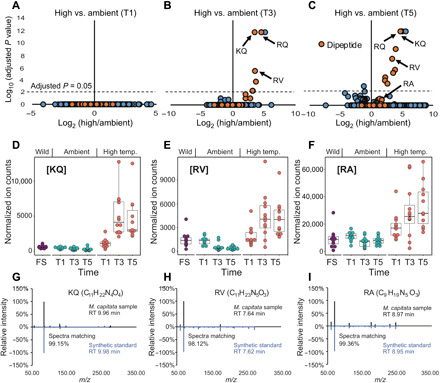
Understanding the response of the coral holobiont to environmental change is crucial to inform conservation efforts. The most pressing problem is "coral bleaching," usually precipitated by prolonged thermal stress. We used untargeted, polar metabolite profiling to investigate the physiological response of the coral species and to heat stress. Our goal was to identify diagnostic markers present early in the bleaching response. From the untargeted UHPLC-MS data, a variety of co-regulated dipeptides were found that have the highest differential accumulation in both species. The structures of four dipeptides were determined and showed differential accumulation in symbiotic and aposymbiotic (alga-free) populations of the sea anemone Aiptasia (), suggesting the deep evolutionary origins of these dipeptides and their involvement in symbiosis. These and other metabolites may be used as diagnostic markers for thermal stress in wild coral.
了解珊瑚整体对环境变化的响应对于指导保护工作至关重要。最紧迫的问题是“珊瑚白化”,通常是由长时间的热胁迫引起的。我们使用非靶向、极性代谢物分析方法研究了珊瑚物种 和 对热胁迫的生理响应。我们的目标是确定在白化反应早期出现的诊断标记物。从非靶向 UHPLC-MS 数据中,我们发现了多种共调控的二肽,它们在这两个物种中的积累量最高。我们确定了四种二肽的结构,并发现它们在海葵()共生和非共生(无藻)种群中存在差异积累,这表明这些二肽具有深远的进化起源,并参与共生关系。这些和其他代谢物可作为野生珊瑚热胁迫的诊断标记物。