Duffy Katharyn A, Schwalm Christopher R, Arcus Vickery L, Koch George W, Liang Liyin L, Schipper Louis A
School of Informatics, Computing and Cyber Systems, Northern Arizona University, Flagstaff, AZ 86011, USA.
Center for Ecosystem Science and Society, Northern Arizona University, Flagstaff, AZ 86011, USA.
Sci Adv. 2021 Jan 13;7(3). doi: 10.1126/sciadv.aay1052. Print 2021 Jan.
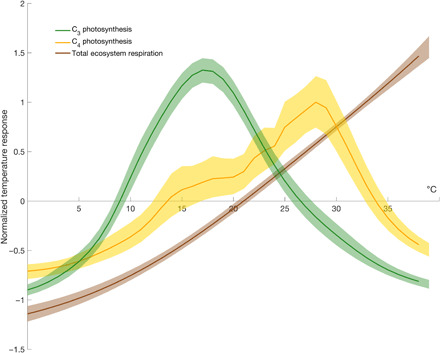
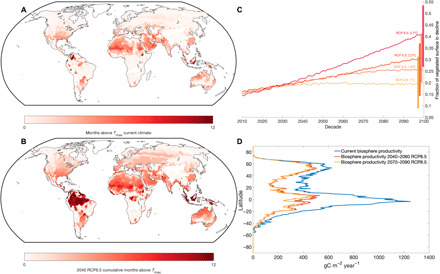
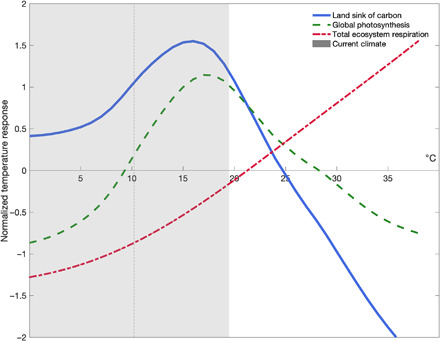
The temperature dependence of global photosynthesis and respiration determine land carbon sink strength. While the land sink currently mitigates ~30% of anthropogenic carbon emissions, it is unclear whether this ecosystem service will persist and, more specifically, what hard temperature limits, if any, regulate carbon uptake. Here, we use the largest continuous carbon flux monitoring network to construct the first observationally derived temperature response curves for global land carbon uptake. We show that the mean temperature of the warmest quarter (3-month period) passed the thermal maximum for photosynthesis during the past decade. At higher temperatures, respiration rates continue to rise in contrast to sharply declining rates of photosynthesis. Under business-as-usual emissions, this divergence elicits a near halving of the land sink strength by as early as 2040.
全球光合作用和呼吸作用对温度的依赖性决定了陆地碳汇强度。虽然目前陆地碳汇可缓解约30%的人为碳排放,但尚不清楚这种生态系统服务是否会持续存在,更具体地说,是否存在严格的温度限制(若有的话)来调节碳吸收。在此,我们利用最大的连续碳通量监测网络,构建了首条基于观测得出的全球陆地碳吸收温度响应曲线。我们发现,在过去十年中,最暖季度(3个月期间)的平均温度超过了光合作用的热最大值。在较高温度下,呼吸速率持续上升,而光合作用速率则急剧下降。在照常排放的情况下,这种差异最早到2040年就会导致陆地碳汇强度几乎减半。