Forsell Nicklas, Turkovska Olga, Gusti Mykola, Obersteiner Michael, Elzen Michel den, Havlik Petr
International Institute for Applied System Analysis (IIASA), Schlossplatz 1, 2361 Laxenburg, Austria.
International Institute for Applied System Analysis (IIASA), Schlossplatz 1, 2361 Laxenburg, Austria ; Lviv Polytechnic National University, 12 Bandera Street, Lviv, 79013 Ukraine.
Carbon Balance Manag. 2016 Dec 8;11(1):26. doi: 10.1186/s13021-016-0068-3. eCollection 2016 Dec.
In preparation for the 2015 international climate negotiations in Paris, Parties submitted Intended Nationally Determined Contributions (INDCs) to the United Nations Framework Convention on Climate Change (UNFCCC) expressing each countries' respective post-2020 climate actions. In this paper we assess individual Parties' expected reduction of emissions/removals from land use, land use change, and forest (LULUCF) sector for reaching their INDC target, and the aggregate global effect on the INDCs on the future development of emission and removals from the LULUCF sector. This has been done through analysis Parties' official information concerning the role of LULUCF mitigation efforts for reaching INDC targets as presented in National Communications, Biennial Update Reports, and Additional file 1.
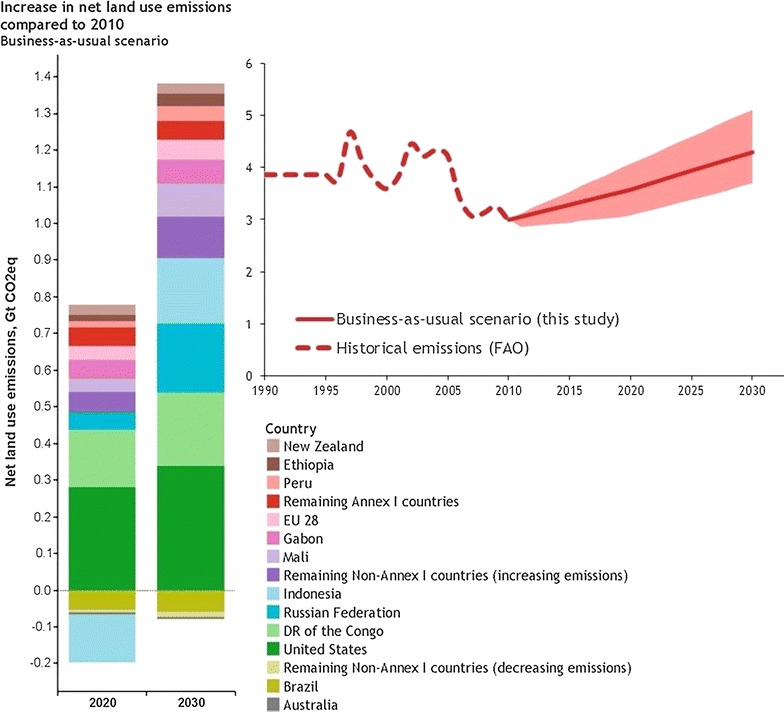
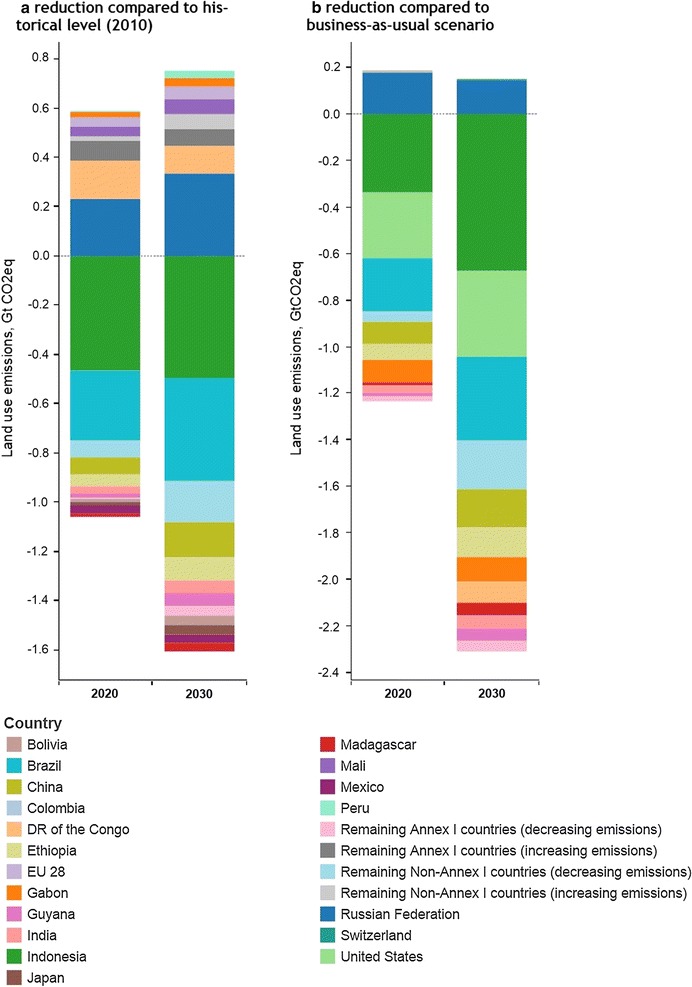
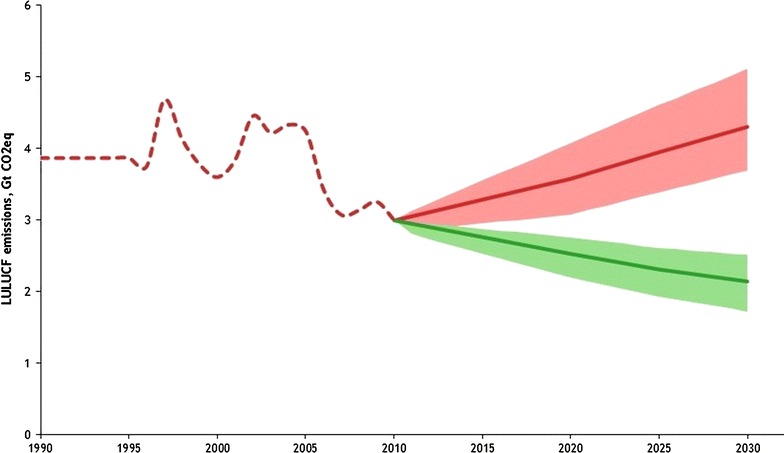
On the aggregate global level, the Parties themselves perceive that net LULUCF emissions will increase over time. Overall, the net LULUCF emissions are estimated to increase by 0.6 Gt COe year (range: 0.1-1.1) in 2020 and 1.3 Gt COe year (range: 0.7-2.1) in 2030, both compared to 2010 levels. On the other hand, the full implementation of the INDCs is estimated to lead to a reduction of net LULUCF emissions in 2030 compared to 2010 levels. It is estimated that if all conditional and unconditional INDCs are implemented, net LULUCF emissions would decrease by 0.5 Gt COe year (range: 0.2-0.8) by 2020 and 0.9 Gt COe year (range: 0.5-1.3) by 2030, both compared to 2010 levels. The largest absolute reductions of net LULUCF emissions (compared to 2010 levels) are expected from Indonesia and Brazil, followed by China and Ethiopia.
The results highlights that countries are expecting a significant contribution from the LULUCF sector to meet their INDC mitigation targets. At the global level, the LULUCF sector is expected to contribute to as much as 20% of the full mitigation potential of all the conditional and unconditional INDC targets. However, large uncertainties still surround how Parties estimate, project and account for emissions and removals from the LULUCF sector. While INDCs represent a new source of land-use information, further information and updates of the INDCs will be required to reduce uncertainty of the LULUCF projections.
为筹备2015年在巴黎举行的国际气候谈判,各缔约方提交了“国家自主贡献预案”(INDCs),向《联合国气候变化框架公约》(UNFCCC)表明了各国2020年后的气候行动。在本文中,我们评估了各缔约方为实现其INDC目标,预计在土地利用、土地利用变化和林业(LULUCF)部门减少的排放/清除量,以及INDCs对LULUCF部门未来排放和清除发展的全球总体影响。这是通过分析缔约方在国家信息通报、两年期更新报告和补充文件1中提供的关于LULUCF缓解努力在实现INDC目标中作用的官方信息来完成的。
在全球总体层面,缔约方自身预计LULUCF净排放量将随时间增加。总体而言,与2010年水平相比,预计2020年LULUCF净排放量将增加0.6吉吨二氧化碳当量/年(范围:0.1 - 1.1),2030年将增加1.3吉吨二氧化碳当量/年(范围:0.7 - 2.1)。另一方面,预计INDCs的全面实施将使2030年LULUCF净排放量相较于2010年水平有所减少。据估计,如果所有有条件和无条件的INDCs都得到实施,与2010年水平相比,到2020年LULUCF净排放量将减少0.5吉吨二氧化碳当量/年(范围:0.2 - 0.8),到2030年将减少0.9吉吨二氧化碳当量/年(范围:0.5 - 1.3)。预计印度尼西亚和巴西的LULUCF净排放量绝对减少量最大(与2010年水平相比),其次是中国和埃塞俄比亚。
结果表明,各国期望LULUCF部门对实现其INDC缓解目标做出重大贡献。在全球层面,LULUCF部门预计将为所有有条件和无条件INDC目标的全部缓解潜力贡献高达20%。然而,缔约方如何估计、预测和核算LULUCF部门的排放和清除量仍存在很大不确定性。虽然INDCs是土地利用信息的新来源,但仍需要进一步的信息和INDCs更新,以降低LULUCF预测的不确定性。