Center for non-coding RNA in Technology and Health, University of Copenhagen, 1871 Frederiksberg, Denmark.
Department of Veterinary and Animal Sciences, University of Copenhagen, 1870 Frederiksberg, Denmark.
Nucleic Acids Res. 2021 Feb 26;49(4):1859-1871. doi: 10.1093/nar/gkab012.
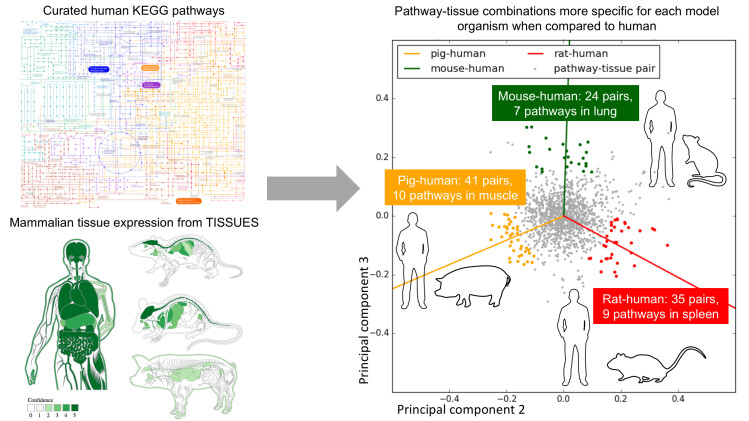
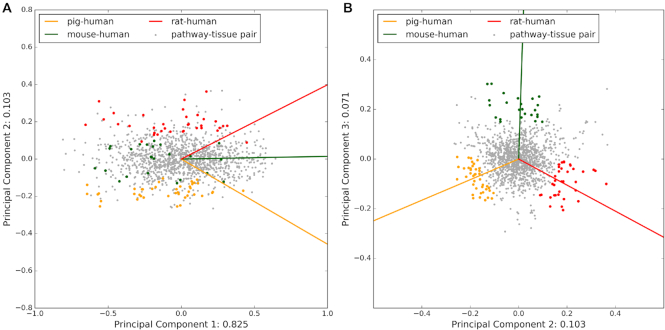
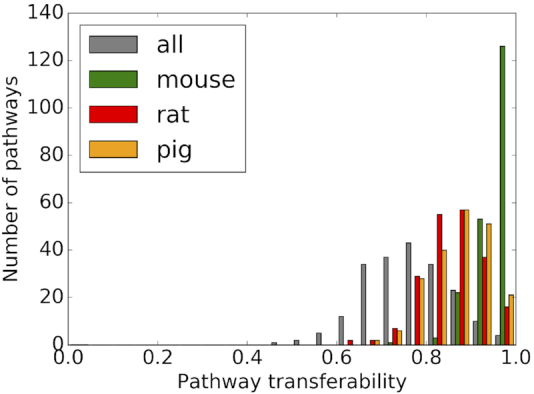
Animal models are crucial for advancing our knowledge about the molecular pathways involved in human diseases. However, it remains unclear to what extent tissue expression of pathways in healthy individuals is conserved between species. In addition, organism-specific information on pathways in animal models is often lacking. Within these limitations, we explore the possibilities that arise from publicly available data for the animal models mouse, rat, and pig. We approximate the animal pathways activity by integrating the human counterparts of curated pathways with tissue expression data from the models. Specifically, we compare whether the animal orthologs of the human genes are expressed in the same tissue. This is complicated by the lower coverage and worse quality of data in rat and pig as compared to mouse. Despite that, from 203 human KEGG pathways and the seven tissues with best experimental coverage, we identify 95 distinct pathways, for which the tissue expression in one animal model agrees better with human than the others. Our systematic pathway-tissue comparison between human and three animal modes points to specific similarities with human and to distinct differences among the animal models, thereby suggesting the most suitable organism for modeling a human pathway or tissue.
动物模型对于深入了解人类疾病相关的分子途径至关重要。然而,目前尚不清楚健康个体中组织表达的途径在物种间的保守程度。此外,动物模型中关于途径的特定于生物体的信息通常是缺乏的。在这些限制下,我们探索了从公开可用的数据中为动物模型(鼠、大鼠和猪)带来的可能性。我们通过整合经过精心策划的人类途径与模型中的组织表达数据来近似动物途径的活性。具体来说,我们比较了人类基因的动物同源物是否在相同的组织中表达。与小鼠相比,大鼠和猪的数据覆盖范围较低且质量较差,这使得情况变得复杂。尽管如此,在 203 个人类 KEGG 途径和具有最佳实验覆盖范围的七个组织中,我们确定了 95 种不同的途径,其中一种动物模型中的组织表达与人类的一致性优于其他模型。我们在人类和三种动物模型之间进行的系统的途径-组织比较,指向了与人类的特定相似性和动物模型之间的明显差异,从而提示了最适合模拟人类途径或组织的生物体。