Department of Epidemiology, Gillings School of Global Public Health, University of North Carolina at Chapel Hill, Chapel Hill, NC, USA.
Department of Child Health and Development, Division of Mental and Physical Health, Norwegian Institute of Public Health, Oslo, Norway.
Environ Int. 2021 Apr;149:106403. doi: 10.1016/j.envint.2021.106403. Epub 2021 Jan 29.
Prenatal phthalate exposure has been linked with altered neurodevelopment, including externalizing behaviors and attention-deficit hyperactivity disorder (ADHD). However, the implicated metabolite, neurobehavioral endpoint, and child sex have not always been consistent across studies, possibly due to heterogeneity in neurodevelopmental instruments. The complex set of findings may be synthesized using executive function (EF), a construct of complex cognitive processes that facilitate ongoing goal-directed behaviors. Impaired EF can be presented with various phenotypes of poor neurodevelopment, differently across structured conditions, home/community, or preschool/school. We evaluated the relationship between prenatal phthalate exposure and comprehensive assessment of preschool EF.
Our study comprised 262 children with clinically significant/subthreshold ADHD symptoms and 78 typically developing children who were born between 2003 and 2008 and participated in the Preschool ADHD Substudy, which is nested within a population-based prospective cohort study, the Norwegian Mother, Father, and Child Cohort (MoBa). Twelve phthalate metabolites were measured from urine samples that their mothers had provided during pregnancy, at 17 weeks' gestation. All children, at approximately 3.5-years, took part in a detailed clinical assessment that included parent-and teacher-rated inventories and administered tests. We used instruments that measured constructs related to EF, which include a parent-and teacher-reported Behavior Rating Inventory of Executive Function-Preschool (BRIEF-P) and three performance-based tests: A Developmental NEuroPSYchological Assessment (NEPSY), Stanford-Binet intelligence test V (SB5), and the cookie delay task (CDT). The standard deviation change in test score per interquartile range (IQR) increase in phthalate metabolite was estimated with multivariable linear regression. We applied weighting in all models to account for the oversampling of children with clinically significant or subthreshold symptoms of ADHD. Additionally, we assessed modification by child sex and potential co-pollutant confounding.
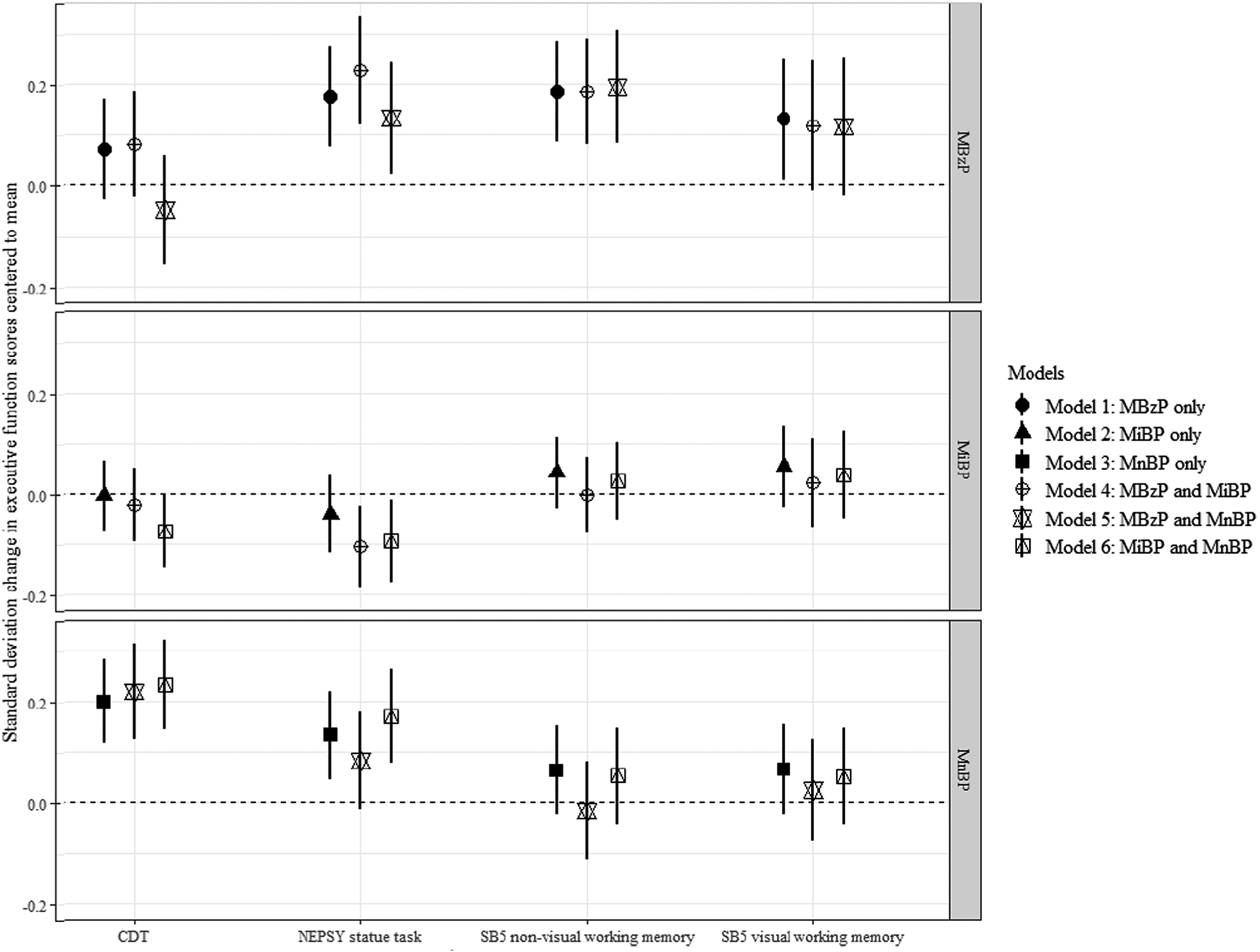
Elevated exposure to mono-benzyl phthalate (MBzP) during pregnancy was associated with poorer EF, across all domains and instruments, in both sex. For example, an IQR increase in MBzP was associated with poorer working memory rated by parent (1.23 [95% CI: 0.20, 2.26]) and teacher (1.13 [0.14, 2.13]) using BRIEF-P, and administered tests such as SB5 (no-verbal: 0.19 [0.09, 0.28]; verbal: 0.13 [0.01, 0.25]). Adverse associations were also observed for mono-n-butyl phthalate (MnBP) and mono-iso-butyl phthalate (MiBP), although results varied by instruments. EF domains reported by parents using BRIEF-P were most apparently implicated, with stronger associations among boys (e.g., MnBP and inhibition: 2.74 [1.77, 3.72]; MiBP and inhibition: 1.88 [0.84, 2.92]) than among girls (e.g., MnBP and inhibition: -0.63 [-2.08, 0.83], interaction p-value: 0.04; MiBP and inhibition: -0.15 [-1.04, 0.74], interaction p-value: 0.3). Differences by sex, however, were not found for the teacher-rated BRIEF-P or administered tests including NEPSY, SB5, and CDT.
Elevated mid-pregnancy MBzP, MiBP, and MnBP were associated with more adverse profiles of EF among preschool-aged children across a range of instruments and raters, with some associations found only among boys. Given our findings and accumulating evidence of the prenatal period as a critical window for phthalate exposure, there is a timely need to expand the current phthalate regulations focused on baby products to include pregnancy exposures.
产前邻苯二甲酸酯暴露与神经发育改变有关,包括外化行为和注意缺陷多动障碍(ADHD)。然而,在不同的研究中,涉及的代谢物、神经行为终点和儿童性别并不总是一致的,这可能是由于神经发育仪器的异质性。复杂的研究结果可以通过执行功能(EF)进行综合,执行功能是一种复杂认知过程的构建,有助于持续进行目标导向的行为。执行功能受损可能会表现出不同的神经发育不良表型,在不同的结构条件、家庭/社区或学前/学校中表现不同。我们评估了产前邻苯二甲酸酯暴露与学前执行功能综合评估之间的关系。
我们的研究包括 262 名有明显/亚临床 ADHD 症状的儿童和 78 名正常发育的儿童。这些儿童出生于 2003 年至 2008 年之间,参加了基于人群的前瞻性队列研究——挪威母婴儿童队列(MoBa)中的学前 ADHD 子研究。在妊娠 17 周时,从母亲尿液中检测了 12 种邻苯二甲酸酯代谢物。所有儿童在大约 3.5 岁时参加了详细的临床评估,包括家长和教师报告的行为评定量表的执行功能-学前版(BRIEF-P)和三项基于表现的测试:发育性神经心理评估(NEPSY)、斯坦福-比奈智力测验第五版(SB5)和饼干延迟任务(CDT)。使用多变量线性回归估计了邻苯二甲酸酯代谢物中值增加一个四分位距(IQR)时测试分数的标准偏差变化。我们在所有模型中应用了权重,以考虑到有明显或亚临床 ADHD 症状的儿童的过度抽样。此外,我们还评估了儿童性别和潜在共同污染物混杂因素的修饰作用。
怀孕期间单苄基邻苯二甲酸酯(MBzP)的暴露升高与所有性别和所有领域和仪器的执行功能下降有关。例如,BRIEF-P 中家长和教师评定的工作记忆得分分别增加一个 IQR 与 MBzP 相关(1.23 [95%CI:0.20,2.26];1.13 [0.14,2.13]),以及通过 SB5(非语言:0.19 [0.09,0.28];语言:0.13 [0.01,0.25])等测试进行评估。单正丁基邻苯二甲酸酯(MnBP)和单异丁基邻苯二甲酸酯(MiBP)也观察到了不良关联,尽管结果因仪器而异。BRIEF-P 中家长报告的执行功能领域最明显受到影响,男孩之间的关联更强(例如,MnBP 和抑制:2.74 [1.77,3.72];MiBP 和抑制:1.88 [0.84,2.92]),而女孩之间的关联较弱(例如,MnBP 和抑制:-0.63 [-2.08,0.83],交互 p 值:0.04;MiBP 和抑制:-0.15 [-1.04,0.74],交互 p 值:0.3)。然而,在教师评定的 BRIEF-P 或包括 NEPSY、SB5 和 CDT 在内的基于表现的测试中,没有发现男孩和女孩之间的差异。
妊娠中期 MBzP、MiBP 和 MnBP 水平升高与一系列仪器和评分者的学龄前儿童执行功能不良有关,在某些关联中仅在男孩中发现。鉴于我们的研究结果和越来越多的产前时期作为邻苯二甲酸酯暴露关键时期的证据,目前有必要扩大当前专注于婴儿产品的邻苯二甲酸酯监管范围,将妊娠暴露纳入其中。