Montoya Zackary T, Uhernik Amy L, Smith Jeffrey P
Colorado State University-Pueblo, 2200 Bonforte Blvd, Pueblo, CO, 81001, USA.
J Cannabis Res. 2020 Dec 11;2(1):48. doi: 10.1186/s42238-020-00055-9.
Cannabidiol (CBD) and selective serotonin reuptake inhibitors (SSRIs) are currently used to treat post-traumatic stress disorder (PTSD). However, these drugs are commonly studied after dosing just prior to extinction training, and there are gaps in our understanding of how they affect fear memory formation, their comparative effects on various types of memory, and of sexual dimorphisms in effects. Also, more studies involving female subjects are needed to balance the gender-inequality in the literature. Therefore, the purpose of this study was to directly compare the effects of CBD to citalopram in affecting the formation of auditory cued, contextual, and generalized fear memory, and to evaluate how extinction of these different memories was altered by pre-acquisition treatment in female mice. We also evaluated the impact of the estrous cycle on each of these.
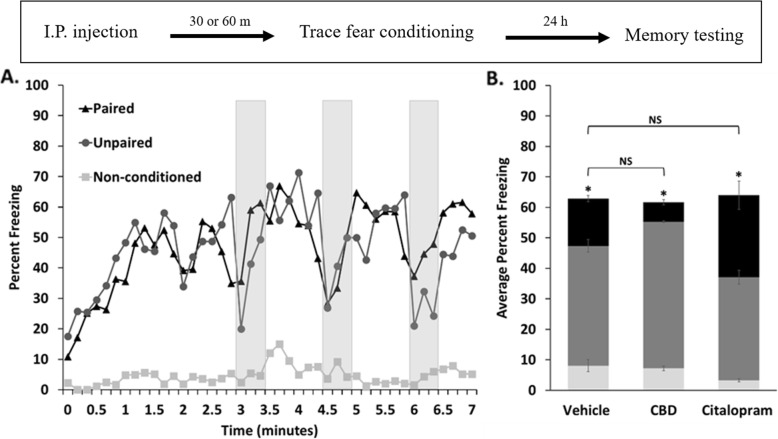
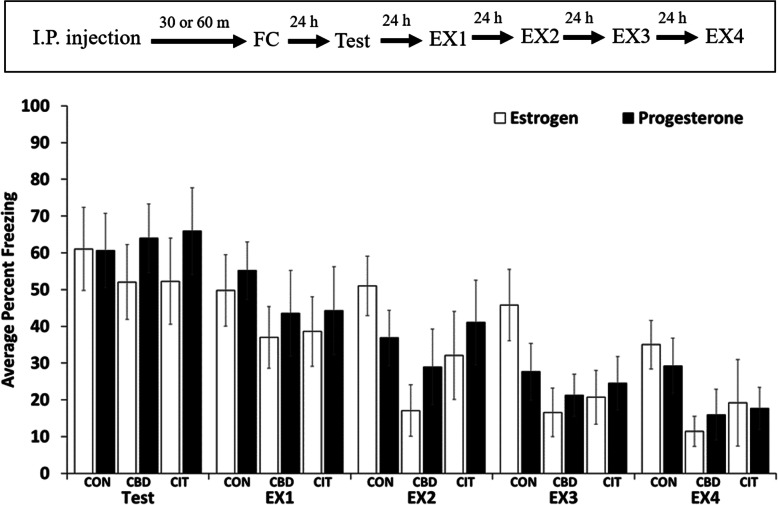
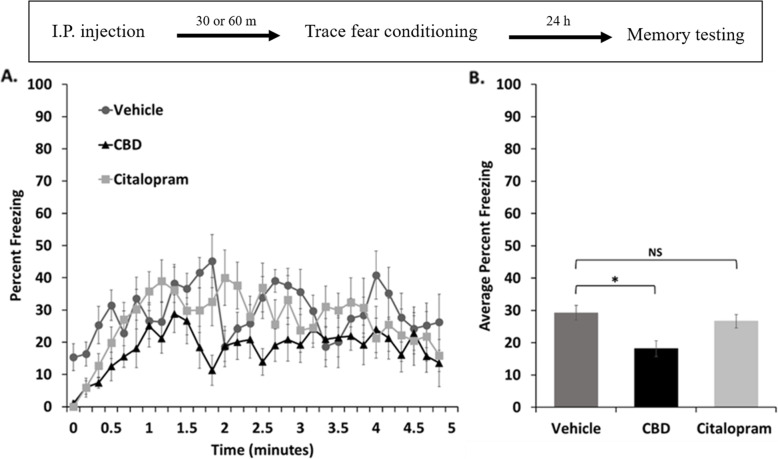
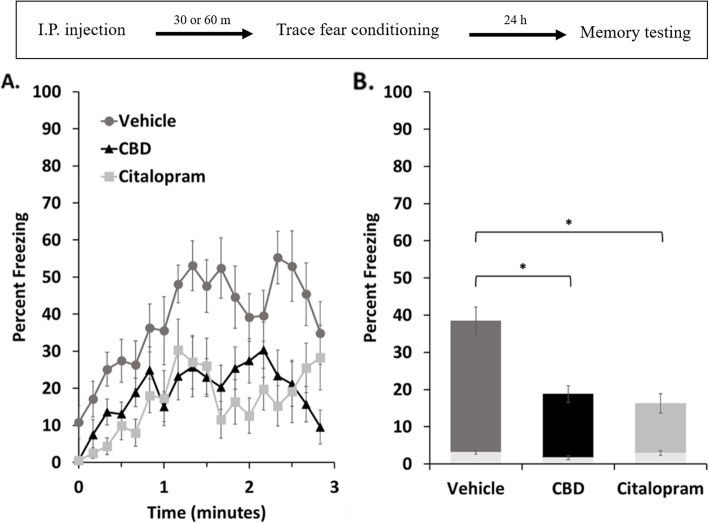
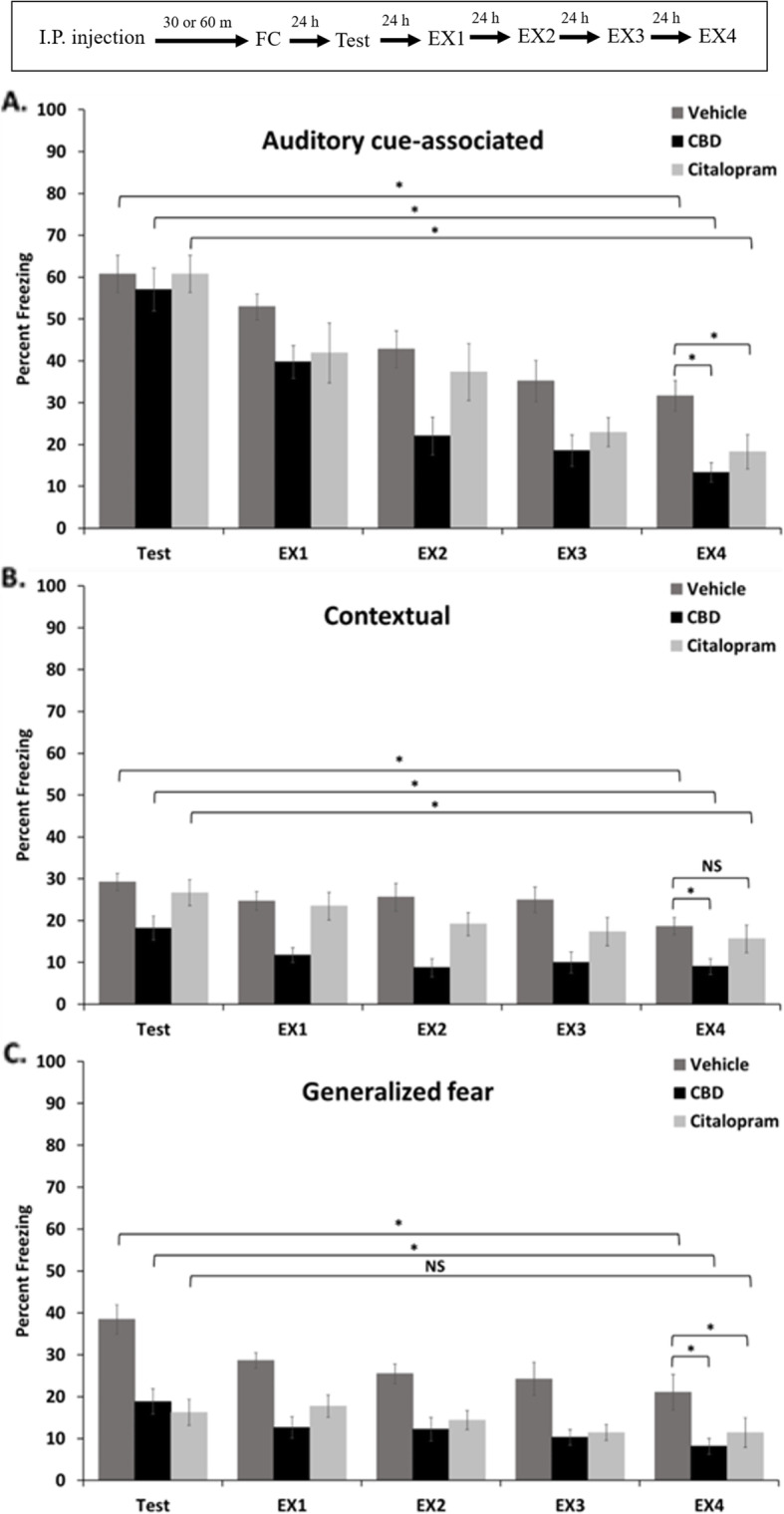
Auditory-cued trace fear conditioning was conducted shortly after dosing female C57BL/6 mice, with either CBD or citalopram (10 mg/kg each), by pairing auditory tones with mild foot shocks. Auditory-cued, contextual, and generalized fear memory was assessed by measuring freezing responses, with an automated fear conditioning system, 24 h after conditioning. Each memory type was then evaluated every 24 h, over a 4-day period in total, to create an extinction profile. Freezing outcomes were statistically compared by ANOVA with Tukey HSD post hoc analysis, N = 12 mice per experimental group. Evaluation of sexual dimorphism was by comparison to historical data from male mice.
Auditory cue-associated fear memory was not affected with CBD or citalopram; however, contextual memory was reduced with CBD by 11%, p < 0.05, but not citalopram, and generalized fear memory was reduced with CBD and citalopram, 20% and 22%, respectively, p < 0.05. Extinction learning was enhanced with CBD and citalopram, but, there was considerable memory-type variability between drug effects, with freezing levels reduced at the end of training by 9 to 17% for CBD, and 10 to 12% with citalopram. The estrous cycle did not affect any outcomes.
Both drugs are potent modifiers of fear memory formation; however, there is considerable divergence in their targeting of different memory types which, overall, could support the use of CBD as an alternative to SSRIs for treating PTSD in females, but not males. A limitation of the study was that it compared data from experiments done at different times to evaluate sexual dimorphism. Overall, this suggests that more research is necessary to guide any therapeutic approach involving CBD.
大麻二酚(CBD)和选择性5-羟色胺再摄取抑制剂(SSRIs)目前用于治疗创伤后应激障碍(PTSD)。然而,这些药物通常是在消退训练前给药后进行研究的,我们对于它们如何影响恐惧记忆形成、对各种类型记忆的比较效果以及效应中的性别差异的理解存在空白。此外,需要更多涉及雌性受试者的研究来平衡文献中的性别不平等。因此,本研究的目的是直接比较CBD和西酞普兰对听觉线索性、情境性和泛化性恐惧记忆形成的影响,并评估在雌性小鼠中,这些不同记忆的消退如何因获取前治疗而改变。我们还评估了发情周期对上述各项的影响。
对雌性C57BL/6小鼠给药(CBD或西酞普兰,各10mg/kg)后不久,通过将听觉音调与轻度足部电击配对,进行听觉线索性痕迹恐惧条件反射。在条件反射后24小时,使用自动恐惧条件反射系统,通过测量僵住反应来评估听觉线索性、情境性和泛化性恐惧记忆。然后在总共4天的时间里,每24小时评估一次每种记忆类型,以建立消退曲线。通过方差分析(ANOVA)和Tukey HSD事后分析对僵住结果进行统计学比较,每个实验组有12只小鼠。通过与雄性小鼠的历史数据比较来评估性别差异。
CBD或西酞普兰对与听觉线索相关的恐惧记忆没有影响;然而,CBD使情境记忆减少了11%,p<0.05,而西酞普兰没有,CBD和西酞普兰分别使泛化性恐惧记忆减少了20%和22%,p<0.05。CBD和西酞普兰增强了消退学习,但是,药物效应之间存在相当大的记忆类型变异性,训练结束时,CBD使僵住水平降低了9%至17%,西酞普兰使僵住水平降低了10%至12%。发情周期对任何结果均无影响。
两种药物都是恐惧记忆形成的有效调节剂;然而,它们对不同记忆类型的靶向作用存在很大差异,总体而言,这可能支持将CBD作为SSRIs的替代品用于治疗女性而非男性的PTSD。本研究的一个局限性在于,它比较了在不同时间进行的实验数据以评估性别差异。总体而言,这表明需要更多研究来指导任何涉及CBD的治疗方法。