Pathak Harshad, Späh Alexander, Esmaeildoost Niloofar, Sellberg Jonas A, Kim Kyung Hwan, Perakis Fivos, Amann-Winkel Katrin, Ladd-Parada Marjorie, Koliyadu Jayanath, Lane Thomas J, Yang Cheolhee, Lemke Henrik Till, Oggenfuss Alexander Roland, Johnson Philip J M, Deng Yunpei, Zerdane Serhane, Mankowsky Roman, Beaud Paul, Nilsson Anders
Department of Physics, AlbaNova University Center, Stockholm University, SE-10691 Stockholm, Sweden.
Biomedical and X-Ray Physics, Department of Applied Physics, KTH Royal Institute of Technology, AlbaNova University Center, SE-10691 Stockholm, Sweden.
Proc Natl Acad Sci U S A. 2021 Feb 9;118(6). doi: 10.1073/pnas.2018379118.
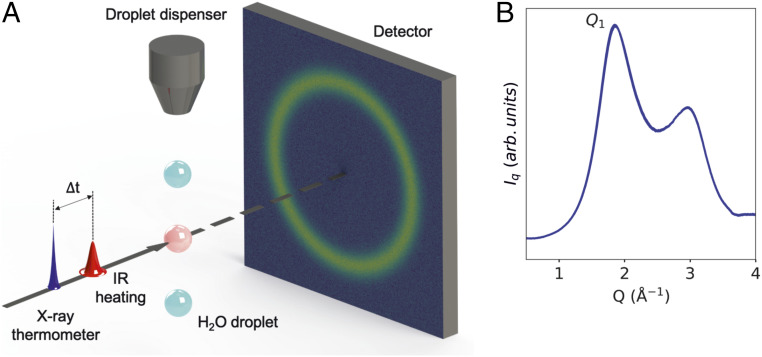
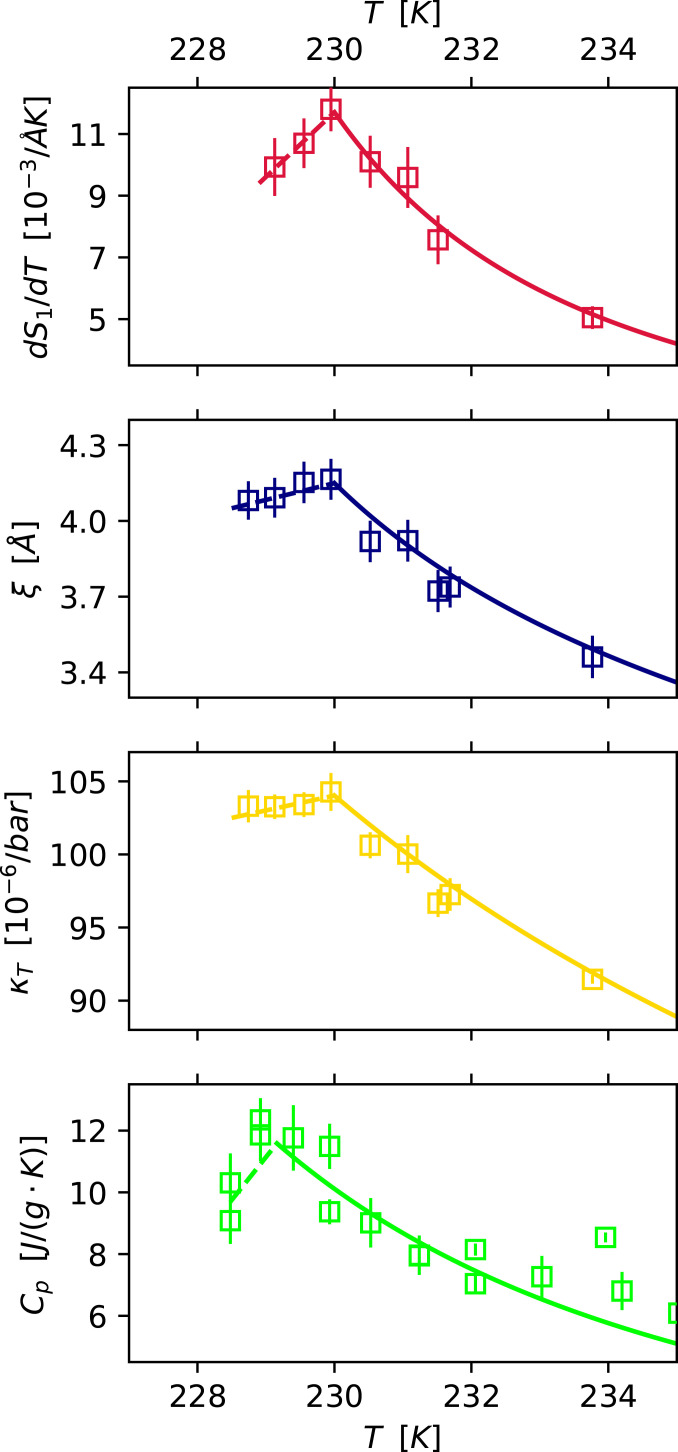
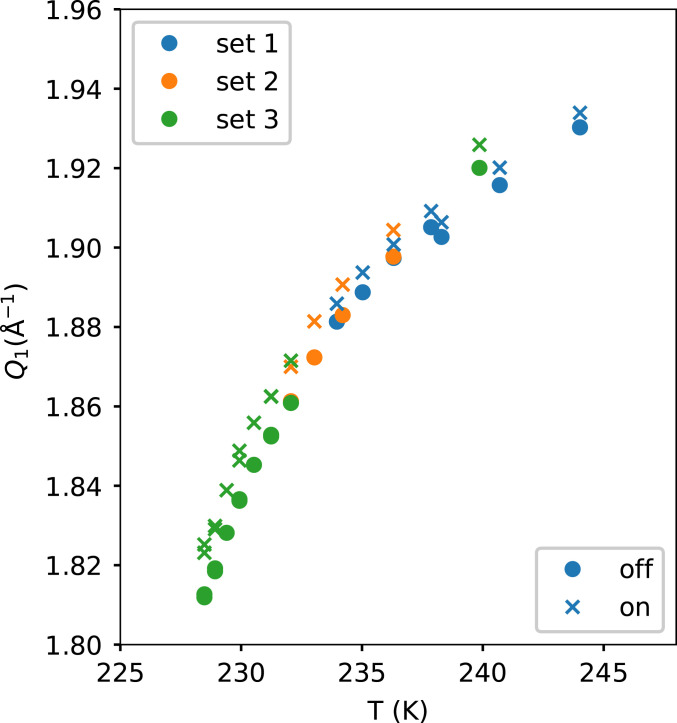
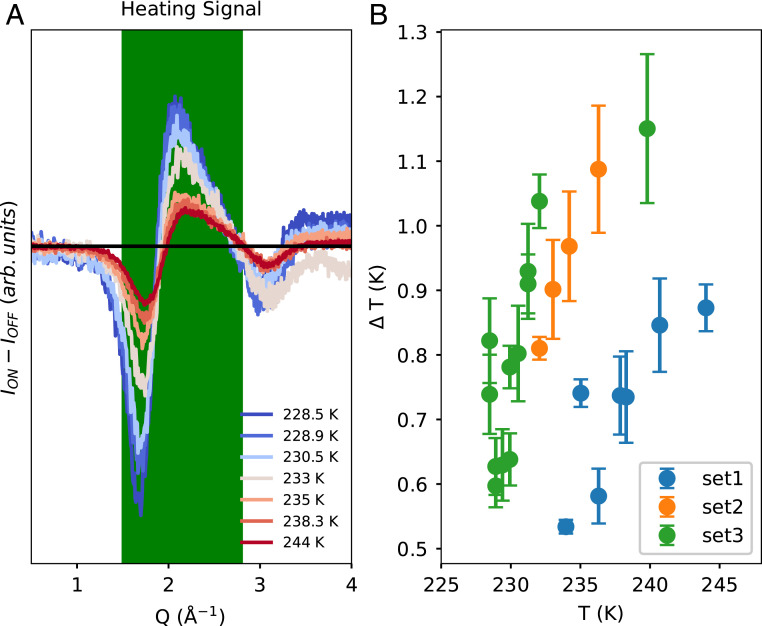
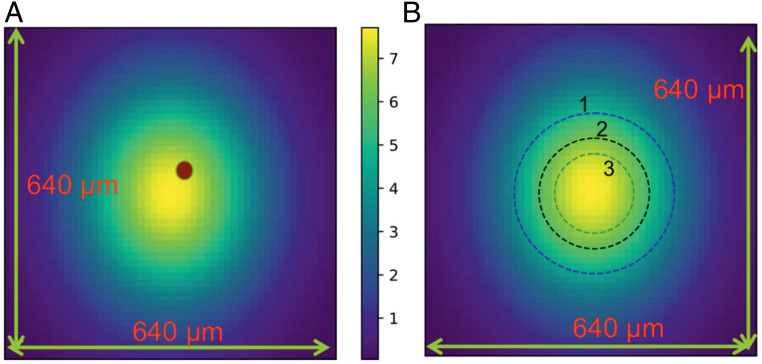
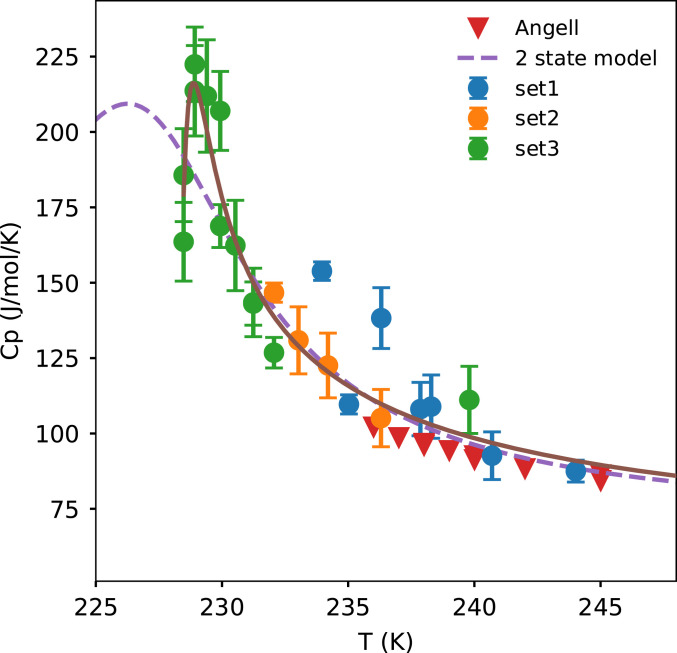
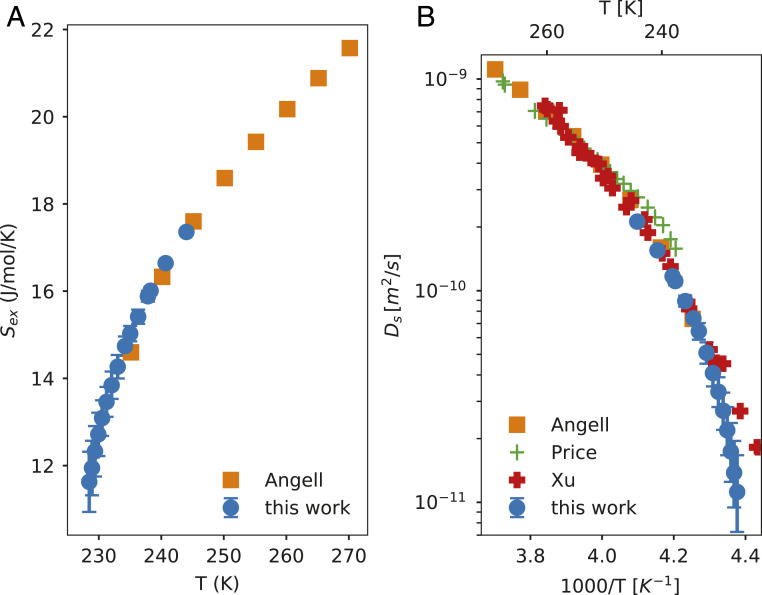
Knowledge of the temperature dependence of the isobaric specific heat (C) upon deep supercooling can give insights regarding the anomalous properties of water. If a maximum in C exists at a specific temperature, as in the isothermal compressibility, it would further validate the liquid-liquid critical point model that can explain the anomalous increase in thermodynamic response functions. The challenge is that the relevant temperature range falls in the region where ice crystallization becomes rapid, which has previously excluded experiments. Here, we have utilized a methodology of ultrafast calorimetry by determining the temperature jump from femtosecond X-ray pulses after heating with an infrared laser pulse and with a sufficiently long time delay between the pulses to allow measurements at constant pressure. Evaporative cooling of ∼15-µm diameter droplets in vacuum enabled us to reach a temperature down to ∼228 K with a small fraction of the droplets remaining unfrozen. We observed a sharp increase in C, from 88 J/mol/K at 244 K to about 218 J/mol/K at 229 K where a maximum is seen. The C maximum is at a similar temperature as the maxima of the isothermal compressibility and correlation length. From the C measurement, we estimated the excess entropy and self-diffusion coefficient of water and these properties decrease rapidly below 235 K.
了解等压比热(C)随深度过冷的温度依赖性,有助于深入了解水的异常性质。如果像等温压缩率那样,在特定温度下C存在最大值,这将进一步验证能够解释热力学响应函数异常增加的液 - 液临界点模型。挑战在于,相关温度范围处于冰结晶迅速发生的区域,这使得此前的实验无法进行。在此,我们采用了一种超快量热法,通过用红外激光脉冲加热后,测定飞秒X射线脉冲引起的温度跃升,并在脉冲之间设置足够长的时间延迟以实现恒压测量。在真空中对直径约15微米的液滴进行蒸发冷却,使我们能够将温度降至约228K,且有一小部分液滴未冻结。我们观察到C急剧增加,从244K时的88J/mol/K增加到229K时的约218J/mol/K,此时出现最大值。C的最大值与等温压缩率和关联长度的最大值处于相似温度。通过C的测量,我们估算了水的过量熵和自扩散系数,这些性质在235K以下迅速下降。