Department of Chemical and Biological Engineering, Northwestern University, Evanston, IL, USA.
Center for Synthetic Biology, Northwestern University, Evanston, IL, USA.
Nat Chem Biol. 2021 May;17(5):531-539. doi: 10.1038/s41589-020-00729-8. Epub 2021 Feb 1.
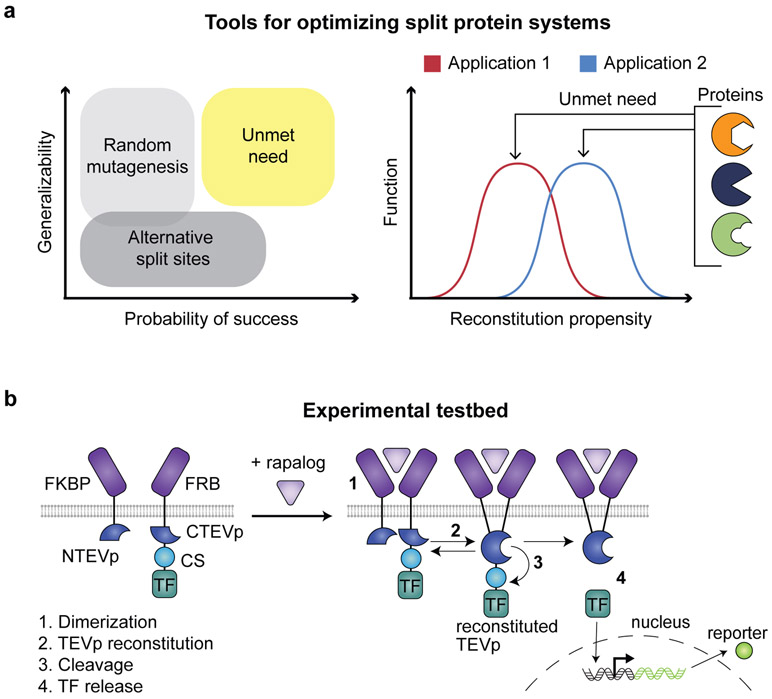
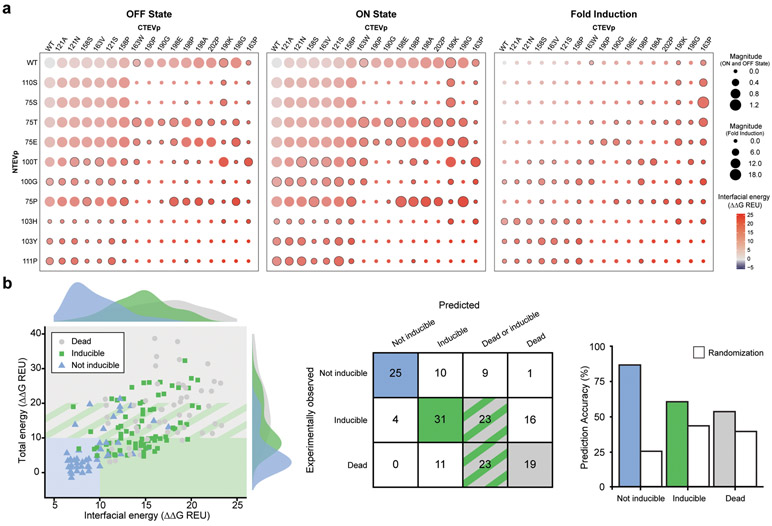
Splitting bioactive proteins into conditionally reconstituting fragments is a powerful strategy for building tools to study and control biological systems. However, split proteins often exhibit a high propensity to reconstitute, even without the conditional trigger, limiting their utility. Current approaches for tuning reconstitution propensity are laborious, context-specific or often ineffective. Here, we report a computational design strategy grounded in fundamental protein biophysics to guide experimental evaluation of a sparse set of mutants to identify an optimal functional window. We hypothesized that testing a limited set of mutants would direct subsequent mutagenesis efforts by predicting desirable mutant combinations from a vast mutational landscape. This strategy varies the degree of interfacial destabilization while preserving stability and catalytic activity. We validate our method by solving two distinct split protein design challenges, generating both design and mechanistic insights. This new technology will streamline the generation and use of split protein systems for diverse applications.
将生物活性蛋白分割成条件性重组片段是构建研究和控制生物系统工具的有力策略。然而,即使没有条件触发,分割蛋白也常常表现出很高的重组倾向,从而限制了它们的应用。目前用于调整重组倾向的方法既繁琐又具体,而且往往效果不佳。在这里,我们报告了一种基于基本蛋白质生物物理学的计算设计策略,用于指导对一组稀疏突变体的实验评估,以确定最佳功能窗口。我们假设通过从广阔的突变景观中预测理想的突变组合,测试一组有限的突变体将指导随后的诱变工作。该策略在保持稳定性和催化活性的同时,改变了界面去稳定化的程度。我们通过解决两个不同的分裂蛋白设计挑战来验证我们的方法,为设计和机制提供了见解。这项新技术将简化用于各种应用的分裂蛋白系统的生成和使用。