Gururani Kavita, Sood Salej, Kumar Anil, Joshi Dinesh C, Pandey Dinesh, Sharma A R
Department of Molecular Biology & Genetic Engineering, G.B. Pant Univ. of Agriculture and Technology, Pantnagar, Uttarakhand 263145 India.
Division of Crop Improvement, ICAR-Central Potato Research Institute Shimla, Shimla, Himachal Pradesh 171001 India.
Biodivers Conserv. 2021;30(3):551-574. doi: 10.1007/s10531-021-02123-9. Epub 2021 Jan 27.
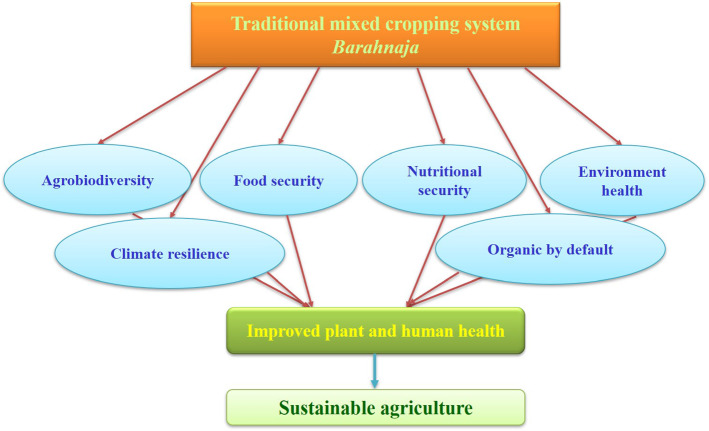
Selective production of input intensive crops in the present scenario have resulted in productivity stagnation or even decline due to excessive usage of chemicals, affecting the farmers economically. Sustainable agriculture is the way to increase agricultural productivity and economic prosperity by protecting all natural resources. It maintains a balance of soil fertility with crop productivity and nutritional quality. The mixed cropping systems followed earlier in different regions according to their tradition, climatic zone, soil and water conditions were climate-smart approaches to sustainable food production based on practical experiences over the years of old generations. The life style changes, imbalance in farming system in last 70 years and demand for more food as well as declining land resources resulted in intensive agriculture. Besides, least returns and less demand of ethnic crops gave more preference to major staple food crops. is a traditional orphan crops based mixed cropping system practiced in Himalayan region due to its sustainability and assured crop harvest during erratic weather conditions. This traditional farming method is an exemplary scientific approach to derive innovations with respect to productivity, quality, plant soil interactions and organic agriculture. The main focus of the review is to substantiate the characteristics of the traditional mixed cropping system by describing the advantages of the system and opportunities for scientific innovation towards new knowledge and sustainability.
在当前情况下,由于大量使用化学品,选择性种植投入密集型作物已导致生产力停滞甚至下降,对农民的经济状况产生了影响。可持续农业是通过保护所有自然资源来提高农业生产力和实现经济繁荣的途径。它维持土壤肥力与作物生产力及营养品质之间的平衡。过去不同地区根据其传统、气候带、土壤和水条件采用的混合作物种植系统,是基于老一辈多年实践经验的可持续粮食生产的气候智能型方法。过去70年生活方式的改变、耕作系统的失衡、对更多粮食的需求以及土地资源的减少导致了集约化农业。此外,小众作物的回报最少且需求较低,使得人们更倾向于主要的主食作物。 是喜马拉雅地区一种基于传统小众作物的混合作物种植系统,因其可持续性以及在不稳定天气条件下能确保作物丰收而得以实施。这种传统耕作方法是一种典范性的科学方法,可在生产力、质量、植物与土壤相互作用以及有机农业方面实现创新。本综述的主要重点是通过描述该系统的优势以及在新知识和可持续性方面进行科学创新的机会,来证实传统混合作物种植系统的特点。