Emmerton Demelza, Abdelhafiz Ahmed H
Department of Geriatric Medicine, Rotherham General Hospital, Moorgate Road, Rotherham, S60 2UD UK.
SN Compr Clin Med. 2021;3(2):437-443. doi: 10.1007/s42399-020-00715-0. Epub 2021 Jan 27.
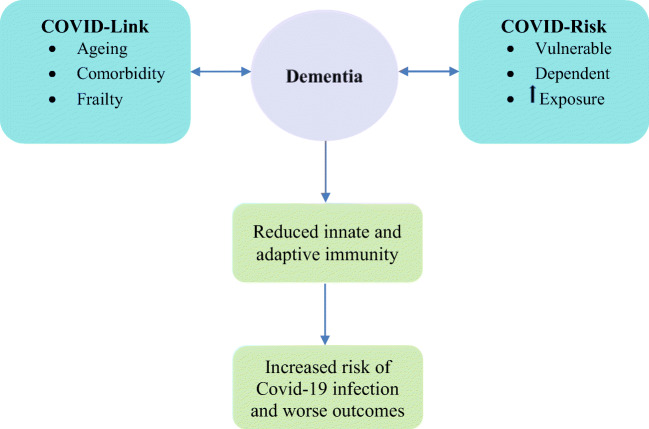
Older people living with dementia, who are likely frail with multiple comorbidities, appear particularly vulnerable to COVID-19. Care for older people with comorbid dementia and COVID-19 is a challenge to health care professionals due to their complex needs. COVID-19 is a respiratory disease which typically presents with respiratory symptoms; however, in older people with dementia, it may present atypically with delirium. Delirium may precede respiratory symptoms, and in some cases, it may be the only symptom, leading to a delay in the diagnosis. Therefore, screening for delirium should be part of the routine clinical practice for older people with dementia and suspected COVID-19 infection. Due to the complexity of care required for older people with dementia affected by COVID-19, a holistic and individualised approach that includes acute, transitional and long-term care is required. Advanced decision-making, for example, ceiling of care and resuscitation decisions, should be made early on admission to hospital. Screening for frailty with clinical frailty scale may help to aid decision-making. Palliative care and relief of suffering should be considered from the outset. Early and regular involvement of patients and their families in care plans and periodic updates regarding any changes in the clinical condition are good clinical practice. The introduction of telehealth programmes that are suitable for older people with poor cognitive function and also cover diverse cultural backgrounds are urgently required for the future support of this vulnerable group of patients.
患有痴呆症的老年人可能身体虚弱且伴有多种合并症,似乎特别容易感染新冠病毒。由于患有合并症的痴呆症老年人需求复杂,对医护人员来说,照顾他们是一项挑战。新冠病毒是一种通常表现为呼吸道症状的呼吸道疾病;然而,在患有痴呆症的老年人中,它可能非典型地表现为谵妄。谵妄可能先于呼吸道症状出现,在某些情况下,它可能是唯一的症状,导致诊断延迟。因此,对患有痴呆症且疑似感染新冠病毒的老年人进行谵妄筛查应成为常规临床实践的一部分。由于受新冠病毒影响的痴呆症老年人所需护理的复杂性,需要一种包括急性、过渡性和长期护理的全面且个性化的方法。例如,应在入院时尽早做出高级决策,如护理上限和复苏决策。使用临床衰弱量表进行衰弱筛查可能有助于辅助决策。应从一开始就考虑姑息治疗和减轻痛苦。让患者及其家人尽早并定期参与护理计划,并定期更新临床状况的任何变化,这是良好的临床实践。迫切需要引入适合认知功能较差的老年人且涵盖不同文化背景的远程医疗计划,以在未来为这一弱势群体提供支持。