Department of Molecular and Comparative Pathobiology, Johns Hopkins University School of Medicine, Baltimore, MD.
Departments of Epidemiology and Biostatistics, Johns Hopkins Bloomberg School of Public Health, Baltimore, MD.
Cornea. 2021 May 1;40(5):635-642. doi: 10.1097/ICO.0000000000002661.
To characterize corneal subbasal nerve plexus features of normal and simian immunodeficiency virus (SIV)-infected macaques by combining in vivo corneal confocal microscopy (IVCM) with automated assessments using deep learning-based methods customized for macaques.
IVCM images were collected from both male and female age-matched rhesus and pigtailed macaques housed at the Johns Hopkins University breeding colony using the Heidelberg HRTIII with Rostock Corneal Module. We also obtained repeat IVCM images of 12 SIV-infected animals including preinfection and 10-day post-SIV infection time points. All IVCM images were analyzed using a deep convolutional neural network architecture developed specifically for macaque studies.
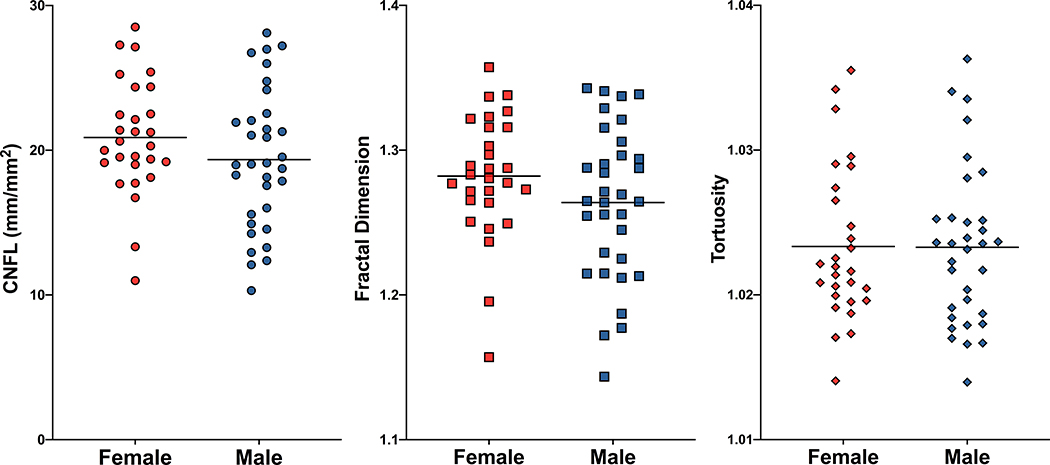
Deep learning-based segmentation of subbasal nerves in IVCM images from macaques demonstrated that corneal nerve fiber length and fractal dimension measurements did not differ between species, but pigtailed macaques had significantly higher baseline corneal nerve fiber tortuosity than rhesus macaques (P = 0.005). Neither sex nor age of macaques was associated with differences in any of the assessed corneal subbasal nerve parameters. In the SIV/macaque model of human immunodeficiency virus, acute SIV infection induced significant decreases in both corneal nerve fiber length and fractal dimension (P = 0.01 and P = 0.008, respectively).
The combination of IVCM and robust objective deep learning analysis is a powerful tool to track sensory nerve damage, enabling early detection of neuropathy. Adapting deep learning analyses to clinical corneal nerve assessments will improve monitoring of small sensory nerve fiber damage in numerous clinical settings including human immunodeficiency virus.
通过将活体角膜共聚焦显微镜(IVCM)与基于深度学习的专为猕猴定制的自动评估方法相结合,来描述正常和猴免疫缺陷病毒(SIV)感染猕猴的角膜基底下神经丛特征。
使用海德堡 HRTIII 与罗斯托克角膜模块,从约翰霍普金斯大学繁殖群中年龄匹配的雄性和雌性恒河猴和长尾猕猴中采集 IVCM 图像。我们还获得了 12 只 SIV 感染动物的重复 IVCM 图像,包括感染前和感染后 10 天的时间点。所有 IVCM 图像均使用专为猕猴研究开发的深度卷积神经网络架构进行分析。
基于深度学习的猕猴 IVCM 图像中基底下神经的分割表明,种间角膜神经纤维长度和分形维数测量值没有差异,但长尾猕猴的角膜神经纤维扭曲度明显高于恒河猴(P=0.005)。猕猴的性别或年龄均与评估的任何角膜基底下神经参数无差异相关。在 SIV/猕猴人类免疫缺陷病毒模型中,急性 SIV 感染导致角膜神经纤维长度和分形维数均显著下降(分别为 P=0.01 和 P=0.008)。
IVCM 与强大的客观深度学习分析相结合是一种跟踪感觉神经损伤的有力工具,能够早期发现神经病变。将深度学习分析应用于临床角膜神经评估将改善对包括人类免疫缺陷病毒在内的众多临床环境中小感觉神经纤维损伤的监测。