Network Aging Research (NAR), Heidelberg University, Germany.
University of Ulm, AGAPLESION Bethesda Clinic, Geriatric Center Ulm/Alb-Donau, Germany.
J Gerontol B Psychol Sci Soc Sci. 2021 Aug 13;76(7):1349-1359. doi: 10.1093/geronb/gbab023.
Previous research supports that subjective views on aging (VoA), such as older subjective age (SA) and negative attitudes toward own aging (ATOA), go along with negative outcomes. A differentiated treatment of health and disease as antecedents of VoA is largely lacking. Therefore, our objective was to estimate the relationship between generally framed physical, affective, and cognitive health as well as specific diseases and VoA, operationalized both as SA and ATOA.
Data were drawn from the ActiFE Ulm study for which a representative sample of community-dwelling older people (65-90 years) was recruited at baseline. Follow-ups were conducted 7.7 years (median) after recruitment (N = 526). Health- and disease-related data at baseline, based on established assessment procedures for epidemiological studies, were regressed on VoA (1-item SA indicator, 5-item ATOA scale) measures at follow-up.
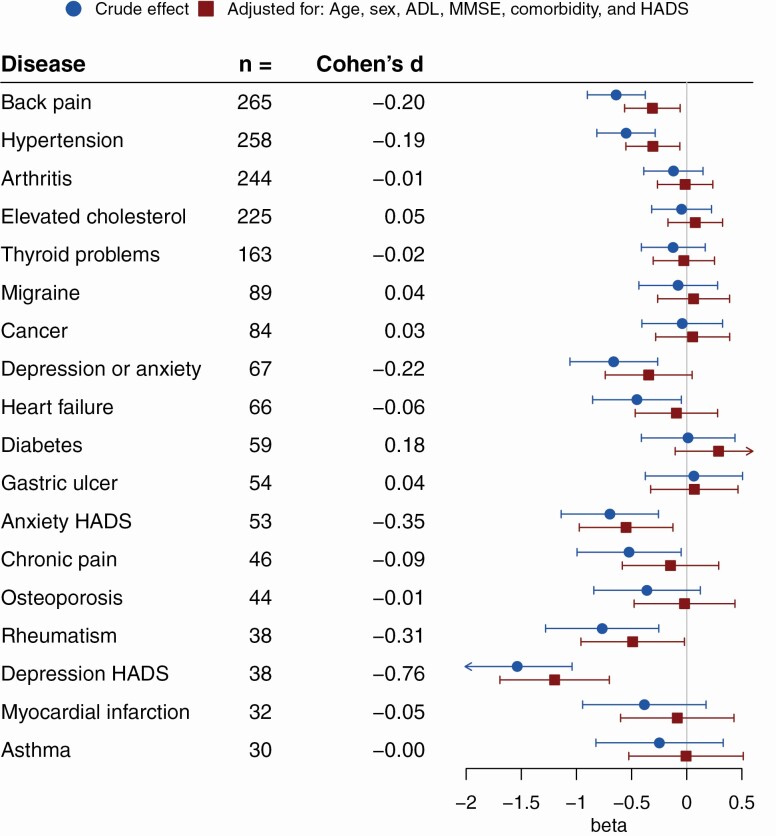
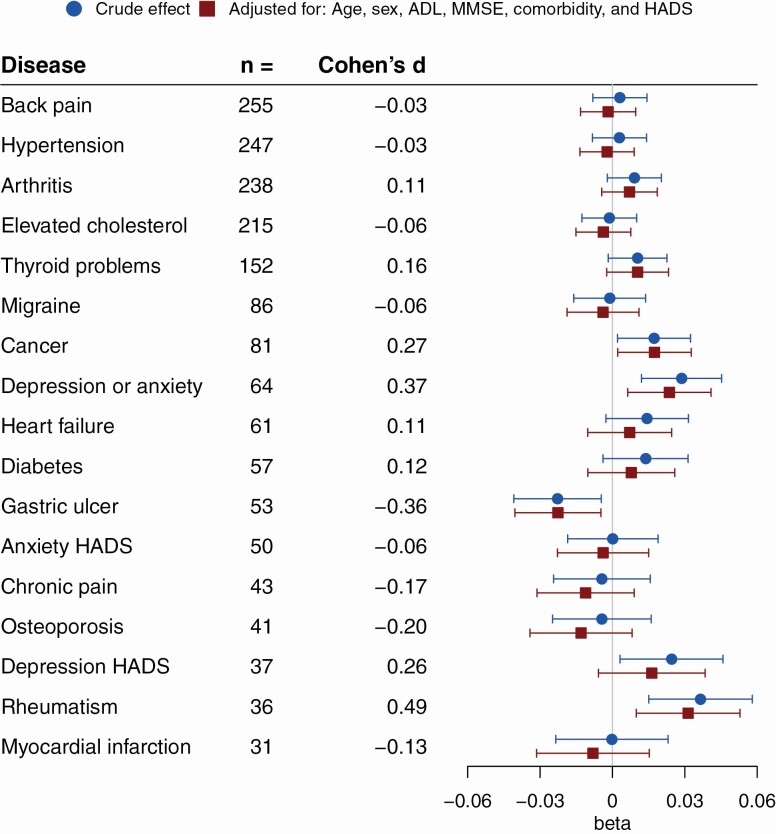
Reported severity of affective health problems such as depression was the strongest general risk factor for both older SA and negative ATOA. Also, some but not all major diseases considered were associated with VoA. Notably, back pain predicted negative ATOA, while cancer was associated with older SA. Rheumatism was linked with more negative ATOA along with higher SA. Throughout analyses, explained variance in ATOA was considerably higher than in SA.
Affective health problems, such as depression, should be regarded as a major correlate of subjective aging views. Interestingly, diseases do not have to be life-threatening to be associated with older SA or negative ATOA.
先前的研究支持主观衰老观念(VoA),如较老的主观年龄(SA)和对自身衰老的消极态度(ATOA),与负面结果相关。健康和疾病作为 VoA 的前提条件的差异处理在很大程度上是缺乏的。因此,我们的目的是估计一般框架下的身体、情感和认知健康以及特定疾病与 VoA 的关系,分别用 SA 和 ATOA 来操作。
数据来自 ActiFE Ulm 研究,该研究在基线时招募了代表性的社区居住老年人(65-90 岁)样本。在招募后 7.7 年(中位数)进行了随访(N=526)。基于为流行病学研究建立的评估程序,在基线时对健康和疾病相关数据进行回归分析,以预测随访时的 VoA(1 项 SA 指标,5 项 ATOA 量表)。
报告的情感健康问题(如抑郁症)的严重程度是影响 SA 和 ATOA 的最强的一般危险因素。此外,一些但不是所有考虑的主要疾病都与 VoA 相关。值得注意的是,背痛预测了消极的 ATOA,而癌症与较老的 SA 相关。风湿与更高的 SA 一起与更消极的 ATOA 相关。在整个分析中,ATOA 的解释方差明显高于 SA。
情感健康问题,如抑郁症,应被视为主观衰老观念的主要相关因素。有趣的是,疾病不必危及生命才能与较老的 SA 或消极的 ATOA 相关。