Key Laboratory of Aquatic Germplasm Resource of Zhejiang, College of Biological & Environmental Sciences, Zhejiang Wanli University, Ningbo 315100, China.
Sars-Fang Centre & MOE Key Laboratory of Marine Genetics and Breeding, Ocean University of China and National Laboratory for Marine Science and Technology (LMBB & LMFSFPP), Qingdao 266000, China.
Mol Biol Evol. 2021 May 19;38(6):2351-2365. doi: 10.1093/molbev/msab030.
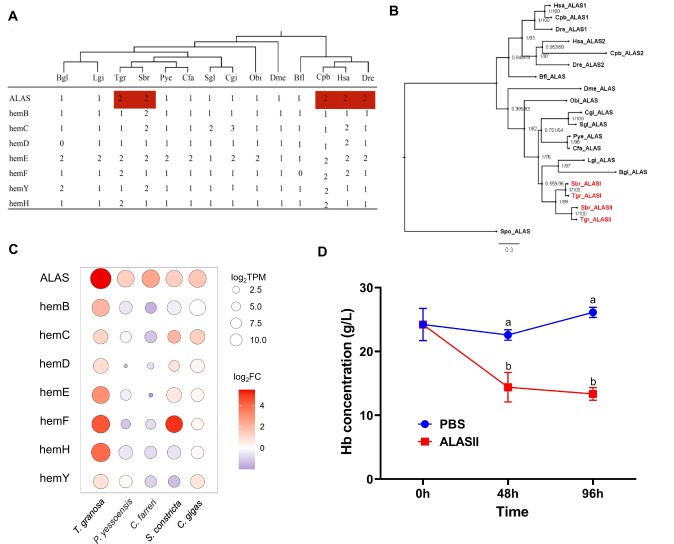
Blood clams differ from their molluscan kins by exhibiting a unique red-blood (RB) phenotype; however, the genetic basis and biochemical machinery subserving this evolutionary innovation remain unclear. As a fundamental step toward resolving this mystery, we presented the first chromosome-level genome and comprehensive transcriptomes of the blood clam Tegillarca granosa for an integrated genomic, evolutionary, and functional analyses of clam RB phenotype. We identified blood clam-specific and expanded gene families, as well as gene pathways that are of RB relevant. Clam-specific RB-related hemoglobins (Hbs) showed close phylogenetic relationships with myoglobins (Mbs) of blood clam and other molluscs without the RB phenotype, indicating that clam-specific Hbs were likely evolutionarily derived from the Mb lineage. Strikingly, similar to vertebrate Hbs, blood clam Hbs were present in a form of gene cluster. Despite the convergent evolution of Hb clusters in blood clam and vertebrates, their Hb clusters may have originated from a single ancestral Mb-like gene as evidenced by gene phylogeny and synteny analysis. A full suite of enzyme-encoding genes for heme synthesis was identified in blood clam, with prominent expression in hemolymph and resembling those in vertebrates, suggesting a convergence of both RB-related Hb and heme functions in vertebrates and blood clam. RNA interference experiments confirmed the functional roles of Hbs and key enzyme of heme synthesis in the maintenance of clam RB phenotype. The high-quality genome assembly and comprehensive transcriptomes presented herein serve new genomic resources for the super-diverse phylum Mollusca, and provide deep insights into the origin and evolution of invertebrate RB.
血蛤与其软体动物亲缘物种的不同之处在于表现出独特的红细胞(RB)表型;然而,支持这种进化创新的遗传基础和生化机制仍不清楚。作为解决这个谜团的基本步骤,我们首次提供了血蛤(Tegillarca granosa)的染色体水平基因组和综合转录组,用于对蛤 RB 表型进行综合基因组、进化和功能分析。我们鉴定了血蛤特异性和扩展的基因家族,以及与 RB 相关的基因途径。蛤特异性 RB 相关的血红蛋白(Hb)与血蛤和其他无 RB 表型的软体动物的肌红蛋白(Mb)具有密切的系统发育关系,表明蛤特异性 Hb 可能是从 Mb 谱系进化而来的。引人注目的是,与脊椎动物 Hb 相似,血蛤 Hb 以基因簇的形式存在。尽管血蛤和脊椎动物 Hb 簇的进化趋同,但它们的 Hb 簇可能起源于单个祖先 Mb 样基因,这可以从基因系统发育和基因同线性分析中得到证明。在血蛤中鉴定出了一系列完整的血红素合成酶编码基因,在血液中表达显著,与脊椎动物相似,这表明脊椎动物和血蛤的 RB 相关 Hb 和血红素功能都存在趋同现象。RNA 干扰实验证实了 Hbs 和血红素合成关键酶在维持蛤 RB 表型中的功能作用。本文提供的高质量基因组组装和综合转录组为超级多样化的软体动物门提供了新的基因组资源,并深入了解了无脊椎动物 RB 的起源和进化。