Plataforma Fiocruz de PCR em Tempo Real RPT09A -Laboratório de Biologia Molecular e Doenças Endêmicas, Instituto Oswaldo Cruz, Fundação Oswaldo Cruz, Rio de Janeiro, Brazil.
Departamento de Análises Clínicas e Toxicológicas, Centro de Ciências da Saúde, Universidade Federal do Rio Grande do Norte, Natal, RN, Brazil.
PLoS One. 2021 Feb 2;16(2):e0246435. doi: 10.1371/journal.pone.0246435. eCollection 2021.
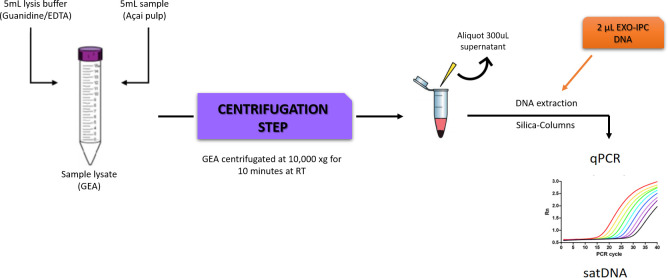
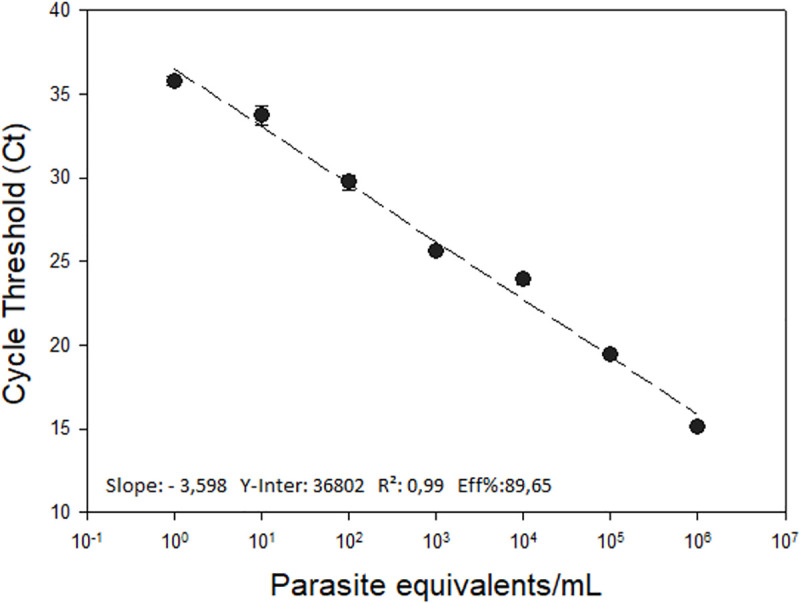
In Brazil, orally acquired T. cruzi infection has become the most relevant transmission mechanisms from public health perspective. Around 70% of new Chagas disease cases have been associated with consumption of contaminated food or beverages. Açai (Euterpe oleracea and Euterpe precatoria) is currently one of the most commercialized Amazonian fruits in the Brazilian and international markets. Therefore, it has become important to incorporate in the production process some procedures to measure out effective hygiene and product quality control required by global market. Molecular methods have been developed for rapid detection and quantification of T. cruzi DNA in several biological samples, including food matrices, for epidemiological investigation of Chagas disease and food quality control. However, a high-performance molecular methodology since DNA extraction until detection and quantification of T. cruzi DNA in açai berry pulp is still needed. Herein, a simple DNA extraction methodology was standardized from the supernatant of açai berry pulp stabilized in a 6M Guanidine-HCl/0.2M EDTA buffer. In addition, a multiplex real time qPCR assay, targeting T. cruzi DNA and an Exogenous Internal Positive Control was developed and validated, using reference from all T. cruzi DTUs and commercial samples of açai pulp, from an endemic municipality with previous history of oral Chagas disease outbreak. Thus, a high-sensitivity qPCR assay, that could detect up to 0.01 parasite equivalents/mL in açai, was reached. As of the 45 commercial samples analyzed, 9 (20%) were positive for T. cruzi. This high-sensitive, fast, and easy-to-use molecular assay is compatible with most of the laboratories involved in the investigations of oral Chagas disease outbreaks, representing an important tool to the epidemiology, control, and surveillance of Chagas disease.
在巴西,经口感染克氏锥虫已成为从公共卫生角度来看最重要的传播机制。大约 70%的新出现的恰加斯病病例与食用受污染的食物或饮料有关。阿萨伊(Euterpe oleracea 和 Euterpe precatoria)是目前巴西和国际市场上商业化程度最高的亚马逊水果之一。因此,在生产过程中加入一些程序来衡量有效的卫生和产品质量控制,以满足全球市场的需求变得尤为重要。分子方法已被开发用于快速检测和定量几种生物样本中的克氏锥虫 DNA,包括食物基质,用于恰加斯病的流行病学调查和食品质量控制。然而,仍然需要一种从阿萨伊浆果果肉的 DNA 提取到检测和定量的高性能分子方法。在此,从稳定在 6M 盐酸胍/0.2M EDTA 缓冲液中的阿萨伊浆果果肉上清液中标准化了一种简单的 DNA 提取方法。此外,开发并验证了一种针对克氏锥虫 DNA 和外源性内部阳性对照的多重实时 qPCR 检测方法,该方法使用所有克氏锥虫 DTU 的参考和来自曾发生过口源性恰加斯病暴发的地方的商业阿萨伊果肉样本。因此,达到了在阿萨伊中可检测低至 0.01 寄生虫当量/mL 的高灵敏度 qPCR 检测方法。在所分析的 45 个商业样本中,有 9 个(20%)对克氏锥虫呈阳性。这种高灵敏度、快速且易于使用的分子检测方法与大多数参与口源性恰加斯病暴发调查的实验室兼容,是恰加斯病的流行病学、控制和监测的重要工具。