Mazurków Julia, Kusior Anna, Radecka Marta
Faculty of Materials Science and Ceramics, AGH University of Science and Technology, al. Mickiewicza 30, 30-059 Kraków, Poland.
Sensors (Basel). 2021 Jan 26;21(3):802. doi: 10.3390/s21030802.
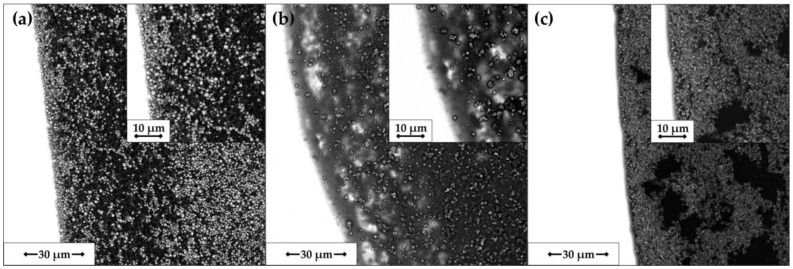
The constant progress in novel nanomaterials synthesis has contributed to the rapid development of nonenzymatic glucose sensors. For working electrodes preparation, drop casting proved to be the most convenient and thus most widely applied method. However, appropriate interpretation of obtained electrochemical signal requires in-depth knowledge of limitations related to this technique. In this study, we prepared solutions based on commonly reported polymers for nanostructures immobilization and investigated their influence on copper sulfides distribution on the electrode. Characterization of suspensions properties and behavior of particles during droplet drying revealed that nonionic polyvinylpyrrolidone (PVP) was favorable for electrodes modification with copper sulfides in comparison with Nafion and chitosan. It ensured homogeneity of the suspension as well as the uniform coverage of the electrode surface with particles, what resulted in increased active surface area and, therefore, higher signal from glucose addition. On the other hand, when cationic chitosan was used as a binder, suspensions were agglomerated and, within dry deposits, a coffee-ring effect was observed. Appropriate adjustment of material and polymer interactions led to enhanced electrode electrochemical performance.
新型纳米材料合成技术的不断进步推动了非酶葡萄糖传感器的快速发展。对于工作电极的制备,滴铸法被证明是最方便且应用最广泛的方法。然而,要对获得的电化学信号进行恰当解读,需要深入了解该技术的局限性。在本研究中,我们基于常见报道的聚合物制备了用于固定纳米结构的溶液,并研究了它们对电极上硫化铜分布的影响。对悬浮液性质以及液滴干燥过程中颗粒行为的表征表明,与Nafion和壳聚糖相比,非离子型聚乙烯吡咯烷酮(PVP)有利于用硫化铜对电极进行修饰。它确保了悬浮液的均匀性以及电极表面被颗粒均匀覆盖,这导致活性表面积增加,因此,添加葡萄糖后信号增强。另一方面,当使用阳离子壳聚糖作为粘合剂时,悬浮液会发生团聚,并且在干燥沉积物中观察到了咖啡环效应。对材料与聚合物相互作用的适当调整导致电极电化学性能得到增强。