Batista Inês A, Quintas Sofia T, Melo Sónia A
i3S-Instituto de Investigação e Inovação em Saúde, Universidade do Porto, 4200-135 Porto, Portugal.
IPATIMUP-Institute of Molecular Pathology and Immunology of University of Porto, 4200-135 Porto, Portugal.
Cancers (Basel). 2021 Jan 26;13(3):473. doi: 10.3390/cancers13030473.
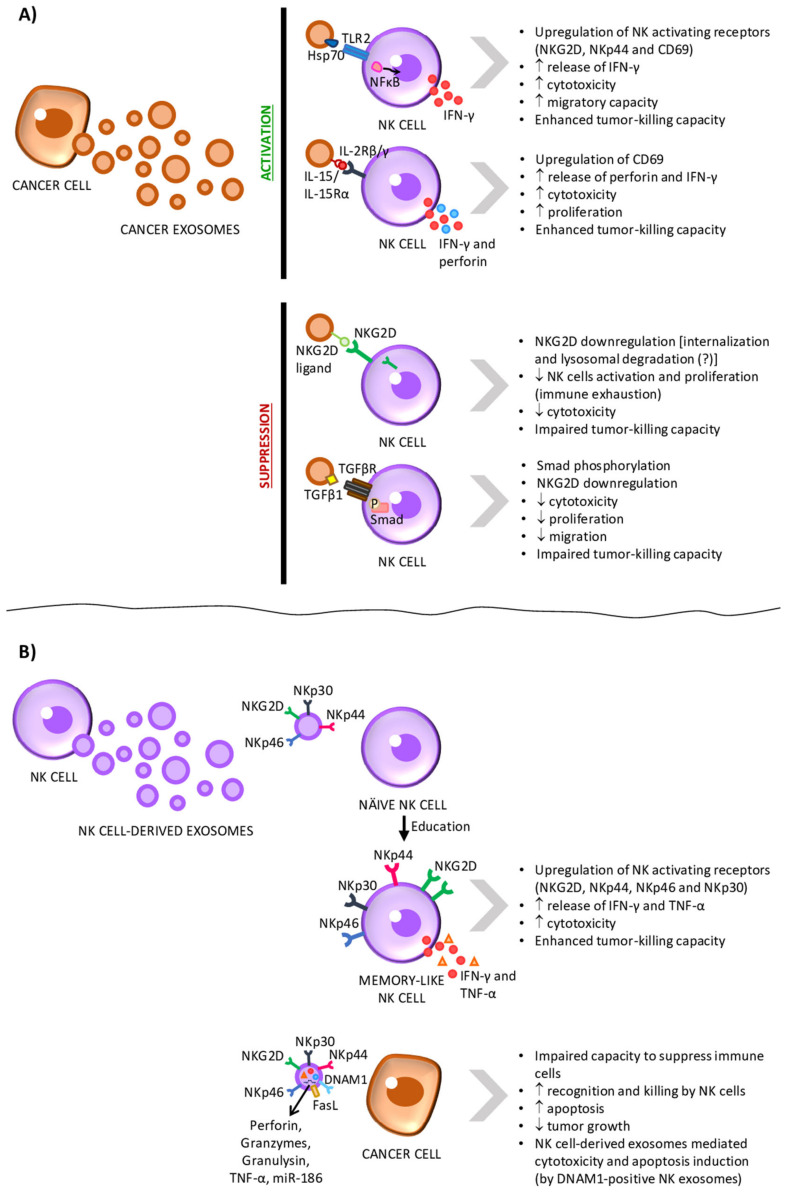
Natural killer (NK) cells are innate lymphoid cells involved in tumor surveillance. These immune cells have the potential to fight cancer growth and metastasis, as such, their deregulation can result in tumor immune escape. Recently exosomes were described as mediators of intercellular communication between cancer and NK cells. The exact role of this subclass of extracellular vesicles (EVs), which transport genetic and molecular material to recipient cells, in NK cell biology in the context of cancer, is still an open question. Several reports have demonstrated that tumor-derived exosomes (TDEs) can exert immunomodulatory activities, including immunosuppression, thus promoting cancer progression. Some reports demonstrate that the interplay between cancer exosomes and NK cells allows tumors to escape immune regulation. On the other hand, tumor exosomes were also described to activate NK cells. Additionally, studies show that NK cell exosomes can modulate the immune system, opening up their potential as an immunotherapeutic strategy for cancer treatment. Our review will focus on the reprogramming effect of cancer exosomes on NK cells, and the immunotherapeutic potential of NK cells-derived exosomes.
自然杀伤(NK)细胞是参与肿瘤监测的固有淋巴细胞。这些免疫细胞有对抗癌症生长和转移的潜力,因此,它们的失调会导致肿瘤免疫逃逸。最近,外泌体被描述为癌症与NK细胞之间细胞间通讯的介质。这种将遗传和分子物质运输到受体细胞的细胞外囊泡(EVs)亚类在癌症背景下NK细胞生物学中的确切作用仍是一个悬而未决的问题。一些报告表明,肿瘤来源的外泌体(TDEs)可以发挥免疫调节活性,包括免疫抑制,从而促进癌症进展。一些报告表明,癌症外泌体与NK细胞之间的相互作用使肿瘤能够逃避免疫调节。另一方面,也有报道称肿瘤外泌体可激活NK细胞。此外,研究表明NK细胞外泌体可以调节免疫系统,从而开启了其作为癌症治疗免疫治疗策略的潜力。我们的综述将聚焦于癌症外泌体对NK细胞的重编程作用以及NK细胞来源外泌体的免疫治疗潜力。