The State Key Laboratory Breeding Base of Basic Science of Stomatology (Hubei-MOST) & Key Laboratory of Oral Biomedicine Ministry of Education, School and Hospital of Stomatology, Wuhan University, Wuhan 430079, China.
Department of Oral and Maxillofacial Surgery, School and Hospital of Stomatology, Wuhan University, Wuhan 430079, China.
Cells. 2022 Jun 16;11(12):1946. doi: 10.3390/cells11121946.
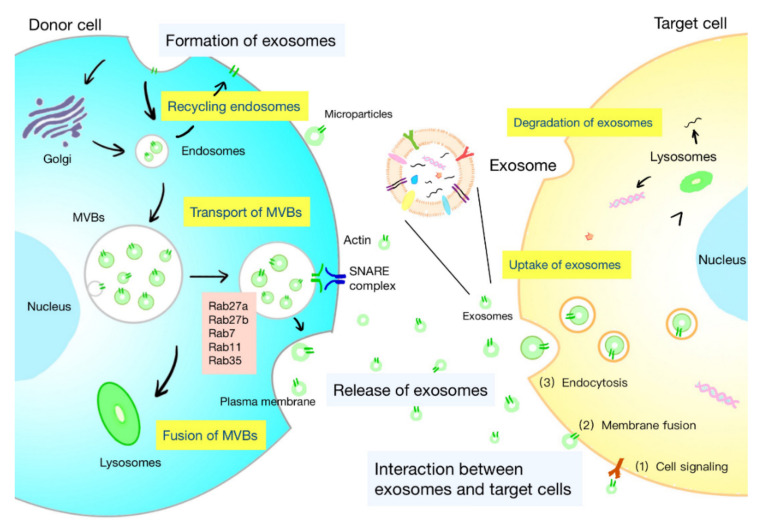
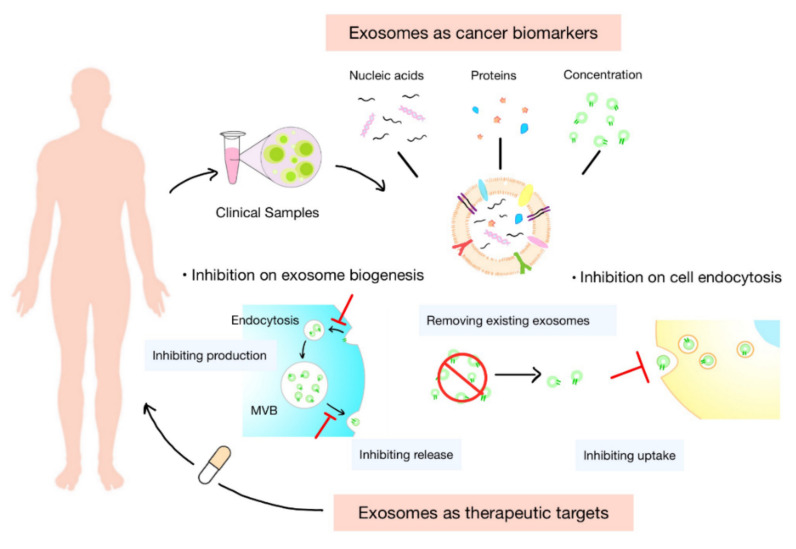
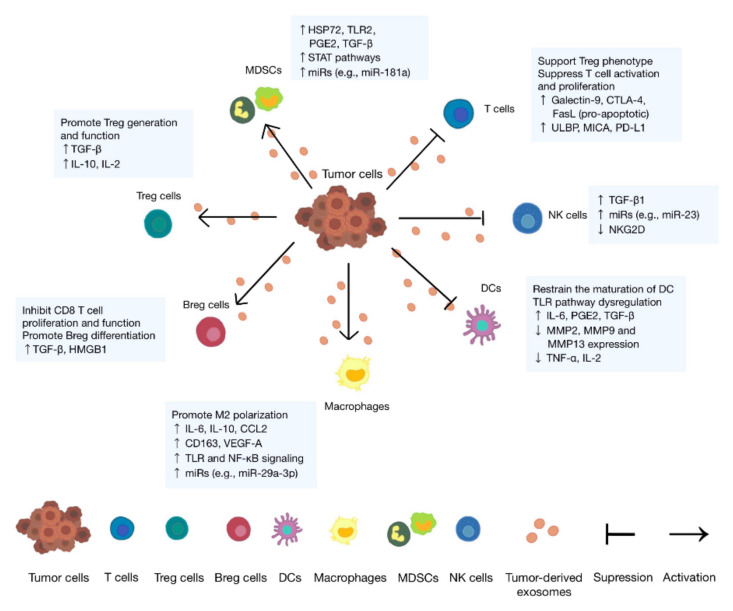
Exosomes are membranous structures secreted by nearly all cell types. As critical messengers for intercellular communication, exosomes deliver bioactive cargoes to recipient cells and are involved in multiple physiopathological processes, including immunoregulation. Our pioneering study revealed that cancer cells release programmed death-ligand 1-positive exosomes into the circulation to counter antitumor immunity systemically via T cells. Tumor cell-derived exosomes (TDEs) also play an immunosuppressive role in other immunocytes, including dendritic cells (DCs), macrophages, natural killer (NK) cells, and myeloid-derived suppressor cells (MDSCs). Moreover, exosomes secreted by nontumor cells in the tumor microenvironments (TMEs) also exert immunosuppressive effects. This review systematically provides a summary of the immunosuppression induced by exosomes in tumor microenvironments, which modulates tumor growth, invasion, metastasis, and immunotherapeutic resistance. Additionally, therapeutic strategies targeting the molecular mechanism of exosome-mediated tumor development, which may help overcome several obstacles, such as immune tolerance in oncotherapy, are also discussed. Detailed knowledge of the specific functions of exosomes in antitumor immunity may contribute to the development of innovative treatments.
外泌体是几乎所有细胞类型分泌的膜性结构。作为细胞间通讯的关键信使,外泌体将生物活性货物递送到受体细胞,并参与多种生理病理过程,包括免疫调节。我们的开创性研究表明,癌细胞将程序性死亡配体 1 阳性外泌体释放到循环系统中,通过 T 细胞系统地对抗抗肿瘤免疫系统。肿瘤细胞来源的外泌体(TDEs)在其他免疫细胞中也发挥免疫抑制作用,包括树突状细胞(DCs)、巨噬细胞、自然杀伤(NK)细胞和髓系来源的抑制细胞(MDSCs)。此外,肿瘤微环境(TMEs)中的非肿瘤细胞分泌的外泌体也具有免疫抑制作用。本综述系统地总结了外泌体在肿瘤微环境中诱导的免疫抑制作用,这种作用调节肿瘤的生长、侵袭、转移和免疫治疗耐药性。此外,还讨论了针对外泌体介导的肿瘤发展的分子机制的治疗策略,这可能有助于克服肿瘤治疗中的免疫耐受等几个障碍。详细了解外泌体在抗肿瘤免疫中的特定功能可能有助于开发创新的治疗方法。