Heinze Karolin, Hölzer Martin, Ungelenk Martin, Gerth Melanie, Thomale Jürgen, Heller Regine, Morden Claire R, McManus Kirk J, Mosig Alexander S, Dürst Matthias, Runnebaum Ingo B, Häfner Norman
Department of Gynecology and Reproduction Medicine, Jena University Hospital, 07747 Jena, Germany.
RNA Bioinformatics and High-Throughput Analysis, Faculty of Mathematics and Computer Science, University of Jena, 07743 Jena, Germany.
Cancers (Basel). 2021 Jan 26;13(3):476. doi: 10.3390/cancers13030476.
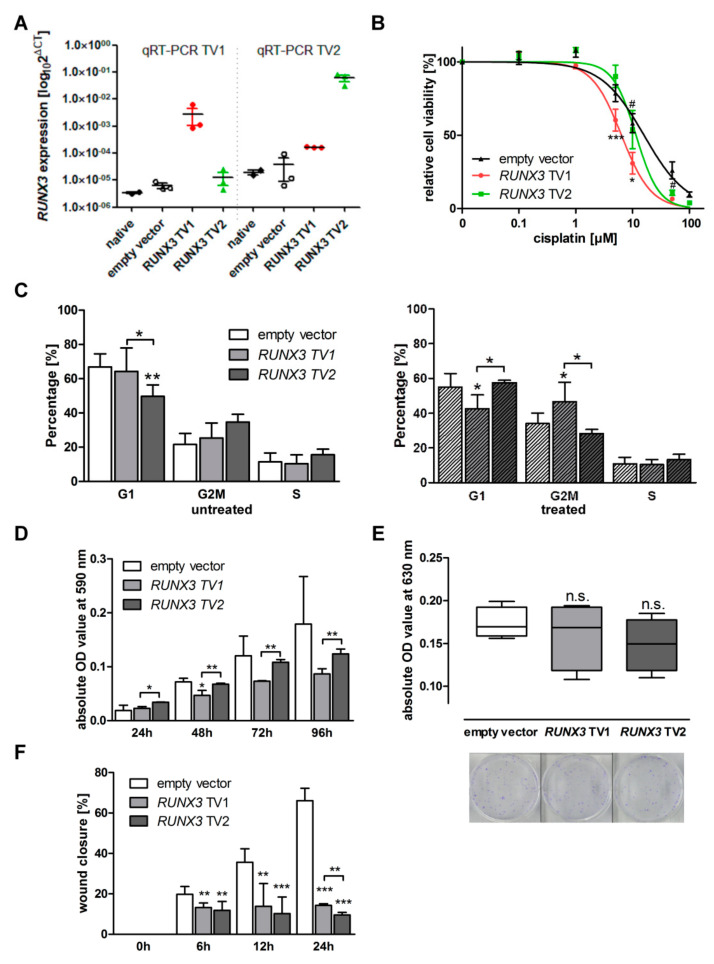
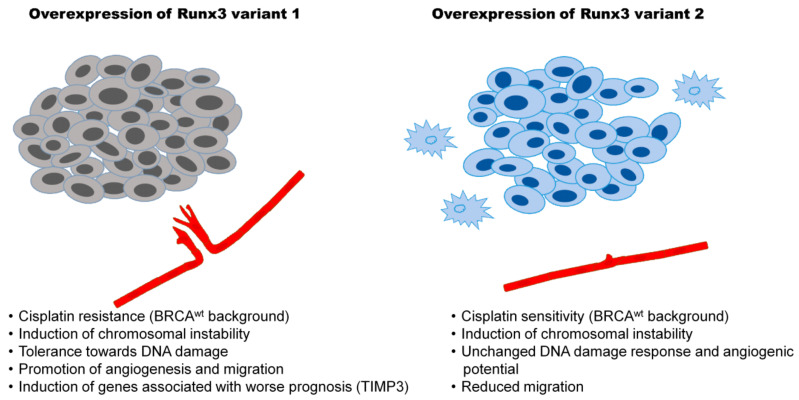
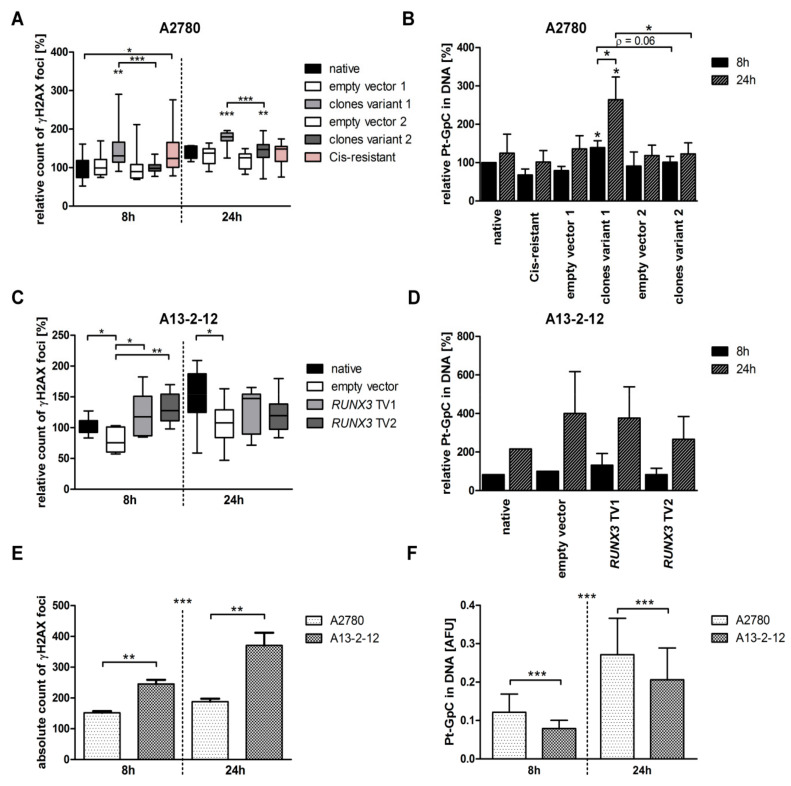
The prognosis of late-stage epithelial ovarian cancer (EOC) patients is affected by chemotherapy response and the malignant potential of the tumor cells. In earlier work, we identified hypermethylation of the gene () as a prognostic biomarker and contrary functions of transcript variants (TV1 and TV2) in A2780 and SKOV3 cells. The aim of the study was to further validate these results and to increase the knowledge about function in EOC. New overexpression models of high-grade serous ovarian cancer (HGSOC) were established and analyzed for phenotypic (IC determination, migration, proliferation and angiogenesis assay, DNA damage analysis) and transcriptomic consequences (NGS) of TV1 and TV2 overexpression. Platinum sensitivity was affected by a specific transcript variant depending on BRCA background. TV2 induced an increased sensitivity in BRCA1 cells (OVCAR3), whereas TV1 increased the sensitivity and induced a G2/M arrest under treatment in cells (A13-2-12). These different phenotypes relate to differences in DNA repair: homologous recombination deficient A13-2-12 cells show less γH2AX foci despite higher levels of Pt-DNA adducts. RNA-Seq analyses prove transcript variant and cell-line-specific effects. Pathway analyses revealed another clinically important function of RUNX3-regulation of angiogenesis. This was confirmed by thrombospondin1 analyses, HUVEC spheroid sprouting assays and proteomic profiling. Importantly, conditioned media (CM) from TV1 overexpressing A13-2-12 cells induced an increased HUVEC sprouting. Altogether, the presented data support the hypothesis of different functions of transcript variants related to the clinically relevant processes-platinum resistance and angiogenesis.
晚期上皮性卵巢癌(EOC)患者的预后受化疗反应和肿瘤细胞恶性潜能的影响。在早期研究中,我们确定了基因()的高甲基化作为一种预后生物标志物,并发现转录变体(TV1和TV2)在A2780和SKOV3细胞中具有相反的功能。本研究的目的是进一步验证这些结果,并增加对EOC中 功能的了解。建立了高级别浆液性卵巢癌(HGSOC)的新的 过表达模型,并分析了TV1和TV2过表达的表型(IC测定、迁移、增殖和血管生成测定、DNA损伤分析)和转录组学后果(NGS)。铂敏感性受特定转录变体的影响,具体取决于BRCA背景。TV2在BRCA1细胞(OVCAR3)中诱导敏感性增加,而TV1在 细胞(A13-2-12)中增加敏感性并在治疗下诱导G2/M期阻滞。这些不同的表型与DNA修复的差异有关:同源重组缺陷的A13-2-12细胞尽管铂-DNA加合物水平较高,但γH2AX焦点较少。RNA测序分析证明了转录变体和细胞系特异性的 效应。通路分析揭示了RUNX3调节血管生成的另一个临床重要功能。这通过血小板反应蛋白1分析、人脐静脉内皮细胞(HUVEC)球状体发芽试验和蛋白质组学分析得到证实。重要的是,来自TV1过表达的A13-2-12细胞的条件培养基(CM)诱导HUVEC发芽增加。总之,所呈现的数据支持了与临床相关过程——铂耐药和血管生成相关的转录变体具有不同功能的假设。